Showing posts with label Deus Ex. Show all posts

Wednesday, March 8, 2017

Deus Ex: A Criminal Past review


    This is going to be a bittersweet review since A Criminal Past is probably going to be the last Deus Ex game in this continuity and almost certainly the last game starring Adam Jensen. For those of us who were hoping for a third game as an appropriate send off to the second most famous cyborg from Detroit, A Criminal Past is a disappointment but it's still a solid game addition worth playing.

    Those who wanted a resolution to all of the outstanding Deus Ex plots covered in the main game like the Illuminati, Juggernaut Collective, and Augmented Rights will be disappointed. This DLC is an independent story set in a maximum security prison. Adam Jensen has been assigned by Task Force 29 to infiltrate an Augs only Federal penitentiary called "The Penthouse."

Who will you befriend? Who will you antagonize?
    There's a rumored terrorist attack occurring against the United States and they need to make contact with an undercover operative who can confirm or deny the truth. Adam soon finds himself neck deep in a conflict between the corrupt prison guards and the riot-minded inmates who are ready to tear the prison apart. Interestingly, all of this is told via a conversation with underdeveloped Task Force-29 psychologist Delara Auzenne.

    As indicated by my above description, this is an entirely self-contained plot which doesn't forward the main plot of the games in any real way. It expands on the character of Doctor Auzenne but she was a minor character to begin with who the "shocking revelation" about the at the end of the main game provided almost no shock value for. Players didn't really have an attachment to her but this does do a lot of setting up for her in a future project which will, sadly, never come to pass. Still, as a self-contained plot it's pretty damned good as I've mentioned and now I'll explain why that's the case.

    The big appeal of A Criminal Past is it really puts Adam in a hostile and unpredictable situation. While I complained about Adam missing his Augmentations in System Rift and Desperate Measures, it makes perfect sense here since all prisoners are afflicted with a virus to keep them from making use of their superpowers-granting cybernetics. The fact there's multiple treatments for Adam's condition spread throughout the prison is a major boon.

This is a really nice prison.
    A Criminal Past also has a colorful cast of characters, too, which is good after the somewhat dull collection in the main game. In addition to the corrupt Warden Stenger and sketchy undercover agent you're contacting, there's also the too-smooth Flossy who is running the prison after the death of its previous boss. There is the autistic Fixer, who seems harmless but is somehow working with every faction in the Penthouse. Figuring out which of these characters is on the level, which can be trusted, and which are irredeemable forms a majority of the plot.

    The prison is full of security devices to hack, power-armored soldiers, and heavily armed forces who have the potential to tear you apart. Moving slowly and carefully through the prison may not be enough for some players with the question of killing your enemies a severe one. I was actually tempted to turn the drones on the guards despite being a nominal pacifist due to how many times I'd been killed trying to complete the DLC. Much like Prince of Persia: The Sands of Time, Doctor Auzenne corrects you every time you die since that can't be right as you're telling her the story in her office.

Things kind of go sideways for the Penthouse. Really.
     A Criminal Past isn't a very long story and I completed it in about four and a half hours but it was an entertaining one with a decent length. I suspect it could have been as long as six hours if I'd spent more time exploring. Speed runners might actually get it done in a much shorter time period with some having managed to solve it in around two hours but that's ignoring the sidequest objectives as well as just ploughing through all of the threats Adam Jensen faces.

    One small bit of irony to this DLC is that it makes it clear the Penthouse is run by the state of Arizona and is neither a corporate-run or federal prison. I found this amusing since so many prisons are run by corporations in real-life and you'd think they'd be even more so in charge of the penal system in a cyberpunk dystopia. Still, I appreciated the fact the villains were small-time criminals and corrupt officials versus the Illuminati this time around (albeit, it's implied they're involved somehow--because of course they are).
Poor Adam is way out of this depth this time.

    There's a few places I think the game could have benefited from changes. I think the character of D-Town could have been used as an actual boss fight rather than a one-off meaningless encounter. I also believe we should have found out why the Illuminati were interested in this case to begin with since it's not like we're ever going to see them brought to task in the main series. There are also a few places where there's only the option to shoot out your enemies that I think could have been handled with a bit more subtlety.

    Overall, I really enjoyed A Criminal Past and if it's not the high point of the franchise which Adam's missions should go out on, it's certainly a solid piece of characterization, gameplay, and writing.

9/10

Thursday, January 26, 2017

Deus Ex: Black Light review


    One of my biggest complaints about Deus Ex: Mankind Divided was the fact it was a story which took place in the middle of itself. There was a very weak beginning where lots of confusing as well as contradictory information was thrown at you as well as a weak ending where we didn't know what was going on.

    Despite this, I enjoyed quite a lot of the world-building and was curious about the novel set between Deus Ex: Human Revolution and Deus Ex: Mankind Divided. I, honestly, wasn't expecting much despite liking Deus Ex: Icarus Effect by the same author. After all, game fiction tends to be disposable. Well, this isn't.

    Black Light is a book which absolutely should be read before a person plays Mankind Divided. It not only follows directly from the original game but fills in a lot of events which are only alluded to in the main game. These include Adam Jensen being fished from the ocean, his recovery time in an Illuminati-run hospital, how he found out about Sarif Industries going under, and then deciding to work for both the Juggernaut Collective as well as Task Force-29. This is in addition to the book's main plot of preventing an arms deal secretly backed by the Illuminati.

    I'm kind of irritated that so much of this was left out of Mankind Divided but I'm going to try to review the book based on its own merits. As such, James Swallow does an excellent job of getting down Adam Jensen's "voice" as well as his vitriolic relationship with Francis Pritchard. We can feel Adam's dismay as he finds himself in a world where not only are Augments (cyborgs) despised but the truth of the incident which drove them violently insane for a day has been covered up.

    The depiction of the world is moving with the sight of Detroit transformed from the crime-ridden but hopeful community in Human Revolution to a hellish wasteland even worse than our present reality. There's also a lot of emotion to be had from the fact Adam wanders around Sarif Industries, finding everything boarded up and forgotten. The Second Renaissance promised by augmentation technology is destroyed and it's all because we weren't able to stop Hugh Darrow and the Illuminati in the first game.

    This isn't a book for individuals who didn't play Deus Ex: Human Revolution as it makes a staggering number of references to the game. It also has a surprising cameo from a character who played a big role in both the original Deus Ex and Icarus Effect. I appreciated this cameo and seeing Adam Jensen face off against him, even though I know they're never actually going to have a definitive fight.

    The characters and politics are spelled out well with everything we need to know about the Illuminati, Juggernaut Collective, and Task Force-29 all shown. I especially liked how the Juggernaut Collective comes off as sinister and invasive to Pritchard rather than an Anonymous-stand-in like it has been portrayed in other games. The fact the Juggernaut Collective has utterly misread Task Force 29, thinking of them as nothing more than Illuminati puppets, is also a neat twist.

    Overall, I really enjoyed this novel and think it's a pretty good addition to the Deus Ex canon. The problem is that this is all stuff which really should have been in Mankind Divided and it's frustrating to find important exposition regulated to side content. Deus Ex fans will enjoy this but I don't think other science fiction fans need to read it.

7/10

Tuesday, January 17, 2017

Deus Ex: Mankind Divided: Desperate Measures and System Rift review


    Deus Ex: Mankind Divided was a game I gave a pretty bad score to (5/10) due to the fact it, literally, felt like half of a 10/10 game. It was a score I struggled with because the parts of the game I played were fine, it's just it had an incredibly disjointed story and wasn't nearly enough of the game for what I was paying for it. Also, I felt microtransactions were shoe-horned in and were necessary to get through the game smoothly.

    So, I was intrigued by the concept of playing Jensen's Stories, which were the DLC sidequests for the game. They would be played independently from the main game with entirely new builds for each entry. This means you can't carry over your character from the main game but have to make do with the provided points to build a unique Jensen for each game. While some may appreciate the option to change your Jensen up, the simple fact is this is particularly irksome with the fact microtransactions were such a big part of the original game. But more on that later.

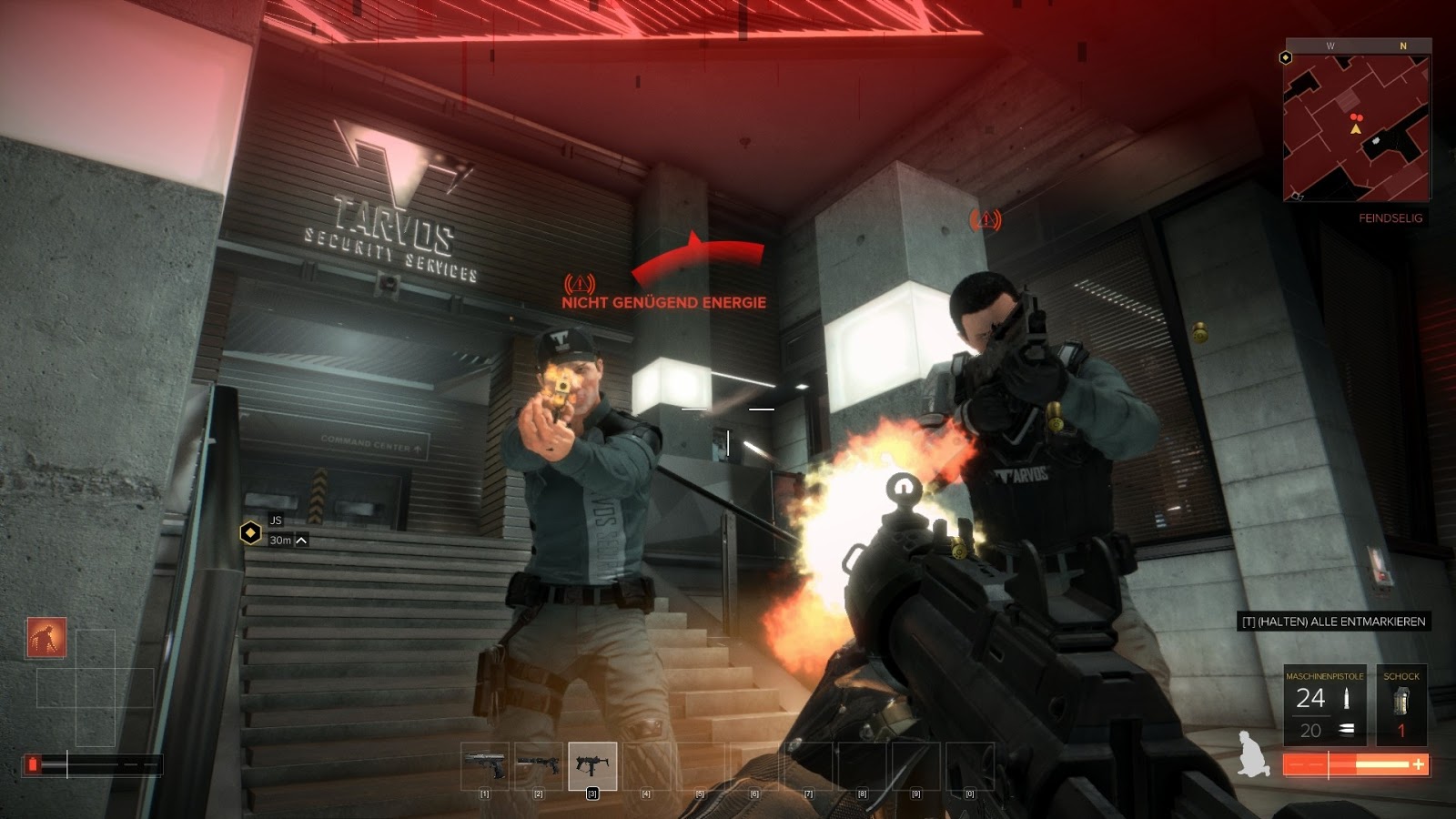
Tarvos Security is a fun punching bag. Much like Belltower Security. Which is completely unrelated. :sarcasm:
    Before I decided to play two of Jensen's Stories, I had heard rumors these were possibly missions which had originally been slated to appear in the main game. I don't necessarily listen to internet scuttlebutt but I decided to keep this fact in mind while playing to see if it was true. My opinion is that Desperate Measures almost certainly was part of the main game and still should be but System Rift feels like genuine DLC.

    The premise is that Adam gets contacted by a train station employee at Ruzicka Station. She claims a member of Tarvos Security paid her in order to allow him access to a computer terminal that contained the security tapes of the bombing. Believing Tarvos Security might be involved in a cover up, Adam goes to their region office to hunt for evidence.

I did Desperate Measures quietly first then hard.
    Desperate Measures is a short one-hour level which takes place during the first day of the game and deals with the bombing of the Prague train station. The train station plot was largely dropped from the game so getting it solved was something I was looking forward to. There's a nice little human story involved here and also a tie-in to the main story's plot. It's not a particularly deep level but it's well-designed and I think it should have been part of the main game.

    I think I would have been less harsh and moved my score for Deus Ex: Mankind Divided up to a 6/10 if Desperate Measures had been part of the main game. It really does feel like this was a part of the main narrative and patches one of the major holes in the game. Not all of them, mind you, but enough for me to believe this shouldn't be one of Jensen's Stories but a mission right before Adam goes to Golem City.

The "Boss Fight" of Desperate Measures is a conversation.
    System Rift, by contrast, feels like it's own thing and something I enjoyed entirely on its own merits. Its premise is Adam gets contacted by his friend from the first game, Francis Pritchard, who is "vetting" the Santeau Group for an employee (later revealed to be David Sarif in an off-hand conversation). To do this, he needs Adam's help to break into the Palisade Blades information bank.

    It's the most secure database in the world and helping them do it is the beautiful hacker ShadowChild, who has her own agenda (because it's Deus Ex--everyone has an agenda). Along the way, Adam decides to investigate a young woman's murder because he's Adam Jensen and can leave no stone unturned.

The return of Pritchard is welcome.
    This is about a 2-3 hour expansion and there's a lot to explore in this game. While I don't think it exactly fits the timeline for the main game, I think it's inclusion in the middle of the game or final third act would have resolved another set of issues I had with the main game's length. Hell, it could be set after the main campaign and be just as much a non-ending except longer.

    I really appreciated the spike in difficulty as well as the focus on stealth for System Rift. There's actual employees rather than just guards hanging around the Palisades Blades. At one point, I found a ball pit which they'd set up for a returning co-worker. It was such a ridiculous and silly bit of fun that I immediately started to regret punching all the employees I had.

I like the character of ShadowChild.
    I was also a big fan of ShadowChild and hope she shows up in future games. The thing is, she's confusing to me because Jensen really shouldn't need a new hacker friend to crack his software problems. Jensen is already part of the Juggernaut Collective, which was an Anonymous stand-in. It's as if they're so obsessed with the idea of the Juggernaut Collective as "the resistance" they keep forgetting its a bunch of hacktivists first.

    Neither of these DLC really breaks the mold but they provide a lot of much needed extra-content to the main game. I like how System Rift provides tweaked sensors and some unique stealth challenges plus many non-human enemies you can destroy with extreme prejudice. Even so, the fact you have to pay for these levels rankles. Unfortunately, at the end of the DLC, you have to play some Breach mode in order to resolve the story and I can't say I was very fond of that segment.

I love the design for the Palisade Blades.
    There's some decent storytelling in both DLC with Desperate Measures having a twist that reveals the "cover-up" has more to do with human decency (as well as misguided love) than conspiracy while System Rift shows a feuding pair of executives sitting at the top of the world. Neither is among my favorite of Deus Ex's stories and I think they're both inferior to The Missing Link's social satire but they weren't brainless rote works either.

    In conclusion, I liked both of these games but they really do feel like something which should have been in the original game even if they'd have to make adjustments for System Rift. Furthermore, they would have improved on a lot of the original game's flaws. Re-setting Jensen's stats every time I played them also really annoyed me. Still, these self-contained stories work better than the original game.

8/10

Thursday, January 5, 2017

The Social Satire of Deus Ex: Mankind Divided


    I consider Deus Ex to be one of the more thoughtful and intelligent series around. The original game tackled such diverse issues as transhumanism, anti-terrorism as an excuse for government support of business, and solutions for failed systems ranging from more control to complete anarchy. Human Revolution continued this discussion with intelligent questions about false religious movements in the service of corporate interests as well as augmentation as symbolic of privilege.

    But what about Deus Ex: Mankind Divided? Is it up to the same level as its predecessors or is it more like Deus Ex: Invisible War where the science fiction trappings arguably make any of its issues irrelevant (aside from a commentary on religion and materialism as a social control issue as framed through competing coffee chains). Deus Ex: Mankind Divided made a lot of headlines by co-opting words like apartheid and "Black Lives Matter" for their discussion of the oppression of Augments, who were previously a privileged caste in the Deus Ex world.

    Honestly, to begin with, I want to address the controversy over the choice to use real life issues of contemporary and not-so contemporary oppression  in context with their fictional oppressed minority. I believe such things are perfectly valid storytelling tools and allow complex issues to be examined from different angles as well as through self-projection into fictional groups. Andrjez Sapkowski discussed racial issues and terrorism through the Scoia'tael in The Witcher novels while the X-men have done an amazing job (and sometimes a not-so-amazing job) analyzing prejudice with their flexible mutation metaphor.

Adam's place as a privileged Augment gives him a unique insider's perspective to the Aug crisis.
    Certainly, Gilles Matoubo, one of Deus Ex: Mankind Divided's directors had a great deal to say on the subject:  "Deus Ex is a very mature and thoughtful franchise that wants to hook gamers on essential questions and considerations: power, control, species, science, sociology, singularity, etc. Racism is a key dark part of our human nature and we wanted to treat this subject. It was especially important for ME to treat this. So it makes me sad and angry that these ignorant people just ASSUME that everyone behind this game is ill-spirited, stupid, and more importantly for me, that they that they are all WHITE (For them devs==white, gamers==white). What these bloggers and tweeters did to me here is beyond mere insults: They have degraded me and have literally erased my identity as a Black developer and as a Black creator that just wanted to share a piece of himself with this game. I wish that they will feel bad about it. I wish they will have the decency to apologize of their gross false assumptions and accusations. To apologize to all the people back in Quebec that have been working hard FOR YEARS to make this game to happen. But since they have no spine, no shame and no self respect they will simply ignore this post (once again denying me voice, legitimacy and identity) and will at best move on another AAA target to toss their freshly defecated shit at. They don't deserve anyone's attention. They don't deserve our industry, our games and the dedication we put into them. They disgust me."

    The premise of the game is after the "Aug Incident" at the climax of Deus Ex: Human Revolution, where almost all Augs were driven temporarily insane by mad scientist Hugh Darrow, they have been segregated from society in specialized cities. Augs are treated with a great deal of fear and hatred by the public at large with an upcoming resolution called "The Human Restoration Act" being designed to permanently strip them of their rights or keep them in said cities. Adam Jensen, as a soldier for the United Nations' Task Force 29, is assigned the task of investigating Augmented terrorism in retaliation for this treatment.

Constant police harassment is a small but real annoyance in the game.
    Interestingly, before I begin, I'm inclined to rebuttal some more criticism that I think is unfounded. One of the common criticisms of this metaphor is the fact Augments make a poor substitute for minorities since they're people who have been subject to surgery to become more than human versus being born this way. Another is that, unlike real life prejudice, Augmented actually are something people have a reason to fear. This last one is one I have a particular issue with.

    Augments actually serve as a fairly decent substitute for minorities being persecuted as they are people who can't help being who they are. They may have been created through science but as we see with Adam Jensen, they often didn't ask for this. Even those that do ask for this are becoming who they feel they were meant to be. The metaphor continues to function because the government and society feel threatened by Augments despite the fact it is fundamentally the bodies of the people they are persecuting and it is none of their business. The choice to become Augmented can be a metaphor for religion, fundamental qualities of a person, or even medical conditions (which it actually is).

One man's saint is another man's agitator.
    The belief they need to be feared is also one which seems to miss the entire point of the game. A violent event occurred with Augments but any player of the game knows it was rigged by Hugh Darrow as a terrorist attack. They were victims of the attack rather than persecutors thereof. The game also makes use of ARC (The Augmented Rights Coalition) to discuss a fairly nuanced view of the still-controversial issue of terrorism and violent resistance. The Augments as a whole are blamed for the actions of the few or the one. It is literally impossible for Augments to go crazy and harm people unless someone wants to build another seventeen kilometer facility while replacing their brain chips.

    The area where I think Mankind Divided most excels is it's discussion of the issues behind modern terrorism and how individuals on both sides of it take advantage. Adam Jensen, as a former police officer turned Interpol agent, doesn't ever justify terrorism. He may sympathize with the people or believe they were driven to lash out but his decisions are always to take down those individuals involved. Even so, the game does an excellent job of showing the vicious cycle which results in terrorists inciting the government to crack down on minorities before said minorities are radicalized, so the terrorists recruit them to continue the cycle.

    Interestingly, the issue of terrorism is one which benefits the series' archvillains in the Illuminati. The activities of ARC, once its radicalized, provide them an excellent smokescreen to put through laws they consider beneficial to themselves. Picus News, more transparently a substitute for Fox News this time around, particularly does everything to inflame public opinion against Augments to benefit its sponsors. Dog-whistle politics where hatred against minorities, immigrants, and other disliked groups framed as "anti-crime" or "anti-terrorism" has been a case in many dictatorships as well as free world societies.

Ghettos remain an unfortunate reality across the world.
    The idea of radical augmented terrorist, Viktor Marchenko, being a agent of the Illuminati is a bit conspiracy theorist (In Deus Ex? NEVER!) with his real-life analogues being true believers of their rhetoric. Even so, the use of him as nothing more than a larger-than-life villain for the public to hate upon is a criticism of the real-life War on Terror. Osama Bin Ladin and other terrorists were turned into supervillains which justified all manner of criminal activity to track them down when the actual discovery was more a matter of standard investigation as well as intelligence work.

    Law enforcement is treated with a nuanced depiction in the game with the police of Prague having been radicalized by the recent bombings but also are riddled with corruption. Even so, they are nowhere near as brutal as the police of Golem City. The police of Golem City are not composed of Augments, however, and are surrounded by a hostile populace they abuse because they're ordered to as well as afraid of while the public hates them since they know they're not there to benefit them. Technology like exo-suits and drones show the police have also become much more militarized than probably beneficial for keepers of the peace.

    Yet, despite this, we see plenty of police officers who don't favor the current situation or are doing the best they can. Despite being catspaws of the Illuminati and establishment, Task Force 29 is composed almost entirely of individuals who believe they are doing  the best job they can. They are, however, pressured by political forces to place the blame for terrorist attacks wherever their civilian leadership tells them to.

"Villains" are often created in order to justify war.
    Being a member of Task Force 29 puts Adam Jensen in an interesting place, socially, as he's essentially an Augment who can avoid the majority of the problems which come with his status. Minorities in positions of authority like police officers (or wealthy enough to avoid most consequences of their status) are often loathed by both sides. Adam Jensen still getsregular police harassment but his position of privilege allows him to ignore the plight of "his" people if he wants--as long as he comes down hard on them.

    The Augmented Rights Coalition is also an interesting group that has many real-life equivalents. It's an organization which is accused of being a terrorist organization and has an extremist offshoot who are terrorists. The organization is a much more complicated than a group devoted to anti-human violence. It is also as close to a local government as exists within Golem City but one unrecognized by the Czech government. They provide for the locals both in terms of resources and security as a government but also force Augs to follow their ideology or else. When the group as a whole moves from one charismatic leader to another, it also takes the entirety of its members with it.

The police constantly abuse those beneath them in the game--because they're afraid of being killed.
    Mankind Divided also has an interesting idea on ethnic homelands as well as larger issues of segregation versus integration. Aside from the Human Restoration Act, a major goal of the Augments in the game is to reach a sort of "Holy Land" where they will be safe. This is where Augments draw from Jewish folklore and the game makes a subtle joke with Golem City in Prague. The original golem being created to protect the Jewish ghettos of Prague. The city of Rabi'ah (Rabbi-ah) is one which many Augments believe will be their hope for the future but it can only hold a tiny minority of them. Likewise, other Augments believe this is either running away from their problems or a trap which won't save anyone.

    In conclusion, I believe Mankind Divided is a far more intelligent game than people give it credit for. It takes a very strong stance on the idea of prejudice, terrorism, militarization of the police, and other major issues by presenting them as horrifying. It also, however, allows the player to express their own views on the subject through their avatar in Adam Jensen. That kind of interactive social commentary is perhaps the best thing which a video game can give to the ongoing debate about many world issues.

Wednesday, January 4, 2017

Deus Ex: Mankind Divided review


    I've been hesitating to do my review of this game for a long time because of a number of reasons: 1. It was a gift from my wife for my birthday. 2. I really-really love Deus Ex. However, just as Deus Ex: Mankind Divided was a beautiful spiritual successor to the original Deus Ex, this basically feels like a redux of the controversial Deus Ex: Invisible War. Actually, no, Deus Ex: Invisible War had a beginning, middle, and end. This just has a beginning and then stops.

    To clarify before we begin, I am not the world's biggest Deus Ex fan. I am, however, in the top hundred. I am a huge fan of the lore, I can recite the games damn near verbatim, and can tell you such facts as Illuminati member Elizabeth DuClare was the mistress of France's Prime Minister. My love for the franchise informs my disdain for the work here and the general sense I've been sold a half-finished product which doesn't seem like it would be that good even if it was finished.

I asked for this game. I didn't ask for its mistakes.
    The premise of the game is Adam Jensen survives the destruction of the Panchea Project from the first game, getting dumped in the middle of the freezing ocean, and being rescued by what is implied to be the Illuminati (before being outright confirmed a little while later). He spends a year in a medical clinic before emerging into a world which now fears and hates Augments. This is due to the "Augment Incident" where

    Mankind Divided used augmentation as a metaphor for privilege so this is kind of a weird reversal that initially took me out of the game before I accepted that, yes, most Augments going crazy and murdering people around them would do a decent job of making them social pariahs. However, this is the start of the game's troubled storytelling but I'll get back to that.

    Adam Jensen has joined UNATCO, err, sorry, Task Force 29 as part of a secret plan of his and the Juggernaut Collective's to track down the Illuminati. The Illuminati wasn't actually responsible for the Augment Incident but they killed a bunch of Jensen's friends so let's go with that. Stuff happens and Adam Jensen has to stop a big Russian cyborg terrorist who wants to start a race war with Augments.  Okay.

The gameplay is perfectly serviceable.
    This is where I get back to the issue I mentioned earlier. This game awful pacing. Incredibly important stuff is skipped over with a couple of lines of dialogue, new characters are introduced as old friends, old friends are removed from the game, and the motivations of characters are told to us without much justification. I can't help but think Adam escaping the Illuminati's control, finding out the world is now a ghetto for Augments, and ending up a Interpol wetworks operative with the secret friendship of Anonymous would have been a much better game than the one we got.

    The sense of stakes and priorities also feel really askew. The previous games were about stopping a globe-trotting conspiracy out to control the world through transhumanist evolution, money, media, and population control. This game is mostly about making sure a guy who builds ghettos isn't assassinated so he can build a really nice one for Augments to segregate themselves. It doesn't even feel like the main quest because major questions like Task Force 29's purpose, the Juggernaut Collective's goals, and so on are all left unanswered. If they want to make Adam Jensen's adventures a regular franchise, fine, but at least give us something meaty to deal with.

    What's really frustrating is there are some really good bits in the game. I genuinely do enjoy sneaking up behind people and punching the crap out of them. I like the expanded range of non-lethal options which the game has provided me. Albeit, I feel like some of the options are absolutely ridiculous and kind of make lethal combat lose its few temptations. Prague is a nice enough city even if I don't want to spend the entirety of my time there. However, even the better elements are twisted as we have a recast David Sarif and the opening level is a Call of Duty-esque attack on terrorists which feels nothing like Deus Ex.

Prague is a decent setting but they should have had more.
    Then there's the microtransactions. I'm an abnormally forgiving guy about this sort of thing. If Eidos wants to sell "Super Easy Mode" by charging real money to purchase Praxis Kits and in-game currency, that's their business. Except, playing the game, I was constantly blocked off from finishing side-quests unless I had specific augments even early in the game. I couldn't help but wonder if this was meant to be an "encouragement" for me to shell out RL money so I could play the game organically. If so, that's just....not cool, Eidos. Not cool, Eidos.

    The game has interesting ideas about mechanical apartheid and the attempt to get rid of unwanted individuals by segregating them out of sight so they're out of mind. A lot of the darkest and most interesting elements of the game come from appropriating this imagery. Still, I'm not sure it works as a metaphor since even mutants from the X-men are in-born as a persecuted minority. Augments, by contrast, are people who are made. Still, I'm willing to give them the benefit of the doubt on this and I may yet change my mind.

   There's some decent things to say about the gameplay. It's still pretty much Deus Ex: Human Revolution and there's even an option to have the original game's control scheme. I also like how they've expanded the non-lethal options so you can more easily disable people without killing them. This includes a non-lethal version of the Typhoon which can knock out a whole section of enemies without killing them. It's still incredibly fun to just go around punching criminals and thugs without a care in the world.

There's some good ideas about terrorism but not great ones.
    I will say that Prague, one of only two hubs in the game, is pretty well-designed. There's a nice contrast between an ancient city and a technological dystopia which I only remember the original Deus Ex doing with Paris. You can feel the apathy and loathing for the environment which radiates off the citizens and police.

    There's a lot of relevant topics discussed in-between the heavy-handed "Augs=Minorities" metaphor like police brutality, the militarization of the police, and overreaction to terrorism. I also generally liked the sidequests as Adam playing cop is enjoyable, just not as his main mission. I even have a few moments which I really enjoyed like annoying the locals by constantly getting on the "Naturals Only" tram.

    In conclusion, Mankind Divided is a underwhelming sequel that I feel I'd have enjoyed even less if I hadn't read Deus Ex: Black Light beforehand to fill in the gaps. I'm still looking forward to the next game but I think they should find someone else to plot the main quest.

5/10

Thursday, April 16, 2015

Deus Ex (2000) review


    This is something of a classic gaming review as Deus Ex was released in 2000, almost fifteen years ago. It is, however, one of the best video games of all time, IMHO. Much of this is due to the way it maximized player freedom to resolve missions however they wished as well as the multiple paths the main character could take.

    The storyline and plot drew from Nineties conspiracy theories but put its own spin on it, making socially relevant commentary which is still accurate to this day. With the sequel to Deus Ex: Human Revolutions revealed to be in development, I can't help but feel it's time to take a look back at this classic of computer gaming.

The graphics are limited but functional.
    The premise of the game, revealed in the opening cutscene, is the corrupt corporate CEO Bob Page and his associate Walton Simmons discussing how they've released a technologically-created plague across the planet. This plague, dubbed the Gray Death, is being used to blackmail the rich and powerful into going along with Bob's ambitions as they're the only people with a treatment. It's also being used to kill the poor and destitute en masse in order to bring the world closer to Bob Page's vision.

    Enter JC Denton, a new agent for UNATCO, the United Nations anti-terrorist organization based on the ruins of Liberty Island. JC Denton, who's initials aren't remotely coincidental, is a nanotechnology-enhanced super-soldier who has been given the mission of fighting those people who oppose the cyberpunk future's failing governments. In this, he is aided by his brother Paul, a cyborg supersoldier named Gunther, a femme fatale named Anna Navarre, and a beleaguered boss named Manderlay.

    As the story progresses, JC will find himself confronted with such age-old groups as the Illuminati, Majestic-12, the remains of the Knights Templar, A.I., revolutionary anarchist groups, Triads, and even Grays. He must choose which organization he wants to side with in order to bring peace to a world which is rapidly falling apart.

Part of what I love about the game is even the bosses are very personalized. Gunther, for instance, is hilarious.
    One of the innovations of the game was that you could choose multiple paths for solving the game. You could use stealth to take down enemies one at a time, shoot your way out, or stealth your way through without ever fighting anyone. This was fairly innovative at the time and most games which followed draw from this line. Not all paths were optimized, of course, but it was still quite effective at its job.

    The game, itself, kind of looked like ass. Even by the standards of 2000. There were also numerous problems with the engine. It's a common statement the game is so dark all the time to cover up the graphical limitations. Whether or not this was true, it does help as making everything dark like The Matrix did help sell the atmosphere and avoid just how bad things appeared. The game's writing was pretty weighty and would influence both my political as well as spiritual views in the future--much the same as Star Wars. It tackled subjects like transhumanism, government control, and philosophical concepts like anarchism vs. philosopher kings.

The game draws from cyberpunk, transhumanism, conspiracy theory, the Matrix films, and more to create unique yet recognizable world.
    The Illuminati are a covert group of manipulators behind the scenes who believe the smartest people on Earth should rule--the thing is, unlike the majority of people who hide behind such claims, they really are that intelligent and forward thinking. The anarchists may want to empower the common masses but they believe they have to tear down infrastructure built by said masses in the name of freeding them.

    You can even become a cyber-god.

    I'm a big fan of the character too. Everyone you fight, other than mooks, is extremely well characterized and you can even chat up some of the mooks. I loved the character of Gunther who just wants to be have a gun installed in his head as well as all the orange soda he can drink. Anna Navarre is a bloodthirsty secret agent who wants to serve her country right or wrong. Paul is both duplicitous and saintly, qualities which don't usually go together. I also love Morgan Everett, who is the nicest leader of a global conspiracy you'll ever meet. Bob Page and Walter Simmons also do a wonderful job establishing themselves as believable yet over-the-top villians.

    And who doesn't love Tracer Tong, who gleefully talks about conspiracy nonsense which turns out to be factually correct?

The gameplay is a well-crafted variant on Doom which went on to spawn many-many spin-offs.
    In short, the biggest thing to realize about Deus Ex is that it's fun. The second biggest thing to realize it's an intelligent game. Many of the game's themes and storytelling ideas are as enjoyable for the tenth time as they were for the first. Unfortunately, the gameplay and graphics are still pretty frustrating even with game mods. Still, that doesn't take away from the fact this is a game which inspired countless imitators. Very few who achieve half of what it managed to accomplish.

10/10

Tuesday, August 12, 2014

What is Cyberpunk?


    When deciding what sort of genre you want to write in, it's important to familiarize yourself with the kind of tropes and expectations of them. One of my favorite subgenres is also one of the most influential and, sadly, one of the ones whose roots have strayed furthest from its original source.

    I, of course, speak of the titular cyberpunk genre. Cyberpunk influences all walks of fiction and even modern-day life but few people identify these elements as specifically from the genre anymore. In a very real way, we are living in a cyberpunk world. Nevertheless, cyberpunk is such an influential genre it created Gothic Punk (which gave rise to urban fantasy), steampunk, and numerous other builds as well as defined much of the contemporary or near-future science fiction of the past forty years.

    Author Bruce Bethke coined the term cyberpunk for his 1983 short-story, appropriately titled Cyberpunk. The etymology of the word also indicates just what it is about. Between the late 16th and the 18th centuries, punk was a common, coarse synonym for prostitute. Shakespeare, himself, used it several times and its vulgarity was part of its appeal.

    Punk music, started in the 1970s, was coined as a term for the garage bands of the day that would take on a defiant anti-establishment tone. Cyber is from the word cybernetic, which comes from the Greek adjective κυβερνητικός meaning skilled in steering or governing. Cybernetics is about technology and tools which interface with us humans.

    What does Cyberpunk mean? Bluntly, it means getting ****ed by technology. In its raw essence, cyberpunk is a view of the world which means that technology will not make life better for humanity but only give the oppressor a different means of brutalizing the underclasses. It's not necessarily a technophobic genre, far from it, but it is an unromantic view of technology's power. 

    If I may be so bold, the first cyberpunk novel may be R.U.R or Rossam's Universal Robots, a 1920 science fiction play by Karl Cabek depicting the oppression of living machines. The roots of technology not being a beneficent force but an oppressive one also shows up in Metropolis and the writings of Ardus Huxley. Huxley, in particular, gave a stunning view of a predominately clone-society ruled by worship of Henry Ford values of greed and industralization in 1931's Brave New World.

The Occulus Rift remains popular in the far off year of 2021.
    The modern conception of cyberpunk is something entirely different, however, and owes its popularity to two primary sources: the works of William Gibson and the movie version of Bladerunner. Bladerunner provided the public with the view of a used-up science-fiction future where the majority of work was performed by enslaved Replicants (androids so real they bleed, feel, and age). The majority of people were impoverished, sick, and living in the shadow of corporate ziggarauts which were deliberately modeled after those of ancient Babylon.

    William Gibson's works, particularly Neuromancer, Count Zero, and Mona Lisa Overdrive created the idea of a massive sprawling civilization which had exaggerated almost cartoonish values of materialism and addiction to technology. Despite not knowing a thing about computers, William Gibson created the hacker-hero archetype with Chase and predicted the importance of safe data transfer with the protagonist of Johnny Mnemonic.

Robocop is a hellish urban crimescape--with a cop as hero.
    Cyberpunk would proceed to become an influence on animation, roleplaying games, fashion, movies, and video games. Among my favorite of cyberpunk works include the original Bubblegum Crisis, Ghost in the Shell: Stand Alone Complex, Hackers, the Deus Ex games, Mike Pondsmith's Cyberpunk 2020, Shadowrun, and The Matrix. There While the last straddles the line of cyberpunk and post-cyberpunk, being about a prophesied messianic figure, it still falls in the line of what the genre is all about.

    A lot of fans of the genre love the tropes without actually caring about the meaning. Cyberpunk is one of the first genres to forward style over substance. Fans of the genre often think of mirrorshades, trenchcoats, cybernetics, hacker heroes, ruthless megacorporations, epic poverty, and a general sense of doom brought about by societal collapse. This is all dross, however, for the real heart of the story. Which is man versus machine and society.
Tron's real life sections had a sanitized take on cyberpunk.

    Cyberpunk is unique in that it is very pro-technology but also extremely wary of it. Science and technology abound in cyberpunk fiction, to an almost-fetishsized level, but the number of misuses from it are astounding. On a basic level, cyberpunk fiction must believe that technology will not make the world a better place. The flaw is in the human, rather than the machine, though. If technology solves humanity's problems or makes the world better then it is probably Post-Cyberpunk or simply science-fiction.

    I've mentioned in previous articles the similarity of cyberpunk to noir fiction. In both settings, the corruption is endemic and irreversible. You may strike against the system, even score a few moral victories, but how much you may actually achieve is questionable. Any salvation the world may achieve is often through the destruction of the old without explaining what will come thereafter.

    Some cyberpunk works actually allow the machine to collapse thanks to the efforts of the protagonist, even if this usually comes with some form of cost. There is a strong anarchist sentiment to cyberpunk and it's not so much the protagonists have a better idea for how to run the world than anything would be better than the status quo. Even so, the protagonists may or may not believe in the positive ends they work toward.

What *is* she advertising?
    The movie version of Johnny Mnemonic has Johnny struggle against his own extreme selfishness versus a larger social good. Despite the near-apocalyptic nature of the threat, Johnny has to be dragged kicking and screaming toward any positive end. Because of the noir sensibility, cyberpunk heroes tend to be loners and rebels. The flaws of these individuals are as intricate to realizing the setting as their merits. Decker, the protagonist of Bladerunner, is an individual who hunts Replicants for a living despite their apparent humanity. Case in Neuromancer is addicted, physically, to the internet.

    To live in the general dystopian worlds of cyberpunk and come away unphased will feel inauthentic to all but the most deft of writing. Genuinely noble souls, like Robocop's Alex Murphy, are often chewed up and spit out by the world--forcing them to rebel because society won't allow them to be good.

    The villains of cyberpunk are typically part of the establishment. They need not be actively malevolent but enforce a status quo which oppresses and dehumanizes. Corporations are a favorite villain in the medium, representing the unchecked growth of greed and profit better than almost any other group. They are not the only sort of villains which can serve as cyberpunk foes, however. Corrupt governments, organized crime, and even mad scientists are all viable enemies for cyberpunk stories.

I find the fact he's smoking the most terrifying part of this.
    Paul Verhoven's Robocop created one of the
most perfect cyberpunk villains in the despicable megacorporation Omni Consumer Products (OCP). Omni Consumer Products destroys the life of noble police officer Alex Murphy, feeds off the misery of Detroit's population like a parasite, and ruins more lives via its business policies than "normal" criminals could ever hope to match.

    OCP's not an uber-efficient evil empire, though, but a bloated fat dragon whose members are so obsessed with their bottom line they're actually incompetent. OCP does as much damage through cost-cutting as they do through any plans which work. This is embodied by the robot ED-209, which is at once highly dangerous and pathetic. The cool efficiency of many science-fiction villains is absent from cyberpunk as not even the cause of evil is immune to the slow decay of the world.

Cyberpunk in the arcology of 2017 Silicon Valley.
    While the genre was most famous in the Eighties, Reagan economics combining with new trends in globalism as well as mechanization, the world has actually become far closer to the globally integrated but poverty-stricken vision scene in the writings of many writers. Computers are ubiquitous, data is taken from us everywhere, and the wealthy are in bed with the ruling class--so only some things are changing. This means cyberpunk is more relevant now than ever but less distinct from daily reality.

    The Watch_Dog video games and popular television show Mr. Robot are both distinct cyberpunk works about rebels fighting against the corruption of the world around them with computer knowledge. They also take place in the quote-unquote real world. Contemporary society is something fully capable of hosting cyberpunk stories now. My own Agent G series is base around how the modern day ends up becoming a chrome and mirrorshades dystopia.

    So what is the appeal of cyberpunk? In a very real way, it is the allure of raging against the machine. An individual may not be able to make the world a better place but he might be able to strike against the oppressor. Everyone loves a rebel and cyberpunk is an excellent way to exaggerate existing trends before sending your protagonists against them.

Tuesday, March 27, 2012

The Social Satire of Deus Ex: Human Revolution: The Missing Link


Warning - this portion of the review will contain spoilers for "The Missing Link" DLC of Deus Ex: Human Revolution.

    Mercenaries, extraordinary rendition, and secret prisons. Sounds like pages ripped from the headlines, doesn't it? Well, at least, circa 2008.

    Part of the problem with being timely in video games is that by the time a game reaches the shelves, the topics raised will seem like old hat. I think the subjects invoked by Deus Ex: Human Revolution DLC The Missing Link are still relevant and should not be dismissed. These subjects included issues of terrorism, detainment, Habius corpus, and other things you normally wouldn't find in your average console game.

    Deus Ex: Human Revolution, itself, included large numbers of references to the privatization of the military. This is a controversial subject in our own world and one when I break from my usual limousine liberal ways to say I actually support. I believe there's substantial numbers of jobs which can be ethically done by mercenaries and if people want to make their living as soldiers of fortune, it's their own business.

    The problem, of course, is supervision. In real life, non-privatized militaries are supervised by their governments. England and the United States, for example, have centuries of legal precedent for how to deal with misbehaving soldiers. Mercenaries, by contrast, have significantly more gray area in how they're to be treated under international law. Furthermore, since at least the Thirty Years War, mercs have had a reputation as atrocity-prone extremists.

    In Deus Ex: Human Revolution, the corporation known as Belltower Inc was created as a moral alternative to the previous unethical private military corporations (PMCs) of the setting. Given Belltower serves as the chief source of mooks in the game, it's fairly obvious this didn't work out too well.

    The Missing Link doesn't forget Belltower's roots with its main NPC, Lieutenant Commander Keitner, being horrified by the actions of her fellows. Given she is a leading force in Belltower, it is implied the corruption of the group has more to do with its extra-legal backers than it does any inherent evil in being a mercenary. Indeed, the actions of Belltower in Deus Ex: Human Revolution are not the doings of a rogue military unit.

    Belltower engages in massacres of civilians, kidnapping, torture and worse but all of this is authorized by the governments which employ them. A major revelation of the first half of the game is that FEMA is being used to build camps where dissidents can 'disappear'. One needs to look no further than the CIA's own real-life prisons in Romania and other countries to know this is not too far removed from reality.

    Belltower, far from being the instigator of atrocity, is just following the orders of its employers. While it is still a partner in the terrible actions it perpetrates, the real cause lies with the people paying them to do it. As mentioned in the The Missing Link, Belltower is only a security company, look to the people who employ them to find the real villains.

    In short, The Missing Link maintains the not-unreasonable position that the behavior of mercenaries can and should be dictated by its employers. Keitner and her rival, Burke, represent two extremes of real-life militaries. Burke, despite being the very model of a rogue military officer, is mostly operating within the authority he's been given by the Illuminati. While the Illuminati, itself, is an extra-legal organization within the setting - it is clearly operating within the accepted bounds of the governments it controls.

    This brings us to the issue of extraordinary rendition. In today's global society, let alone Deus Ex: Human Revolution's, people can hop from one country to the next without difficulty. This makes issues of criminal pursuit and prosecution difficult. The method used by the second Bush administration to deal with this was to target individuals deemed to be threats and capture/eliminate them. Fair enough. As proven with Osama Bin Ladin's termination in Pakistan and Adolf Eichman's capture by Israeli agents, there's some argument to this approach.

    Heck, it would be hypocritical not to point out that the hero of Deus Ex: Human Revolution is engaging in his own personal crusade to rescue kidnapped US citizen, Megan Reed. We could be here all day listing the various crimes Adam commits in his pursuit of justice.

    The difference, of course, is what happens when a subject isn't guilty. The Missing Link's prison for Belltower detainees is filled with hundreds of innocent women kidnapped for the Hyron Project. In a nice subversion of everything you know about video game villains, it's obvious that the Belltower employees have no idea that the people they're kidnapping aren't terrorists. Bluntly, the mercs are told they're criminals and have no reason to believe they're not. It puts an interesting spin on the deaths of any Belltower operatives you may been responsible before finding this out.

    Audiences familiar with Belltower's treatment of the female prisoners may argue that they go beyond what is professional treatment for them (if I may dance around the issue). I think that just highlights an all-too real problem. In plenty of societies, when men are put in positions of authority over women they consider inferior, the results aren't pretty.

    While the characters of Commander Keitner and Doctor Kavanagh have moral reasons to act the way they do, the treatment of female prisoners undoubtedly played a role in their defection. Let's face it, it can't exactly be a comfortable place for them to work.

    In short, Belltower's prison is a place rife with potential for abuse. You have prisoners who have no way of proving their innocence, people who consider them scum irregardless of their guilt or innocence, and no way for them to serve their sentence or atone for any crimes they may have committed. In short, arrest by Belltower transports a person to a life sentence without the possibility of parole in a place you may or may not be eventually used for medical experiments. It's pretty much a fate worse than death.

    Adding further moral ambiguity to the story is the presence of the terrorist organization, the Juggernaut Collective. One of the things I always liked about the original Deus Ex was the moral ambiguity. While Bob Page was unambiguously evil, your allies were decidedly less than heroic. The New Sons of Freedom, for example, was a collection of paranoid right-wing nutjobs who were probably hording guns in a bomb shelter before the game started.

    In this case, the Juggernaut Collective and their leader Janus wants to recruit Adam for their organization, but are very clearly the sorts of terrorists Belltower is supposed to be fighting. Only the fact they're helping you against your current enemies makes them the kind of people Adam wouldn't want to take down. Certainly, it was only gratitude towards Quinn that prevented me from shooting him in the head. Like in real-world politics, morality can get very gray when the bad guys want to team up with you.

    Overall, The Missing Link is a very socially conscientious  work that contains many interesting ideas about real world political questions and ideas. If video games wrote more material like this more often, the medium would be much better respected.

Deus Ex: Human Revolution: The Missing Link review


    This review of Deus Ex: Human Revolution's only major piece of downloadable content (DLC) is going to be divided into two parts. First, I'm going to talk about add-on itself. Second, I'm going to discuss its social message. Video games are rapidly becoming a new medium for conveying ideas beyond, "rescue the princess from the castle" and it's important to analyze these messages when they appear.

    For those who just want to know whether or not it's worth the Microsoft Points to download, the short answer is yes. The Missing Link is an expertly designed adventure which contributes an additional nine hours or so of game play.

    The level design and graphics are top notch, with obvious care towards making it as fun as possible for people of varying game-styles. Gamers who prefer to sneak around problems will find as much to do here as those who enjoy blowing their problems away.

    The premise of the adventure is that, during the third act of Adam Jensen's journey, he stows away in a cargo container. In the game proper, this just takes him to his final destination. In The Missing Link, he is found by Belltower mercenaries, the bad guys for the majority of the game, and has his cybernetic augmentations turned off. Adam has to find his way out of their secret base as well as expose the corruption going on. It's a simple enough premise and nicely interwoven with the main narrative.

    Well, sort of.

    While it intersects neatly with the final section of the game, The Missing Link is actually played separately from the game proper. You have to physically go to a link called "Downloadable Content" on the main menu and start a new game as opposed to just playing through Deus Ex: The Human Revolution. Even worse, you can't take any of the experience or equipment you gain to the final levels of the game. It's a completely unconnected story and might as well be considered a distinct, if short, game like Portal was to Half-Life 2.

    I can understand the design choice, this allows players to enjoy the DLC's contents at any point rather than during a narrow time window. However, for me, it was mood-breaking and I would have preferred them to stick it after the main storyline or somehow incorporated it into the game itself.

    The game play is touted as being much smoother than the rest of the game, being created after they "perfected" it, but I don't think so. The Missing Link is noticeably harder than the rest of the game, even on Easy Difficulty, with a much larger collection of foes than even the penultimate level. There's fewer breaks in the tension than in the main game and fewer chances to decompress. Faster and more intense doesn't mean "better" in my mind, though.

    Sometimes, it felt more like Metal Gear Solid 4 1/2 than Deus Ex. I would have preferred the game include a section where you're able to peacefully interact with NPCs on the Belltower base like Detroit or Hengsha. The gameplay, while entertaining, was a little too action-orientated for a franchise built on characterization.

    While there are only a few NPCs you can interact with on a nonviolent level, I liked each of them. The character of Keitner reminded me that not all of Belltower's mercenaries were puppy-kicking evil. Irish black marketeer Quinn was amusing for reasons I'd be spoiling the game if I revealed. The main antagonist, Burke, was thoroughly-loathsome and defeating him was immensely satisfying.

    The storyline of the adventure was also well-written. Adam finds himself effectively visiting one of the prisons he encounters earlier in the game, containing huge numbers of individuals seemingly captured because of their political activities. I'll devote a whole article to the social issues raised in The Missing Link but, for now, simply state that the work has a large number of things to say about a wide-variety of subjects from private military contractors to extraordinary rendition.

    I appreciate when games try and think outside the box and possess a social conscience. That, alone, brings my score of the game up considerably. Those who are not interested in a game's political message, however, can safely overlook it for an otherwise enjoyable game play experience. The game manages that careful balance of having something to say without becoming overly preachy.

    I can honestly say that The Missing Link was enjoyable and well worth the money spent on it. The DLC removed most of my complaints regarding the game being too short and gave me more than my share of vent-crawling takedown-using cybernetic action.

    The only major flaws it possesses are the fact its removed from the rest of the game and there's not nearly enough social interaction for what amounts to an entirely new zone in the setting. The difficulty spike was, further, something I could take or leave.

    I give the DLC an 9/10 and mark it as a worthy addition to the game proper.

Sunday, March 25, 2012

Deus Ex: The Icarus Effect review


    Deus Ex: The Icarus Effect is a novel set in the Deus Ex setting, roughly six months before the events in Deus Ex: Human Revolution. The novel stars two original characters and expands on several enemies encountered by Adam Jensen in the game.

    The books title comes from the in-universe Icarus Effect. It's a fictional sociological theory about humans and animals turning against the truly exceptional. Also called "Tallest Poppy Syndrome" by TV tropes.org and "Crab Bucket" by Terry Pratchett, it's when a bunch of people unsatisfied with their own lives get nasty to the people who succeed. I'm not sure it exists in nature but there's a certain level of truth to it in society.

    Truly, I'm not sure the Icarus Effect was the best idea to base a book around in the Deus Ex setting. Given what we later find out about augments, wouldn't a better name be the Perseus Effect? I.e. an  augment has the potential to be a great hero because of them but he's likely to end up with hubris as a result?

    The stars are Secret Service agent Anna Kelso and Belltower mercenary Ben Saxon. Both are augmented individuals who have exceptional abilities as well as highly important positions in their respective organizations. Both are individuals used to taking orders and being on the side of authority.

    Both make a nice contrast to Adam Jenson and JC Denton. Adam Jensen is a corporate mercenary and ex-SWAT team leader betrayed by his superiors. JC Denton, on the other hand, begins the original Deus Ex as a secret agent in the service of UNATACO. Anna Kelso and Ben Saxon, like Jensen and JC Denton, want to be able to trust their superiors and blindly follow orders. That's just not an option in a world run by the Illuminati.

    As you may have guessed, I found both protagonists very interesting and was eager to follow their journey through the surreal yet familiar world of Deus Ex 2020. Ben Saxon runs a little on the stereotypical side being a super-soldier with a conscience but I've used that character several times in my own writing so I'd be a hypocrite to begrudge Mister Swallow it. Amusingly, I kept thinking of Mister Saxon from Doctor Who and was tickled by the comparison. Likewise, Anna reminded me of Kate from NCIS.

    Also expanded in this book are the Tyrants, the quirky-miniboss squad of mercenaries from Deus Ex: Human Revolution. Mister Swallow really doesn't have much to work with here as their depiction mostly treats them as a bunch of gun-toting psychopaths. This doesn't change in the book, though the character of Namir is expanded to become a truly malevolent evil genius. The kind of banal monster which can believe himself to be a good man while simultaneously murdering thousands of people.

    I, likewise, enjoyed the author's handling of Yelena Fedorova. She remains as mysterious as ever but does something so strange it causes you to speculate about her motives. You'll know what scene I mean when it happens. A special guest star shows up towards the middle of the book, one who made me smile every time he opened his mouth. Fans of the original Deus Ex games will love his inclusion.

    I was especially pleased by the inclusion of a new faction, Juggernaut, which makes an appearance in the "Missing Link" DLC. Juggernaut a group of anarchist hackers roughly analogous to the Illuminati but exalting everything they hate. I'm a sucker for conspiracy stories and giving the Illuminati an archenemy pleases me to no end. I hope this isn't the last we see of the oddball group of cyberterrorists.

    Mister Swallow has an excellent gift for bridging the gap between 2012 and 2020. While Deus Ex's timeline split from our own probably as early as the 1980s, the world is somewhat familiar. It's the kind of place where people suffer Wallstreet anxieties and televangelists form an obnoxious power-bloc in politics. The only major difference is the role of augmentation and, really, I rather like that sort of world-building.

    Was the book perfect? No. It has the flaws expected of a side-story which has to dance around the events of the game while simultaneously is unable to effectively resolve the fates of its central villains. After all, the Tyrants have to live until Adam Jensen can face them in-game. Still, I enjoyed the work and recommend it to fans of the Deus Ex franchise. I wouldn't mind seeing the surviving characters again and will be paying attention to Mister Swallow's future writings.

8/10

Buy at Amazon.com