Showing posts with label Tom Clancy. Show all posts

Saturday, May 4, 2024

The Division 2 review

The Division 2

    The Division 2 has been out since 2019, so this review is a bit late but it’s an interesting time to take stock of a game at the end of its game life rather than the beginning. Ubisoft have been keeping The Division 2 steadily updated after a meager opening and the final results are very different from the beginning ones. With the announced multiplayer free-to-play sequel, The Division: Heartland, in the works, it also feels like a good time to go back and review what worked as well as didn’t for this installment of the franchise.

    The premise for The Division universe is that a genetically engineered smallpox variant called the Dollar Flu was released in New York before spreading across the globe. It has killed most of humanity off and left the survivors forced to fight over resources as well as territory. One government agency, the Strategic Homeland Division, is still a active and was given authority to do whatever it took to rebuild society.

    The Division 2 picks up several months after the events of the first game. You may or may not be playing the original Division agent but it’s not a character driven game so there’s not really a problem with this. Basically, after an attack on New York City facilities by mysterious forces from Washington DC, your character heads down to the former nation’s capital to contact the former federal government’s remnants in the Joint Task Force (or JTF). They are a pathetic shell of their former self with most of the city controlled by three gangs: the Outcasts, Hyenas, and True Sons. Go kill them, retake city. You know the drill. There’s also the occasional hints toward a larger more advanced force that has been feeding the chaos post-Dollar Flu.

    At the risk of spoiling a five-year-old game, The Division 2 retcons away the premise of the original The Division. One of the cheekier twists of the lore was that it turns out there was no major scary conspiracy behind it all. No, the Dollar Flu was created in a personal lab by a crazy Malthusian scientist who wanted to save the environment by killing off 98% of humanity. He did it with some basic university equipment and stuff you’d buy online. This goes out the window in The Division 2 and now there’s a massive Russian-owned PMC, treacherous Vice Presidents, and dark money trying to rule the ashes.

    Honestly, this was probably a smart play on the part of Ubisoft because the original twist works fine in the works of Tom Clancy (that is this ostensibly based on) but he wrote novels rather than ongoing video game franchises. Indeed, in Rainbow Six, the novel by Tom Clancy that the Division universe actually takes a lot of its premise from (with the villain succeeding), there was a corporate conspiracy that had much of the same motive. Indeed, I dare say that Tom Clancy would appreciate once more making the Russians the bad guys of a techno-thriller involving taking over the world with bioweapons.

    But enough of the plot and lore business. How does the game play? It’s a lot better than the first The Division. I am extremely biased in this because The Division was perfectly designed as the team-based game that it was originally designed as. However, if you are like me and are an antisocial nerd who prefers to solo his multiplayer experiences then The Division 2 is far better balanced. It also has endgame content with plenty of missions after the original and an eternal “gang war” going on where areas you’d previously liberated fall back into enemy hands.

    As a cover-based looter-shooter, there’s not much attempt to reinvent the wheel. You shoot a bunch of bad guys, level up your loot, and attempt to get enough collectibles to craft what you don’t have. Some of the systems are better than others with mods being something I flat out didn’t bother with and feel like the game didn’t care if I did or not. There’s taking outposts, bounties, liberating prisoners, destroying propaganda, and other side activities that are fun. You can get killed but that just knocks you out temporarily. Your goal is to finish the story missions and upgrade the various survivor settlements, so they go from being tent cities to thriving post-apocalypse communities full of children.

    Washington DC is an excellent setting for doing post-apocalypse adventuring and has the same general appeal as Fallout 3, except instead of the place being a radioactive desert, it’s overgrown and graffiti covered. Having shoot outs in the Lincoln Memorial, Washington Monument, and Congress will never not be fun. The nature of the highly visible landmarks and recognizable architecture gives it a lot more entertainment value as a setting versus NYC. Can you believe there was no Statue of Liberty mission in The Division? I can’t. There’s one in The Division 2‘s WARLORDS OF NEW YORK, though.

    Ubisoft was criticized for denying the game had a political message and, honestly, I’m kind of with the developer on this. As difficult as it is to parse, “Government flubbed a pandemic response and as a result bad Russian-aligned people are trying to take over in order to end democracy” not being political, I’m pretty sure that was an accident rather than intentional. One of the groups is even a bunch of conspiracy theorist cultists but they have about as much personality as orcs.

    In conclusion, The Division 2 is a solid game that gives you a definite “meat and potatoes” shooter experience. It’s an improvement on The Division in terms of solo play as well as having a lot more to do perpetually. You can go on missions post the “final” one like attacking Camp David, going to a zoo, and other enjoyable experiences. If you also manage to beat the game (technically before but I wouldn’t recommend it), there’s Warlords of New York. The game includes several seasonal events, but these are one that you’ve probably missed the majority of.

Thursday, September 7, 2023

The Division: Broken Dawn by Alexander C. Irving

    THE DIVISION: BROKEN DAWN by Alexander C. Irving is a volume in the Ubisoft post-apocalypse action series, THE DIVISION. It is an intequel set between the events of the first two games. The premise of The Division games are that the world has been ravaged by a virus called the Dollar Flu. The exact number of people that have died is unknown but it is enough that cities are now largely abandoned as well as filled with roving bands of humans fighting for survival. Pretty much like The Walking Dead but without zombies. It is also under the Tom Clancy label, which means that it is vaguely spy themed and makes a very bare bones pretense at realism.

    The premise for Broken Dawn is that we follow the perspectives of four survivors as they deal with an interlocked story, Quentin Tarantino style. The primary star is April Kelleher, a widow whose husband was a biologist that may have created the cure for the Dollar Flu. Violet is a child who lives in the Smithsonian Castle that has been turned into a colony for survivors of Washington D.C. Aurelio Diaz is a Division agent who has begun pursuing another agent, Ike Ronson, for abandoning his duty. Ike is the final perspective as he's betrayed his oaths as a Division agent to work for a mysterious new employer.

    Unlike HEARTS OF FIRE, Broken Dawn decides to tell a much more continuity-heavy story that doesn't deal with the personal elements of being trapped in a post-apocalyptic world. There, the story was about a pair of sisters finding themselves on opposing sides while the world fell apart around them. Here, we have lots of allusions to the quest for the broad spectrum anti-virus, the Black Tusk conspiracy, and the rogue agent network. 

    This isn't necessarily a bad thing as the kind of people who are going to pick up this book are the kind of people who, presumably, are ones who are fans of the Division world. Unfortunately, it does make this a poor entry for people who are first getting into the Division and want to try to do so with the novels rather than the games. The story still holds up without the knowledge of the games but you lose a lot of the context with April Kelleher from the first game's side quests as well as who Ike's mysterious employer is.

    The biggest boon of the novel is definitely the fact that it actually takes us outside of New York and Washington D.C. for a time. We get to see what's happening in other states like Pittsburgh, Michigan, and rural America. While this is the basis for the upcoming The Division: Heartand, this is right now the biggest indication of how the rest of the world is dealing with the Dollar Flu. The rest of America is actually doing a bit better than the two major cities but not without their own problems. Much of America is returning to 19th century levels of technology to deal with the disruption to supply lines.

    Unfortunately, the book does have a few flaws. Violet and the other children just aren't that interesting as they are fairly normal adolescents in the apocalypse. Which means useless. They also don't have much of a major effect on the plot as well. The book also just sort of ends with very little resolution of the major plots. This wouldn't be a problem if we were going to have a sequel planned or this was part one of a trilogy but Broken Dawn feels very much like the author was telling us to buy The Division 2. Still, I overall enjoyed it as a Division fan.

Available here

Monday, September 4, 2023

The Division: Hearts on Fire by KC Wayland


    THE DIVISION: HEARTS ON FIRE is an audiobook drama produced by Ubisoft and Audible. It is written by KC Wayland and stars a cast including Katie Sackhoff (The Mandalorian, Battlestar Galactica) and Shannon Woodward (Westworld) among a dozen other actors. It is set in the dark and austere world of THE DIVISION video games. It may seem strange to review a Tom Clancy video game spinoff here but despite the “realism” of the games, they are post-apocalypse science fiction.

    The games’ premise is that an unknown individual or organization has launched a bioweapon attack on New York City during the infamous Black Friday sales after Thanksgiving. The Dollar Flu, also known as the Green Poison, is a smallpox variant that is incredibly lethal. While starting in New York, it quickly spreads across the globe and the United States activates the Strategic Homeland Division (AKA the titular Division) with broad authority to do whatever it takes to get the country back in order.

    Mostly, the games exist as an excuse to explore the ruins of once-majestic American cities while shooting up hundreds of criminals preying on their fellow survivors. They’re basically zombie games without the zombies. However, both games contain a massive number of side content that tell very human stories of survival as well as horror. As with most post-apocalypse fiction, the real enemy of most survivors is less the crisis than their fellow humans taking advantage of it. Though, The Division is more hopeful than most as the SHD woks tirelessly to get things back in order.

    Hearts on Fire is a story that attempts to expand upon the world established in the games and function as both side content for those who already enjoy them as well as an introduction to those who aren’t already players. Video game spinoff fiction is, bluntly, usually crap but there have been rare diamonds among the rough. Much to my surprise, I’m going to say that I think this may be one of the best examples of its medium and is a genuinely good story. It’s also on the short side with only five and a half hours of content, which means it doesn’t make the usual mistake of wearing out its welcome.

    A summary of the audiobook versus the games’ plot is that Melanie Hoskins (Sackhoff) is a fire fighter and paramedic who impresses a Division agent while trying to save a dying child. Offering her membership in the Division, she would only be activated in the event of a catastrophic disaster and would mostly just return to her normal life with her husband as well as young son. Unfortunately, catastrophic disaster has occurred, and she is activated, only to find that the government is grossly unprepared with many of the Joint Task Force unwilling to guard contagious victims.

    The matter is even more complicated because of Melanie’s sister, Johanna Fisher, who is a member of the New York Sanitation Department and an Iraq veteran. Unfortunately, she’s become embittered by her experiences and sucked in by conspiracy theories that convince her that the Dollar Flu is a product of the US government. Rejecting vaccinations and hospital treatment, she joins with her fellows on a mission of burning alive the infected to “cleanse” New York. It is a Cain and Able situation that might seem contrived, but I can personally attest to plenty of families being divided on how to deal with Covid-19, so I’m willing to take this as a simple exaggeration for storytelling potential versus wholly unbelievable.

    Fans of the game will obviously get the most of this story, but I believe someone unfamiliar with The Division‘s world would find this a pretty good introduction. The acting is top notch throughout the story, and I really believed in Melanie’s character. Sackhoff is definitely the best but everyone does a good job. One particularly powerful moment was a Division agent having left his family in quarantine and finding out that they’d been burned alive to “contain” the infection. It is dark but good stuff and definitely something for those who love dystopian and apocalyptic fiction.

 Available here

Tuesday, April 7, 2020

The Division (video game) review


    I'm preparing to do my second update of my corona virus self-quarantine journal but thought I'd take a time to talk about my experience playing through The Division games by Ubisoft. They are a very different game to play through than they were when they were first released. Both because both of them have been updated extensively and the whole viral apocalypse thing currently going on right now. This is not me attempting to undermine the real life tragedy going on but the fact the game really does have a lot more resonance than it did before. I'm not the only one to notice it either as Forbes did an article on it.

Does this remind you of anything?
  The premise is that the United States and other nations have been brought low by a worldwide disease called the Dollar Flu. An act of biological terrorism, it spreads on Black Friday throughout the United States and kills huge amounts of the population. The state collapses and an emergency order called Directive 51 is enacted, activating sleeper called the Division to "take back their nation" and restore order. The game takes place in New York City that has fallen to warlordism and a group of gangs that have driven back emergency services as well as the police. It is your job to shoot your way back into a stable society.

    I was initially off-put by the game's seemingly authoritarian overtones. Executing fellow Americans without trial in the middle of the streets was a hard sell in 2016 and hasn't really gotten more palatable. However, the atmosphere of a breakdown in civility and order following a natural disaster has gotten more relatable with people fighting over toilet paper in the super-market. I've lived through a number of natural disasters here in Kentucky and summarize the experience as, "Most people are a few missed meals away from becoming Mad Max Raiders."

Central Park is a field hospital. Oh dear.
    I turned out to be prematurely judging The Division's political content as well. Unlike Extra Credits, which reads a great deal into the Division being about preserving property over life, the game makes it abundantly clear the primary purpose of Division agents is to re-establish supply lines. The people you shoot in the game aren't being shot because they're looters, they're being shot because they're murdering people to hoard resources.

    While I would have appreciated fighting a bunch of Wallstreet bankers and their hired security, this is about setting up free hospitals and turning the lights on. The Division also has numerous characters question whether the Division is doing more harm than good with numerous members of the organization going rogue. You might be a decent Division agent but the power, violence, and training has turned a bunch of them into Bond villains. Indeed, for such a apolitical game of Good vs. Evil, it's become a scarily critical of the incompetence of the government that mirrored some of this version's actions.
The Sanitation Union has taken up new hobbies.

    Honestly, I think the game's vision of New York is easily the best part of it. The visual storytelling is better than any previous game I've played and that includes Skyrim or Fallout 3. A thousand little stories are told with details like the garbage piling up, apartments that had been fortified into little shelters, and the mass graves created with trenches dug throughout Central Park. The game is absolutely gorgeous and one of the most evocative I've ever played.

    Unfortunately, the world-building is pretty much where the storytelling begins and ends. The NPCs are barely present and almost the entirety of the story can be skipped as it requires you to hunt down audiologs to listen to. They're not even strategically placed like the ones in Bioshock but actually scattered across the map in very different places to find. Much like every other open world Ubisoft game, there's hundreds of collectibles scattered across the map of dubious value.

I wish I could have played this game.
    The game could have heavily expanded its cutscenes and NPCs in single-player with an option to skip but it seemed determined to get you to the shooting as possible, which is a shame. I also, annoyingly, object to the fact you can't listen to the radio with your Division headset. This seems like a game that needed that to be added to your Pip Boy 3000 equivalent. Maybe adding music would have been too expensive or detracted from the mood but I would have at least enjoyed listening to the narrator outside of safehouses.

    Which brings me to the gameplay, which is sadly something I choose to describe as aggressively mediocre. It's cover-based shooter with a strong focus on looting clothes as well as weapons from the dead in order to slightly increase your scores. I'm fond of this in Borderlands as well as Destiny but it's a bit annoying going from +1 extra points on your magic sword to +1 extra on your scarf. The fact that enemies are bullet sponges despite being normal people, not even armored ones, also undermines the realism of the setting.

The weather effects deserve their own praise.
   In one of the easiest observations ever made, the game is a lot more fun if you're playing with friends or even acquaintances online. The games missions seem to be made with the idea you won't be soloing them. Indeed, the first mission where I fought a boss all by myself took about eighteen tries. There was no way to level grind before this happens and the game then dumps you into a wide-open world where it's sometime before you're equipped enough to handle encounters without frustration. The fact you can frequently re-spawn two or three minutes of walking/jogging away can also be a source of great frustration.

    I have no real interest in PVP so I can't comment on the Dark Zone arena that occupies a third of the map but the stories I've heard from my friend basically indicate it is unnaturally scaled to the hardcore players. They have the best gear and have grinded them to be almost invincible. Thankfully, I have always preferred PVE instead. As much as the game was a bit grindy and could have used more enemy variety, I came to like the Rioters and Cleaners a great deal as factions.  I admit I would have joined the Cleaners if I could since a bunch of garbage men with flame throwers deserves points for originality.

This isn't a cinematic. This is the actual graphics.
    I'll be honest, the game is a grind but it's the enjoyable busywork kind of grind that does take advantage of its unique arena. The AI in the game is good with the enemies using decent tactics as well as a mixture of shooting, grenades, and sometimes special abilities. The variety is nothing to write home about (as mentioned above) but I rarely disliked fighting the enemies. Upgrading the Home Office of the Division from disaster zone to fully functional hospital, tech lab, and police station was also something that I got a real thrill out of. It reminded me of Club Purgatory in Saints Row 2, which I always enjoyed turning from an underground rat hole into a sexy nightclub.

    Either way, I'm glad I stuck with The Division. I don't think I would have appreciated it as much without being quarantined but I'm glad I did pick it up as a discounted title. I've been informed many of the adventure varieties and relatively smooth gameplay is the result of many fixes over the past few years. I think this was well worth the thirty dollars I paid for it but I had a bunch of frustrations along the way. Still, if you want to game a scenario that addresses the seriousness of our times, this is an ironic and sadly prophetic story.

7/10

Friday, April 13, 2018

Tom Clancy's Ghost Recon: Wildlands review


    I'm actually a huge fan of Tom Clancy, which is kind of oft-kilter since he's the original "Dad's thriller" author who created a genre defined by America being under threat by any number of increasingly ridiculous threats. I'm particularly fond of the excellent marketing he did before his death, creating the character of Sam Fisher, the Rainbow Six series, and Ghost Recon. Still, there's one thing about the man's legacy which leaves me kind of iffy and that's the fact despite being no more realistic than your average James Bond movie, they tend to be taken as more "realistic" than your average shooter.

Hundreds of fun missions in pseudo-South America.
    This is no better illustrated than by the Ghost Recon: Wildlands game where you take place in Bolivia, a nation of 11 million people, and see the entirety of the population are either enslaved peasants or members of a Mexican drug cartel. Really, Ubisoft, you couldn't even let the Bolivians have their own cartel? They used to be third in the world for cocaine production and now they have to outsource their supervillains? Mind you, in real life, they legalized coca (not cocaine) production and basically won their War on Drugs where other countries still struggle but that's not the premise of the game. No, in this country, they're utterly boned and have been effectively turned into a narco-state. When doing this sort of thing, I think it's better to take the Far Cry route and make a fictional nation. They could have named it New Bolivar or Cocaineland or something--Tom Clancy "realism" be damned.

    The premise is that a U.S. embassy has been bombed by the Santa Blanca cartel. They're a Santa Muerta worshiping cartel headed by, for all intents and purposes, Batman's Bane (who doesn't sadly wear a luchador but has a cross tattooed on his face). It has effectively conquered Bolivia and runs the country like one of Saint's Row's archvillains. You have to eliminate his carnival of crazy badasses before moving against him and freeing Bolivia from the iron-grip of the cartel....except not.

     Politically, a game set around a bunch of US Special Forces working for the CIA going on a campaign of anti-narco terrorism could be highly controversial even without setting it in a real life nation. Famously, George H.W. Bush decided to take the War on Drugs literally and thousands died in the conflict against genuinely bad dudes (sadly, many of them not at all bad). A lot of people dismissed the game as being propaganda as a result--which is bad because while this is a deeply silly game about fighting narco-supervillains, it's also surprisingly well written with a lot of nods to the fact the War on Drugs may be unwinnable even in a world of Hydra vs. the A-Team-level cartoonishness. In fact, it reminds me a lot of Tom Clancy's Clear and Present Danger. A book which did NOT turn a real life country into a caricature of narco-terrorists vs. heroic Americans.

Worst car driving in gaming--and it's BETTER than it was.
    Clear and Present Danger basically amounts to a stand-in for Pablo Escobar murdering the President's best friend (who was laundering money for them) followed by a terrorist attack against several American officials. This causes the President to sign off on a bunch of American Special Forces teams to privately go into Columbia and murder the hell out of a bunch of cartel bosses. It quickly turns into an enormous disaster as the government has taken on more than they can chew and the cartels retaliate. The movie makes it an even bigger scandal as the President's men attempt to sweep the soldiers in Columbia under the rug.

    Ghost Recon: Wildlands is never better than when it analyzes the complicated and morally ambiguous politics behind the War on Drugs. As cartoonishly evil as the Santa Blanca cartel is, it's also got plenty of grey figures like a CIA doctor betrayed by her employers, a native coca grower criminalized for making the same plant his ancestors have for 8,000 years, and the fact the poverty of the local communities is something the charitable arm of the cartel does more for than the government ever did. You don't expect that from something where the majority of the cartel worship the Angel of Death to a Temple of Doom degree (including human sacrifice).

Some of the characters have fascinating backstories.
    But how is the game? Pretty fun, actually. It's not great, to be honest. The car driving in this game is absolutely awful with the machines being barely able to stick to the road. You can either go in guns blazing or stealthfully, eliminating people one at a time. The game resembles Just Cause 2 only with an artificial multiplayer (I don't play with other people) and it doesn't take much to put down the various sicarios you face throughout the game. The missions get a bit repetitive but are broken up with quite a few very entertaining ones like filming a general's tryst with a prostitute where he admits to stealing a cat's prosthetic leg. I admit, by the end of the game, I was mostly just using the drone to mark targets and eliminate them before sneaking in.

Fast cars on dusty dirt roads and hills. Weee...not.
    I had a huge amount of fun stomping around Faux-Bolivia, shooting up the cartel's numerous fortresses and completing the innumerable sidequests for the local communist resistance. The exploration of the vast map is something I've enjoyed for weeks as I love the fact the "cartel heads" information gradually opens up as you collect information as well as explore new provinces. It made me go out of my way to pick up every little piece of intel I could. Not all of the Cartel underbosses and buchon are identified so you need to interrogate people to find out who they are as well as what they're up to.

    Still, I feel like the game is a bit dated and could have been done a bit better in terms of performance. The tactical portion of the game mostly consists of sending off your little drone, marking targets, and then having your invisible team mates eliminate them all. That is, unless you're like me and just want to slaughter everyone Call of Duty style. Except, that's a terrible idea and I've been revived by my teammates hundreds of times. I think the game would have benefited from a few more side-activities or perhaps the inclusion of more enemy types like animals. Honestly, most of my complaints could be summarized as "make it more like Far Cry except with better driving."

El Sueno is like Killbane from Saints Row 3. High praise!
     The environments are beautiful and it's a wonderful playground for our activities. If I have a complaint, the environments are a bit hard to traverse whether in vehicles or on foot. There's a lot of travel which has to be in this game and I hate to come back to it but the bad vehicle handling hurts my enjoyment. On the plus side, Ubisoft seems to be interested in supporting this game and has added everything from Predator to Splinter Cell.

   Much of the game is the usual Ubisoft grind. You scour the map for collectibles because that's the only way you can raise your skill set as getting the ability to use a grenade launcer, plastic explosives, or fly a drone all depends on having enough resources. This means quite a bit of the game is grinding. That is, if you want to play with all the special toys. The honest-to-God's truth is that you could probably finish the game without any of the special toys as the enemies mostly die when you shoot them once or twice. Still, I must have done hundreds of cargo heists and rebel operations in hopes of getting those toys--which is terribly addictive. I wanted to extend out the experience as long as I could.

Needed more nods to the book.
    I'm reminded a bit of the game Mafia III that overdid its grinding in order to take down the various mob bosses necessary to remove its Big Bad from power. Ghost Recon: Wildlands is a lot like that in its format but doesn't end up overstaying its welcome like Lincoln Clay's adventures did. Many times you're required to capture rather than kill cartel bosses, interrogate others, sabotage events, or steal vehicles. These managed to break up things so its not just a constant series of "infiltrate X, kill Y."

    My biggest surprise is the fact I think the game has one of the best casts of characters in the past few years despite the fact you rarely get to interact with them. The villains are a diverse bunch of interesting characters with most having distinctive personalities and a few of them surprisingly sympathetic. I also very much liked the main character, Nomad, who is a customizable character that still exudes a detached badassery as well as cynicism about the whole mission he (or she) is on. Karen Bowman, your CIA contact, is a sociopath driven insane by her time down in Bolivia but that just makes her even more determined to destroy the cartel. I also loved the casual chatter between your squadmates about everything from Bolivian history to how much they'd love to steal some of Santa Blanca's hot rods for themselves. The bittersweet ending is also great, showing there's no easy answer to cocaine trafficking.

    In conclusion, I recommend fans of the game pick it up but not to think it's going to be a gamebreaking example of the genre. Still, I enjoyed the journey through the heavily fictionalized Bolivia and shooting the hundreds of drug-cartel members I faced. I also thought the characters were all very well-designed and suitably theatrical. I wouldn't mind another game starring Nomad, his team, and Kate Bowman.

8.5/10

Friday, April 22, 2016

Tom Clancy's Division video by Extra Credit

    This isn't my video but I have to say it reflects a lot of my views. It's always a crapshoot looking for artistic merit in video games, not because the artistic talent and vision isn't there but because so much of it is the product of multiple storytellers working together.

    A strong central vision is needed and when there's not one, you can very often have conflicting, watered down, or just plain dissonant viewpoints expressed. The Division isn't any of these things but in the developers attempts to justify, "shoot-em-up" gameplay in a real-world context, they've unwittingly made a very politically charged game.


    Extra Credit does a good job of expressing how The Division unwittingly throws a lot of commentary onto things like law, order, justice, and acceptable levels of force to use in a crisis. The fact none of this is anything the developers seemed to have cared about is perhaps more distressing than if it had been the product of deliberate effort.

     I've only played a little bit of The Division but my own opinion on the subject is the game could have been a far less problematic game if they'd bothered to throw in the tiniest bit of effort. Instead, the game vilifies just about everyone in the crisis as a potential target because, well, that justifies the shooting gameplay.

     It's ironic because they did a fairly decent job with a similar premise in Infamous almost a decade ago. There, you fought more colorful gangs of evil doers while working to protect the citizens of a post-disaster New York. Here, I didn't feel like a guy trying to protect the citizens of New York and rebuild society so they could survive but more like a gun-toting lunatic waving a badge. It's not exactly a heroic feeling. Which plays into the larger point Extra Credit is making: games make statements even when they're not trying to.

     That's the nature of art.

Friday, September 11, 2015

Splinter Cell: Blacklist review


    I'm a fan of Tom Clancy's work in spite of the fact they're more the kind of books my dad prefers to read than my usual tastes. Despite this, I'm never going to lose my love of his over-the-top spy fiction. While Tom Clancy's role in creating the Splinter Cell series is limited to the creation of Third Echelon and the character of Sam Fisher, I see a lot of his influence in every level of the semi-grounded series.

    The premise of the series is Sam Fisher is a past-his-prime Special Forces operative who specializes in getting into places and out of them without being seen. Working for Third Echelon, he is given carte blanch by the government to do whatever it takes to protect American freedom. In real life, that doesn't work out very well but we're in fantasy-land so I'll give it a pass. In Splinter Cell: Conviction, this proved to be a mistake as Third Echelon turned traitor and it fell to Sam to destroy his former comrades.
It's never a good day for terrorists when Sam's around.

    Blacklist picks up a year later with Sam Fisher having inexplicably gotten twenty-years-younger and being portrayed as a man in his mid-thirties-to-early-forties rather than someone pushing sixty. Having left the service of the United States government to become a private military contractor, Sam gets roped back into it when his best friend is badly injured during a terrorist attack on Guam's military base.

    Now the head of Fourth Echelon, Sam is given the task of tracking down and eliminating ex-MI6 operative Sadiq and his collection of terrorists known as Engineers. If not, they will unleash a series of devastating attacks on America called the Blacklist.

    The game has a big budget action-movie sort of feel from beginning to end. There's big epic plans to poison Chicago's water, set the natural gas reserves of the United States on fire, and other huge James Bondian plots. The game looks every bit as good as Conviction, better even, with a strong focus on memorable charaters as well as keeping the plot moving. There's never a dull moment in the game save, perhaps, some of the latter levels going on a little too long. The fast-paced, epic plotline has both good and bad effects.

No torture in the game but many forceful interrogations.
    The good is this is an immensely entertaining game which manages to capture a 24-meets-Metal Gear Solid level of play. Sadiq is an effective villain and I could easily imagine watching this on the big screen. The sets are big and grandiose with locations that stick in your memory like Iran's secret police's headquarters and the bunker where all of the United States' leadership is kept during a crisis. The game can be played in its traditional stealth mode but also in a hard action shoot-em-up style.

    The camaraderie with Fisher's Fourth Echelon team doesn't approach Mass Effect levels but it's in the same ballpark, which works fine. I love how many of the characters flat-out don't trust each other in the beginning, only to gradually warm to each other in unexpected ways. I especially liked the relationship between Sam and Grimdottir, which was permanently damaged by her actions in Conviction.

These characters DO NOT like each other.
    Watching them try to work together when Sam flat-out holds her in contempt is an interesting experience. Anna is forced to confront the hard reality that making her "hard choices" in previous games have consequences which extend far beyond the political. Sam and she may now feel like exes rather than father and surrogate daughter but the relationship is still fascinating.

    The bad is the game tends to be a little underdeveloped for what it could be. Sadiq's motivations are never followed up upon other than he is an MI6 operative who feels betrayed and hates America. Likewise, I feel we could have gotten deeper into the characters of the game despite Blacklist focusing more on them than previous volumes. That's not to say the game isn't good, by any stretch of the imagination, it could have just been better.

    The gameplay for Blacklist is very fun, combining the best of previous Splinter Cell games with the more action-orientated Conviction. The return of non-lethal takedowns was a welcome addition with the fact you're dealing with complete scumbags meaning it was a genuine choice whether to spare or kill your opponents. You get your mission grading based on what style of play you choose to indulge in and I admit, I usually went the assault route.

To shoot or sneak, that is the question.
    Long-term fans of the game will dislike the fact Michael Ironside is no longer voicing Sam Fisher but, honestly, I think it was time for a change. The problem is, I think they should have taken the time to replace Sam Fisher himself.

    Maybe have the newer, younger version of him in this game be his nephew or protege. Eric Johnson does a serviceable job in the role and I think manages to capture the spirit of the character, even if it's played much-much younger than a man with a twenty-five-old daughter.

    The game comes with the option of high-definition graphics but this proved to be a mistake as my Xbox 360's hardware wasn't able to run the game without an immense amount of problems. The voices of the characters dropped, there were pauses in the game, and other problems which left me feeling severely disappointed. These problems disappeared when I ran it without the upgrades, however.

    The game is beautiful with amazing sets, locations, and character-design. I loved the supporting cast, action, and gameplay. The voice-acting was excellent while the plot was a little stereotypical in places but still enjoyable. I'm not a big fan of the game's multiplayer nor was I really pleased with the amount of bugs I faced when dealing with the high definition Xbox version. I hope, when it gets to Xbox One, it'll play much-much better.

9/10

Tuesday, September 8, 2015

Splinter Cell: Conviction review


    With the advent of backwards compatibility for the Xbox One, a lot of old games are about to become new again. One of the series which I hope not only makes the jump to the next generation consoles but also will, hopefully, receive a sequel made with present-day levels of technology. Despite this enthusiasm, I've got to say I've always had a love-hate relationship with the Splinter Cell series.

    On one hand, I really like the series in terms of gameplay as well as the premise. You're always going to find me enthusiastic about stealth action adventure stories. Splinter Cell is about halfway between Hitman and Deus Ex, which makes it a pretty awesome place to be. I also love spy fiction both in terms of reading as well as gameplay.

    However, the politics are terrible.

Sam Fisher is Batman in many places.
    It's part of the reason why I could never get into 24 as the show's lack of self-awareness until later seasons was always a sticking point with me. It's the same issue I have with a lot of Tom Clancy's work as it's entertaining as hell but you have to well and truly shut your brain off about the story being anything other than good-guys doing what it takes to take down the EVIL bad guys. Which is appropriate since the concept for Sam Fisher and his organization came from Clancy originally. God rest your soul, you techno-thriller crazy man.

    So with that lengthy intro, I have to say something which will invalidate almost everything I've just said: Conviction is really-really good both in plot as well as examining the setting's implications. Okay, not really. It's the EVIL bad guys who are being controlled by a mysterious EVIL group but it takes the premise Sam Fisher's ruthless "ends justify the means" organization can and does do some horrible stuff both to other people as well as Sam himself.

Sam kills a LOT of people in this game. No disable for you!
    The premise is Sam Fischer is retired from Third Echelon, the NSA-based secret organization of secretiveness which Sam has been serving for all of the previous games, in large part due to the death of his daughter. When Anna Grimsdottir, his handler, contacts him about a plot against the United States by the now-treasonous Third Echelon, he is uninterested in helping until it is revealed they have his still-living daughter. It's the kind of situation where, for fans of the series, it feels like Moneypenny is holding Bond's wife Tracy hostage.

    And yet it works somehow.

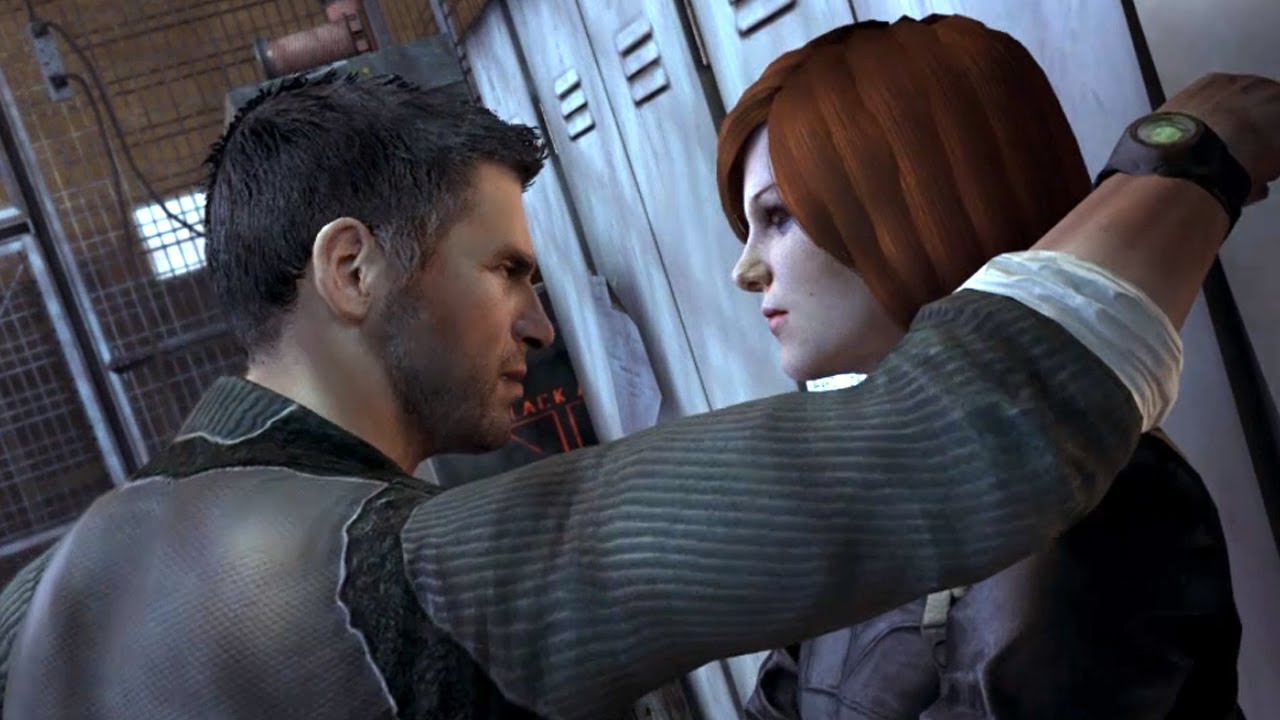
    The graphics are beautiful in Conviction, being one of the best-looking games of the Xbox 360. Everything is gorgeous and I loved the character design. It really does capture the Nineties techno-thriller atmosphere and looks like a movie. Even sets which shouldn't be interesting like a dingy locker-room are full of little tidbits that make it look more lived in. An immense amount of attention was put into making the game leap off the screen and you can see it everywhere.

Anna's redesign is amusing. Did she get some work done?
    Michael Ironside's acting is very well good and he maintains the high quality of the series throughout the game but he's a little too long-in-the-tooth for the character onscreen. It would have been a good idea to recast the character, I think for this game just as they did for Splinter Cell: Blacklist. I know I've attracted the ire of many purists with this statement but it's only my opinion. Still, he manages to convey the gruff weary old soldier thing very well and really makes you believe he's well and truly done with Third Echelon's bullshit.

    The gameplay continues to emphasize stealth but ramps up the action considerably, which I didn't mind but some players might find off-putting. Sam also abandons his willingness to take his opponents down non-lethally and becomes a human Terminator. I didn't mind this but this makes the story significantly darker and edgier for no-reason since, really, the non-lethal takedowns of previous games were part of the appeal. One element I did enjoy, however, was the "tagging" system which allows you to do bullet-time executions of your opponents that are always fun to watch.

The use of shadows and lighting in the game is great.
    There's a lot of really good levels in the game such as an escape from a United States Air Force base, an infiltration mission in a carnival, a couple of levels in Iraq which switch genre from stealth to action, and a mission where you invade Third Echelon. You even get to invade the White House and that's just awesome. There's none of he typical underground bases and crumbling buildings which make up most games.

    Sam Fisher is a great character with a lot of grizzled toughness and sly sardonic humor. He's a pretty generic in the context that he's a distillation of every single rugged American soldier type since Rambo wandered onto the stage but that's not necessarily a bad thing. The fact Michael Ironside's performance, too old for the role or not, conveys how thoroughly DONE with all this crap really amps up the emotional investment I had in the story. I may not feel for the guy quite the same way I do as Solid Snake but he's still a very enjoyable on-screen presence.

Feeling betrayed is a good reaction to betrayal.
    I could describe the plot but it is a nonsensical yet fun collection of various modern spy fiction tropes: EMPs, a plot to kill the President, evil PMCs, faked terrorist attacks, rogue government agencies, and secret conspiracies in the highest levels of government.

    It's funny because most of this is the exact opposite of Tom Clancy who tended to lionize the US government no matter what (unless they'd been taken over by naive-bordering-on-stupid liberals). Still, it's closer to my kind of politics and I won't lie to you by saying that didn't improve my opinion of the game.

    I think my favorite part of the game was the complicated and devastated relationship between Sam Fisher and Anna Grimsdottir. Sam has treated her like a daughter/potential love interest for much of the game series so watching her violate his trust so completely (by hiding his daughter's survival from him) is horrifying. However, it fits strongly with the themes that Third Echelon was never as heroic or noble an organization as Sam believed it to be and they would do anything to get their job done. It's just Sam never believed that would fall on him.

    In conclusion, this is a really fun game and one I have very few complaints about. There's an exceptionally frustrating and unpleasant section involving evading laser beam trip-wires but, otherwise, I can't say I didn't enjoy any element of this game.

9/10