Showing posts with label Metal Gear. Show all posts

Wednesday, February 12, 2025

Metal Gear Solid V: The Phantom review


    Metal Gear Solid V: The Phantom Pain is a not-so-old entry into the video game library of Konami games, coming out in 2015. Which is still ten years ago and worthy of giving a retrospective toward. It is mostly famous for being the supposed end of the Metal Gear franchise, the source of Konami’s break with Hideo Kojima, and several questionable decisions related to the franchise’s end like the replacing of David Hayter with Kiefer Sutherland as well as overly sexualized depiction of its female companion, Quiet.

    The game takes place in the early 1980s with the Soviet Invasion of Afghanistan and the Angola-Zaire conflict. It was preceded by the ultra-short game, Metal Gear Solid: Ground Zeroes, which is included in Metal Gear Solid V: The Definitive Experience. For the sake of this review, I’m going to count that as part of Metal Gear Solid V: The Phantom Pain since the games really should have been one continuous story except for corporate shenanigans.

    The premise for The Phantom Pain is the complete destruction of everything that Naked Snake AKA Big Boss achieved in Metal Gear Solid: Peacewalker. The mercenary army that Snake assembled is slaughtered, Mother Base headquarters is destroyed, his child soldier companion Chico is killed, and beautiful (but traitorous) friend Paz is used to blow up the helicopter that Snake is riding on. Naked Snake is left in a nine-year coma and wakes up with a piece of shrapnel stuck in his head among other permanent injuries. He doesn’t get long to recover, though, because the hospital he’s staying in is attacked by the black ops forces of XOF (Fox spelled backward).

    What follows is a lengthy story of the rechristened “Venom Snake” seeking his former companions to rebuild his mercenary company, re-christened Diamond Dogs, to get revenge on the rogue intelligence agency of Cipher (theoretically XOF’s bosses). They must disable and kidnap soldiers from Soviet and mercenary forces before convincing them to join their cause. They must also carry out numerous missions to build up their resources that take them up against the real-life atrocities of this time period. They also must deal with XOF’s access to genetically enhanced zombie-like super soldiers, Metal Gear bipedal tanks, and a weapon they claim will surpass nuclear weapons (though they have plenty of those too).

    What makes The Phantom Pain interesting to grimdark fans is that it is a much more serious take on the sometimes-goofy Metal Gear universe than previous entries. Multiple characters from the previous games are killed, often in horrific ways, while others are left maimed or a shadow of their former selves. Master Miller, who was Snake’s goofy supporter, is now a broken man with missing limbs that wants nothing more than to kill as many Cipher supporters as possible. The subject of child soldiers, imperialism, and pandemic response all come up in this story. There’s some goofy moments like in previous Metal Gear Solid entries but, for the most part, The Phantom Pain plays it all very straight.

    The first half of the game is extremely well done with the slow build-up to face Skull Face and his super-weapon well-done from beginning to end. The story is a bit minimalist, and we lack the usual collection of mini bosses but the Man on Fire, Floating Boy, and Quiet are all memorable characters. Skull Face seems, in part, inspired by Freddy Kruger and is a memorable antagonist despite his short time on-screen. The gameplay is also fantastic and makes every mission worth repeating until you get that coveted “S-Ranking.” If they’d ended the game after its final mission, “Sahelanthropus”, I would have given it a 10 out of 10.

    Unfortunately, the second half of the game sucks and feels like it was where Konami cut off Kojima’s funding. Most of the second half consists of NG+ style missions with extra requirements while only a handful meaningfully advance the story. There are some good moments like the revelations regarding Huey Emmerich and the end to Quiet’s story but, infamously, Eli’s (Liquid Snake’s) story is just left unfinished with his final mission never completed. It’s a massive let down after so much build-up. Another flaw is the fact that the game’s story is primarily in cassette recordings that require a lot of sitting around and listening to.

    The game is gorgeous and there’s an endless amount of fun to be had sneaking up behind people, tranquilizing them, and then sending them up through balloons to be brainwashed into your followers. The game is hard but not overly so with Snake able to absorb more punishment than any human being other than the Master Chief but not so much that three people shooting him won’t put him down. I love D-Dog, D-Horse, and Quiet with each bringing something new when you bring them along missions. I also think the game has a fantastic soundtrack with “She Blinded Me With Science”, “Maneater”, “The Final Countdown”, and other classic tunes.

    However, I would be remiss if I didn’t bring up the fact that the game’s biggest twist is a controversial one. Without getting into it, a lot of fans felt that it renders most of the game’s character development for its lead pointless. For me, I didn’t mind it but The Phantom Pain is also a story about how legends are lies. Given that misinformation and propaganda are running themes in the franchise, I give it a pass, but others are still furious about it a decade later.

    Do I recommend the game? Yes. But once you complete the main campaign, I suggest doing the remaining story missions and nothing else. The Phantom Pain is a game that clearly exceeded its ambitions.

     9/10

 Available here

Monday, April 21, 2014

Metal Gear Solid 4: Guns of the Patriots review


    Nine hours of cutscenes.

    This is going to remembered as the game's most distinguishing feature. In a world where the majority of games tend to cap about eight hours, the vast majority of this being game play, the lengthy cutscenes in Metal Gear Solid 4 have become infamous. One holds a place in the Guinness Book of World Records for length, extending to the length of a short movie.

    This would all be justifiable if the game play (as well as storytelling) were worthwhile. Unfortunately, the former is decent at best while the latter is crippled by the need to address each and every little plot point point brought up by the previous three games. Hideo Kojima has always been an idea man rather than a figure known for coherent storytelling. Thus, it must have been a daunting prospect when he was hired to create a game to answer all the questions raised in the previous games.

    And by previous games, I mean Metal Gear Solid 2: Sons of Liberty.

The transformation of Solid Snake to Old Snake is terrible but moving.
    I'll get to this later but Metal Gear Solid 2 was created as sort of an affectionate middle-finger to the fans and meant to tear apart expectations for sequels. It created a vast conspiracy, quadruple agents, secret programs for dominating the world, and the set-up for a grand battle between various powers. The thing was, Hideo Kojima never actually intended to answer any of these questions. The next volume in the series was Metal Gear Solid 3: Snake Eater and was a prequel to the events in previous games. Fans wanted answers, though, and applied enormous pressure to get a game where they received them.

    Did they get them? Well, sort of.

    The massive number of cutscenes attempt to answer such questions as "Who are the Patriots?" "Is Liquid Snake possessing Revolver Ocelot?" "Who was Solid Snake's mother?" "What happened to Meryl?" "What happened to Eva?" and so on. This requires them explaining who a large number of these characters are to new audiences. It gets a bit recursive as after all the explanation, the stories actors have to repeat themselves because their points have gotten lost in digression.

The grim war-torn battlefields are some of my favorite parts of the game. Sadly, they become rather generic with time.
     Much as can be expected, the actual answers are less satisfying than the questions posed. The Patriots are a bunch of soulless artificial intelligences (learned early on), Revolver Ocelot is possessed by Liquid (though there's a twist), and almost every character from previous games has survived only to become a much grimmer person. The sheer amount of continuity in the game is something only a die-hard Metal Gear Solid fan can appreciate. As a self-described member of this fraternity, I appreciated the fanservice but it was at the expense of the series' trademark tactical stealth. I can't imagine the game being very enjoyable to regular gamers and it's probably totally incomprehensible to those who haven't been fans of the series from beginning.

    The actual game play itself is improved from Snake Eater but I can't say in such a way as to be amazingly memorable. When events are happening like the Raiden fight against Vamp, you can't help but think it would have been more enjoyable to BE the cyborg ninja versus just watching the character go to town. The Solid Eye and Mark 2 are useful but I can't help but think this was made as a movie (or miniseries) first and a game second.

The return of old favorites should be cause for celebration but their characterization leaves much to be desired.
    Even the bosses are perfunctory. The Beauty and the Beast Unit is composed of four beautiful women who have been traumatized by war but who engage with the plot only to the extent of providing boss battles. The exceptionally well written novelization of the game by Project Itoh eliminates the Beauty and Beast bosses entirely and nothing is lost for it.

    Really, the most interesting storytelling device is the rapid aging of protagonist Solid Snake. Established in previous games as a clone, his genetics start breaking down  Seeing a character go from a man in his mid-thirties to somewhere approaching seventy is a heart-breaking experience. It also "seals the deal" that we're seeing the final adventure of Snake as there's no going back from this.

    If I had any real approval to the story, it's the extensive use of cyberpunk elements. Snake is the lone rebel left in a world which has been hopelessly compromised by technology designed to oppress, control, and kill human beings. Worse, the people who might normally be stopping this have been compromised by the system itself. While it ends on a semi-happy note, the themes of oppression through misapplied science are at their strongest since Sons of Liberty.

    Overall, I've got to say that Metal Gear Solid 4: Guns of the Patriots is just not that good. Its primary purpose is to wrap up the hydra-like plot of previous games and provide a definitive ending for the character of Solid Snake. This, at least, it achieves with gusto. Still, I can't help but wonder what Kojima would have written if he hadn't had to explain himself.

    6/10

    Addendum: I would actually argue reading the novelization would be more satisfying to fans of the series. It not only manages to trim the story in several places but it contains all of the massive amount of information you need to know in order to appreciate the game's plot given in a concise fashion. It verges on the melodramatic at times but I'm okay with that and give it an 8/10.

Friday, April 4, 2014

Captain America: The Winter Soldier (spoiler) review


     So, okay, this is basically Metal Gear Solid: The Movie. Sometimes, Hollywood produces a film which is pretty much the exact theme and mood of a property even if it's a wildly divergent example of said property. Van Helsing is as close to a Castlevania movie as you're going to get and the same can be said for The Book of Eli and Fallout.

    The premise of Captain America: The Winter Soldier is about a poor aged veteran dealing with a conspiracy formed within the government to use a superweapon against the public at large. It's about information control and unaccountability of government. It's about the difference between superior genes and regular genes. It's also about idealism versus practicality on the battlefield.

    There's even a tanker level.

The SHIELD eagle is very Roman and ostentatious. It's also used as a symbolic clue something is wrong.
    The revelation that the Winter Soldier is Captain America's best buddy, Bucky Barnes, from way-back when isn't the movie's twist. The movie telegraphs that Bucky survived from the first trip to the Smithsonian. No, instead, the actual twist of the movie is the revelation that Hydra has infiltrated SHIELD and co-opted its leadership to the point only Nick Fury is uncorrupted.

    I'm of mixed feelings regarding this particular revelation. On one hand, I might have found it stronger to have something other than a Neo-Nazi organization taking over the government and being obvious bad guys. Then I thought about it and felt this was actually superior in the long run. Why? Because Neo-Nazis took over the world intelligence apparatus and no one noticed.

    While its Godwin's law not to compare a group to the Nazis unless you really mean it, I rather like this movie's ethos. That if you removed the racism from the Nazis and all the politically incorrect bits to leave only the National Socialism as well as ruthlessness they'd STILL be the most reprehensible people you've ever met.

    Our substitute for the Red Skull is Alexander Pierce who is an interesting character. A lot of people speculated he was the Red Skull because the original lived in a cloned body of Captain America for a long time in the comics. Others believed he might be the modernized Baron Strucker or other figure. Instead, no, he's just an American politician who really believes Hydra is the best way to bringing order to this fair rock.

    An attitude which is infinitely scarier.

The movie enjoyed teasing Captain America and the Black Widow but they remain platonic throughout.
     As mentioned, the central premise is SHIELD has developed an infallible drone-strike system to kill anyone their computers indicate is a threat to national security. This ominous idea is not so removed from reality because we do that now. Not just against foreigners, whatever sort of defense that is, but against American citizens who just happened to be abroad.

    Yes, there's the argument they're "bad people" but the kidnapping and torture of innocents shows that the American intelligence apparatus is not perfect. There's also the fact our missile attacks against terrorists have inflicted no end of civilian casualties. One of the most sobering stories I read was the story of "double-tapping" where the USA would drop a missile on a spot and then drop another when they saw people rushing to rescue the survivors buried under rubble. People only paled with a "what have I done" when someone explained that rather than collaborators, these individuals were mostly ordinary citizens who saw their fellow human beings in trouble and tried to help.

Killing people without trial is bad? I never thought of it that way.
    Captain America: The Winter Soldier doesn't go into the specifics of this controversy but simply expresses the Good Captain's disgust with the fact people are being executed without trial or recourse. In wartime you can surrender or negotiate but with the military powerhouse SHIELD is unleashing, it's just (as Harry Lime put it) "Victims? Don't be melodramatic. Look down there. Tell me. Would you really feel any pity if one of those dots stopped moving forever?"

    CA:TWS demonstrates why Mister Lime's philosophy is bad when HYDRA tallies up just how many dots they need to eliminate from the American seaboard in order to assume control. The number is above 700,000 and Alexander Pierce says they intend to do this sort of tallying up to every country in the world. We also do a cool "zoom" effect where we see those dots being a father at a soccer field and a few of them named, including Anthony Stark.

    I think this sort of satire is effective because it just shows a very simple truth. When you sacrifice power from the people and restraint in law, it's not necessarily you who is going to suffer first. However, eventually, there's the possibility the people in power will be the kind who don't like you. It's a sobering thought and one I'm glad to see addressed in a mainstream Hollywood film.

    Anyway, Captain America's idealism never feels forced in the movie and it's interesting to see him come down so strongly on the side of transparency as well as the dismantling of large-scale military-intelligence efforts. To the Good Captain, HYDRA infiltration isn't the problem, it's the entire organization of SHIELD. Watching poor Nick Fury deal with the fact there's no way his beloved organization is going to survive this disaster is tremendously moving.

    I also love the Black Widow's handling during this story, dealing with the fact she wanted desperately to be on the side of the good guys because she didn't have to be one herself as long as she was supporting them--which is undermined by the realization her side is the same as Hydra. This, in the end, inspires her to make changes in her life she should have done years ago.

    While I think this is the best Falcon they've ever done, I can't say I'm entirely behind his handling in the movie. The movie makes it a point to show Falcon trying to catch up with Captain America despite lacking superpowers. Sadly, the movie goes out of his way to show that he'll always be second best not only physically but morally. Falcon agrees with the Captain on everything as a plot point and it's kind of disheartening.

    Robert Redford's character is a perfectly understated evil with Alexander Pierce never once wavering from Hydra dogma yet having such conviction you have to wonder if he's onto something. When the heroes thwart his plan, he says, "what a waste" versus having a breakdown. Even a scene where he kills his housekeeper for listening into something she shouldn't have was a great moment because he seems saddened he has to do it yet does so without hesitation. It's a testament to his skill as an actor he can make a line like, "I only have to kill about twenty million people to make it work" sound rationale.

     The surprise villain of the movie is Armin Zola who returns as the consciousness of the evil Nazi uploaded into a 1970s set of computers. He's simultaneously creepy, weird, goofy, and fun all in the same scene. There's something awesome about a scene which references Wargames (which Cap has seen!) only to then reveal that SHIELD has failed to stop thousands of deaths over the years due to Hydra's manipulating them from the inside. Zola's appearance is, hands down, my favorite part of the movie.

This guy doesn't really scream Crossbones to me.
        The Winter Soldier makes several appearances throughout the film but only a few of them stand-out. Since he spends the majority of the film as a brainwashed slave, we don't get much insight into the way the character's mind works. Any future use of the character will depend greatly on where they take him after the events of the movie. I will say, though, his mind-wipe scene was impressive.

     Crossbones, the Red Skull's favorite henchman, also makes an appearance in the film but there's nothing particularly Crossbones-esque about him. I've got to say that I would have preferred him to just be a generic bad guy rather than such an iconic characters. Of course, the fact Falcon beats the crap out of Crossbones makes it almost worth it.

     In conclusion, Captain America: The Winter Soldier is an awesome movie and has a lot of worthy things to say. Captain America remains a symbol of uncompromising integrity in an otherwise ambiguous world of espionage and that's rare enough on its own. The fact they manage to go further and suggest every secret of SHIELD should be posted on the net is awesome. I only wish that were the case in real life (barring undercover assignments like in Mission Impossible).

10/10

Thursday, April 3, 2014

Metal Gear Solid: Ground Zeroes review


    Way back before the oceans drank Atlantis and the rise of the Sons of Aryas, in the year 2001, there was a teaser demo for a game called Metal Gear Solid 2: Sons of Liberty. This teaser allowed you to play as Solid Snake on an oil tanker which was secretly carrying a Metal Gear for the United States government.

    Solid Snake, the avowed enemy of all things Metal Gear, was going to take some pictures of it in order to expose the government's violation of international treaty. Things went pear shaped and fans eagerly bought up the demo (even if they had to pay full-price for Zone of the Enders to get it) and were disappointed when they found out the main game was about newcomer Raiden rather than Solid Snake.

    I am reminded of this story when I play Metal Gear Solid: Ground Zeroes, which is the hour to two hour long first mission of Metal Gear V: The Phantom Pain snipped away from the main game and released as an independent $30 release.

    This is actually half of what the original price was intended to be and only at the bidding of Hideo Kojima the developers. This, despite the fact that most of these sorts of demos are free and the equally long Dead Rising 2: Case Zero, only cost $5.

Camp Omega is a vast open-world level you can take from any direction you want.
    Now, there's reason to argue that selling this two-hour-preview is worth more than Case Zero. The graphics are top-notch, Metal Gear is a much-much bigger franchise than Dead Rising, and the gameplay is far more intricate. You could even argue with rising Triple A game costs, it's necessary to release DLC and separate discs in order to defer costs.

    I agree, which is why this game should have probably cost $15. Either that or they should have thrown in enough levels to make it a four to five hour experience and charged the same. As is, the game is incredibly overpriced and better as a rental or "buy and return" from Gamestop.

    The later which, honestly, I consider crooked. So, fans of the game, I suggest you pick it up used or when the price goes down if you want your money's worth. Still, I've wasted 15 bucks before on much stupider things than this so you CAN buy it if you want. I'm just saying the price is an issue.

The sneaking in Metal Gear: Ground Zeroes has a lot more options, including shooting the spotters and lights.
     The premise of Metal Gear: Ground Zeroes is that it is about a month or so after the events of Metal Gear Solid: Peacewalker. Paz Ortega, the seemingly peace-loving teenage co-star, has been captured by a Freddy Krueger-looking American soldier nicknamed Skullface.

    Worse, Chico, Big Boss' surrogate son and conscience tried to rescue her and ended up getting himself captured. Skullface is the leader of a group called XOF (Fox spelled backwards) and he's apparently tortured both of them as well as performed all manner of gross medical experiments.

    Yeah, nice guy.

    Big Boss, being the honorable guy that he is, decides he's going to recover Chico at any cost. He's not so concerned about Paz and first suggests putting a bullet in her head to silence her. Those who played Metal Gear Solid: Peacewalker shouldn't be surprised by this. Big Boss is convinced to rescue them both, though, and heads to US-run black site "Camp Omega" in Cuba. Gee, I wonder what location inspired this place? There's also something about Big Boss' mercenary company getting investigated by the U.N.

Your goal is to rescue prisoners and that's a pretty decent motivator right there. No matter what you think of Paz or Chico from Peacewalker.
    Anyway, the plot is surprisingly complex for a game which lasts a little under an hour for the main story. There's even a lengthy 11 page explanation of Peacewalker's plot available from the start screen. I love Hideo Kojima's work as much as the next man but he's learned nothing from the 9 hours of cutscenes in Metal Gear Solid IV has he? I also think anyone who hasn't watched a Let's Play of Peacewalker or completed the game is going to be somewhat lost as to who Paz is and why they should care.

    The gameplay is what everyone really wants to talk about, however. Metal Gear Solid: Ground Zeroes is probably the most user-friendly and multi-gamestyle capable entry into the franchise yet. After years of finding it punishingly hard to complete these games, I completed Ground Zeroes both as a "run and gun" character as well as through stealth.

    There's forty or so Marines in Camp Omega and it's quite possible to kill them all. The fact the game allows you a few seconds to shoot them in a "bullet time" effect when they first spot you is a great gift for those of us who lack godlike stealth abilities. Unlike in previous entries, if you kill them, they can't call for help and gunfire doesn't automatically inform the military of where you are. I'd say this adds replay value but it's, literally, possible to complete the game in seven minutes once you know where Paz and Chico are.

    Artificial means of extending the game's length include trying to rescue all of the prisoners in Camp Omega and a number of side quests you gain by retrieving XOF patches. While I feel emotionally compelled to do the former, the latter doesn't really interest me. Sadly, I think there's several more side missions which could have been performed in Camp Omega which would have made the game more interesting.

Skullface has a face only a mother could love.
    You could have also lengthened out the existing missions by putting a few necessary steps in-between. Rescue Chico>Recover evidence about the torture going on in Camp Omega>Kill the Scientist conducting the experiments>Capture the Base Commander to find out where Paz is>Rescue Paz. Some of this is touched on in the side missions but they could have all formed a coherent main narrative.

    Graphically, Ground Zeroes' Camp Omega is one of the most beautiful settings I've ever played in. The dreary, dark, and foreboding location combined with its stormy atmosphere makes it a wonderful setting for a rescue mission. The Fox Engine even allows you to "wait out" the storm so it can be daylight when you explore, though it loses some of its feel thereafter. The contrast of modern military equipment to dog kennel-like conditions for the prisoners is also a real kick in the gut.

    One final warning, the treatment of Chico and Paz by the forces of XOF goes beyond the bounds of good taste. Kojima wishes to make a point about the sadistic treatment of prisoners by torturers and includes the potential triggers of sexual abuse along with a sickening placement of explosives. If you are easily offended, you should probably avoid this game. Thankfully, the worst of it is never alluded to beyond the audio tapes.

8/10

Monday, March 31, 2014

Metal Gear Solid: Peacewalker review

 
    Metal Gear is one of my favorite video game franchises. I played the original Metal Gear on my Nintendo and tried to keep up with the series as it progressed from console to console. It hasn’t always been easy, being the die-hard Xbox fanboy that I am, but I managed. Metal Gear Solid: Peacewalker, though, is an odd entry into the franchise and one I want to give my opinion on despite the fact it only recently became available on Xbox via the Metal Gear HD collection.

    It should be noted the game was originally available on the Playstation Portable and is an adaptation rather than a work meant for home consoles.The premise of Peacewalker is that John a.k.a Naked Snake a.k.a Big Boss has left the service of the United States government after the events of Metal Gear Solid 3.

    While this game chronologically taking place after the events of Metal Gear Solid: Portable Ops, only one rather dismissive line references its events and I’m comfortable saying they’re either non-canon or simply irrelevant to the larger saga as a whole. Big Boss is currently the head of a massive mercenary organization called the Militaires Sans Frontières or “Army without Borders.”

The graphics are quite good despite being a port from a handheld.
    The implications being that he’s sort of running his own version of the A-team, doing good work for nations without military power. Big Boss’ good-guy status is almost immediately called into question when he accepts a job from the KGB, though, in order to investigate the possibility of his slain mentor (The Boss) still being alive.

    Metal Gear Solid: Peacewalker has a dismissive attitude to the Cold War’s moral element, highlighting how both superpowers treated other nations as pawns to be used and discarded at a whim. American players, in particular, will probably be surprised by the sympathetic attitude given to Panama’s Sandinista movement. Assuming they’ve even heard of it. 

    In 2014, the Cold War is a distant memory to America’s youth and more than a few subtleties of the conflict are going to be relayed by games like this rather than personal experience. With a game series so focused on ideas like memes and information control, it’s interesting to realize a lot of our perspective will be shaped by folk like Kojima who care enough to weigh in on events. The game even throws in positive commentary on revolutionary, Che Guevara, who is like most lionized historical figures in that he possessed elements of both a hero and a monster.

The codecs, as always, are the primary source of character development.
    Big Boss is explicitly compared to him and I find this an appropriate comparison. Peacewalker also highlights an element of both Che and Big Boss in both men became more legend than reality as time passed. Big Boss in Peacewalker is a man, not a god, but his men elevate him to the status of demigod by the end while his enemies want to make him the avatar of evil worldwide.

    While no great sympathizer to Soviet-style communism, I appreciated the uncompromising treatment of how US foreign policy and imperialism affected Latin America in this game. I’ll discuss it further in “The Social Satire of Metal Gear Solid: Peacewalker.”

    Really, the politics are the most intriguing part of the game with issues like deterrence and the role of military forces in achieving peace discussed at length. It’s what moves this game from a disposable storyline like Portable Ops into the realm of high art like Metal Gear Solid 2 (my favorite of the franchise).

    The characters are delightfully quirky with Paz, Doctor Strangelove (yes, like the movie), and Kaz Miller being quite entertaining. The villain Hot Coldman, as indicated by his unfortunate name, is a cartoonish caricature of the CIA but no more so than Colonel Volgin was of Soviet-style military officers. The KGB doesn’t come off much better, either.

The cutscenes are in a beautiful B&W style.
    Still, outside of Spec Ops: The Line, I can’t think of a nastier portrayal of the US foreign intelligence agency. Depending on where one sits on the political spectrum, this may be a bonus or a negative as far as you are concerned. The gameplay is the area where Metal Gear Solid: Peacewalker becomes troubled and this is obviously the result of being a port.

    Really, I think they should have made this game as Metal Gear Solid 5 and the world would have been better off as a result. There’s over a hundred and twenty missions, usually taking about fifteen minutes each, but crippled by the fact the original game is meant to be played as a co-op campaign. What do I mean by this? Well, the simple fact that one of the first bosses is an Armored Troop Vehicle (ATV) and is meant to be fought by two or three Big Bosses.

    When it’s fought by a single Big Boss, the battle becomes almost impossible as there’s no way to sneak past the thing or blow it up with heavier weapons which aren’t available yet. What should be a fun run and gun with buddies becomes damn near impossible cherry-tapping while dozens of smaller soldiers swarm around you. The fact that Big Boss must restart his missions from area one in multi-area missions is also immensely frustrating. If the game had started you from the area of where you died or given you heavy weapons to counter the bosses when playing singular, my gaming experience would have been much more enjoyable.

    Unfortunately, it didn’t and my advice to gamers is to find someone to play with for bosses or it will never be any fun. The Mother Base system is one of the more intriguing elements to come out of the game and a way of rewarding the style of gameplay the developers desire. Big Boss wants to recruit the disenfranchised soldiers of his enemies to his private army so he's encouraged to not kill them. If you don't, you win them over to your cause and can use them to build up your forces on an offshore oil rig. Once I got the hang of getting soldiers carried away by helicopter, it proved quite entertaining.

     In conclusion, Metal Gear Solid: Peacewalker is a worthy addition to the franchise. Unfortunately, it is marred by the changes from a port to a console. Given so much else of the game is AAA, I find myself unable to forgive the format problems. With a bit of jimminying, this could have been one of the all-time greats.

    8/10

Wednesday, March 20, 2013

The Social Satire of Metal Gear Rising: Revengeance


    Metal Gear Rising: Revengeance is a much more thoroughly straight-forward in its satire than its sister title Metal Gear Solid. Despite this, its themes are no interesting. After the somewhat overwrought dissection of the War Economy and Media Control in Metal Gear Solid 4: Guns of the Patriots, Metal Gear Rising: Revengeance returns to a more grounded reality. Well, a more grounded reality with cyborg ninjas and hundred-foot-tall mechanoids.

    The heart of Metal Gear Rising: Revengeance is the question of violence and its necessity. What level of violence is need to solve the world's problems, if any? It's an old question based around a fundamental problem with no solution. How does one solve the issue of violence without violence? If one side is willing to use violence and the other side isn't, does that mean the side which is willing will win automatically? History shows us examples from both sides.

    The Metal Gear series is decidedly anti-war but the games long struggled with the fact you were encouraged not to kill opponents while, nevertheless, still being a soldier. Revengeance's protagonist  is a character who fully embraces his role as a killer. Throughout the game, he gives various justifications for his violence ranging from "they chose this" to "I am a killer, so this is what I do."

    At the start of the game, he discusses the concept of deterrence and how a sheathed sword can prevent others from being drawn. I.e. the threat of violence is more important than the actual use of it. Likewise, he talks about the idea of killing one man to save many. The game dissects this question from multiple angles, pointing it out as both hypocrisy which favors the morality of killers and also as a truth of reality.

    Raiden saves many lives by killing villains but he's also confronted by the fact that the people he kills are usually employees, not evil themselves. Those who do evil deeds are unlikely to be intimidated by threats of violence against their minions. In short, deterrence is difficult unless you're willing to strike at those who make the decisions.

    Throughout the game, we have Raiden serving as the so-called "sword of justice." The gameplay encourages us to view combat as a ballet of swordplay, combos, and finishing moves. In contrast to Metal Gear Solid, which is filled with a largely melancholy instrumental score, the game is filled with Devil May Cry heavy metal which encourages you to enjoy the violence going on. As Raiden is cursed with "Jack the Ripper", his alter-ego who loves killing, so do we experience his blood-lust in a positive manner.

Raiden is not your ordinary hero in many respects.
     Yet, the strongest scene in the game is undoubtedly when Raiden is forced to confront a set of cybernetic policemen who have been brainwashed into being unable to retreat. Raiden is forced to kill them despite having their electronically recorded thoughts projected into his brain. He and we are forced to hear how terrified they are of fighting Raiden and how they have no idea what's going on.

    It's a brutal moment that calls into question the philosophy of war where one man is evil but to stop him you may have to kill ten thousand good ones. What about if said evil man was going to kill ten thousand and one or a million? The game gives no easy answers. Instead, it invites you to think about the serious consequences of going to war.

    The game's harshest criticism, in-fact, is of individuals who go to war for stupid or ill-considered reasons. America receives a rather brutal slamming in the game not for being the world's sole remaining superpower but having a military policy based on public opinion. The idea of going to war to raise public morale and industry is ruthlessly slammed. The game attributes this to the "toxic meme" of American exceptionalism.

    During one scene, Raiden literally pauses in the middle of a battlefield to surf the internet. He discovers that America is going to go to war with Pakistan because a group of mercenaries trying to assassinate the President have been killed (by Raiden). The nuances of the situation are completely lost in favor of the fact Americans have been killed on Pakistan soil.

    Unexpectedly, the villain of the piece, Senator Armstrong is repulsed by the typical attitudes of his fellow Americans. He loathes the greed, materialism, self-satisfaction, and lack of ideals amongst stereotypical US citizens. In a time when people have no religion or philosophy (a gross overstatement but reflecting feelings in some circles), being born in a specific place is no substitute for ideology. Unfortunately, his substitute is to try and replace it with an anarchy he believes will foster an environment of the strong.

    I think Kojima is being unfair to Americans in this respect. Americans are one of the most religious people on Earth and many others have secular ideologies. There is a strong undercurrent of materialism in the country but it is, by no means, the defining force behind our politics. Instead of accurately trying to deal with the issue of American exceptionalism, the game just ascribe Social Darwinist theory to its villains. They are all killers and believe the strong should rule the weak.

    Social Darwinism is a theory which has mostly been discredited (with good reason). However, Metal Gear Rising examines an element of it which relates to the eternal conflict between militancy and pacifism. The majority of Metal Gear Rising villains espouse a doctrine of "might makes right." However, repeatedly, Raiden is confronted with the fact that high ideals mean nothing against his opponents until he's strong enough to oppose them. In short, might doesn't necessarily make right but the right NEED might to enforce it. In short, violence is a tool that those who seek peace need as much as those who profit from war. I appreciated this point.

    The game also addresses, though not at length, the use of mercenaries and the problem of vagrant children. While both are issues in the real world, the game argues the real struggle is against human apathy towards them. Both continue to be a problem because people don't care enough to involve themselves. I'm not sure this is true. In my opinion, the larger social-political-economic issues are a great deal more complex than the game indicates but it, at least, made the effort to say the issue deserved more attention than it gave it.

    The main villains of Metal Gear: Revengeance are a PMC which has become so large and prevalent, it has started using advertising to brand itself as a family-friendly brand every American knows. This, despite the fact the PMC has nothing to offer most Americans. It has become normalized to the point it's nothing more than another company. After all, why not? America is a democracy and appoints the leaders which employ private military contractors. I feel highlighting this issue drew attention to the wrong questions to be asked about any company which profits from war.

    Yet, unlike previous games where the PMCs are demonized unilaterally, the game also shows Raiden's own military outfit as fairly moral. Raiden points out that most Private Military Contractors are just security providers and treating them all as mercenaries or war profiteers is unfair. It's a nice bit of reality in a game series which has, until now, treated all PMCs as instruments of evil.

    Its moral ambiguity on the subject is thrown away, however, with the PMCs use of child-soldiers. Thankfully, this is a subject we can all agree is universally bad. However, the game doesn't just stop at child soldiers but talks about poverty in general. The world is filled with abandoned or vagrant children who are either easy prey for criminals or unable to receive the kind of education which would pull them out of their circumstances. I consider education, alone, not enough but that's a conversation for another time.

    Metal Gear: Rising talks at length about how the problems with homeless children are manifold but have been ignored because it is too difficult a subject for most to tackle. The game forces the exploitation and suffering of the defenseless into your face and comes up with an imperfect but workable solution for the individuals involved. Raiden can't save the world but he can possibly save a small number of its citizens.

    The economics of both war and the failure of nations to care for children are both dealt with in the game. No one, aside from the cartoonishly-evil Desperado corporation, wants to hurt children. However, no one wants to foot the bill for their recovery either. A major subplot of the game is the attempt by the Maverick PMC to find a cost-effective solution for the care and education of the victims they find in Mexico and later Colorado. The end result seems to be putting the cost on the children, themselves, who must pay for the cyborg bodies which were cruely ripped away from them. "An imperfect solution for an imperfect world" indeed.

    In conclusion, the game is extremely effective at conveying its ideas of violence. Overall, I think the game comes down on the idea that violence is both necessary but also something not to be trivialized. As a student of the martial arts, however briefly, the first thing I learned was fighting was meant to be a last resort. The game taking the simple philosophy that violence begets violence but one should be prepared for it is a good one, especially when coupled with the knowledge it's something to be avoided when possible.

    More games should have this attitude.

Monday, March 18, 2013

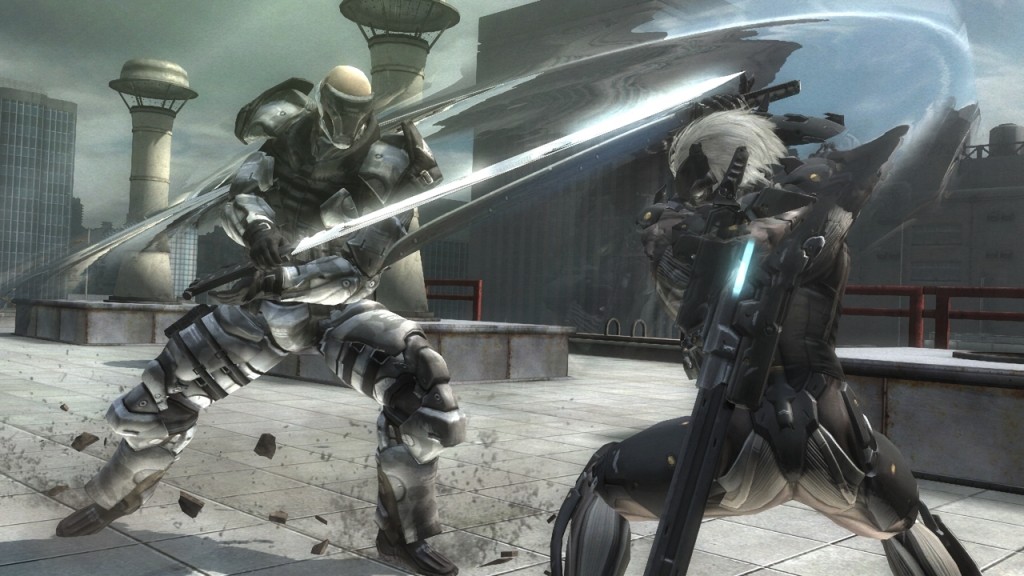
Metal Gear Rising: Revengeance


    I love the Metal Gear franchise in all its iterations.

    I can't play them worth a damn, however.  

    Metal Gear has one of the most entertaining storylines ever created for a video game. In a game world which starts in the 1960s and moves up to the near-future across numerous continents, the plot of the franchise is labyrinthine and bat**** insane (but in a good way).

    It's beautiful, thought-provoking, and proof video games can be a form of art. They're also damn difficult for people who don't like Stealth gameplay. Which, unfortunately, includes me. So, automatically, I'm going to give Metal Gear Rising: Revengeance a lot of credit for branching out. Metal Gear Rising: Revengeance is an action game. You slice up lots of enemies and I do mean lots.

    The game really does an excellent job of making you feel like you're an invincible cyborg assassin--which is a pretty hard feeling to instill. It's not a perfect game, though, its flaws hampering a great premise and fun gameplay. The usual bat**** insane conspiracy theories which are a mainstay of the series have been noticeably mainstreamed (I hesitate to use the word "dumbed down") while the plot is absent the usual twists. Worse, there are parts which flat-out do not make sense with what we know of the setting.

    Metal Gear Rising: Revengeance is also rather short, clocking in at about six hours to complete. It has a New Game Plus mode, which allows you to restart the game with all of your upgrades after beating it but this is a poor substitute for what should have been a few more levels. Finally, the game has more than a few plot-holes, a quality which was surprisingly absent from the convoluted series until now.

Yes, a cyborg ninja is fighting a robot wolf. It's that sort of game.
    The premise of the game is that Raiden, the protagonist of Metal Gear Solid 2, has taken up work as a Private Military Contractor for an unnamed African country. Unlike most depictions of mercenaries, he's actually doing the job they're allowed to do in the real world--which is being is a bodyguard. No points to you for guessing his contract is killed and Raiden decides to get revenge.

    Hence the title.

    The plot later becomes focused on the use of child soldiers, cybernetics, mercenaries in conflicts, and American exceptionalism. Unfortunately, the game is too short to delve into these topics too much. There's even a serious plot hole where the villain explains his plan in detail at the end, only to never explain how the previous actions he'd taken benefit it in any way. Indeed, several actions done by the villains make no sense except to get the main character involved.

Is it wrong to chop up hordes of faceless mooks with your super sword? Does anyone care once the bullet time begins?
     The gameplay is completely the opposite of Metal Gear Solid, involving the character of Raiden slicing through literally hundreds of foes with his cybernetic sword. With the use of a Bullet-time mechanic to slow down enemies, you are capable of using your sword to slice foes into literally hundreds of pieces.

    There's an option to stealth through the game but it is actively discouraged by sections of the game getting "blocked off" until you have killed all of the various enemies who have spotted you. Really, you're much likely to have more fun by killing all of your foes with your high-tech sword. At least a couple of commentators have mentioned this game is a spiritual successor to the old arcade game Strider (where you play a cyborg ninja with his robot dog) and I can see their point.

    In a nod towards the franchise's well-known pacifism, the game eventually takes a rather dark turn which highlights that Raiden's rather cavalier attitude towards killing. I won't spoil this section but it's exceptionally powerful and the only moment I really felt like this game was a worthy successor to its predecessors. That doesn't mean it's not fun, however, just a tad underwhelming.

The game's tagline is lightning bolt action. It delivers, which is a good thing. Unfortunately, it gets a bit repetitive in places.
      I like Raiden's new look, attitude, and character development. The confident, dangerous, and somewhat insane character of this game bears little resemblance to the awkward newcomer of Metal Gear Solid 2 yet perfectly fits with what we know of him. I think the absence of Raiden's wife Rosemary, always a somewhat questionable addition to his story, helped matters somewhat. Rosemary  needs serious retooling if she's going to be an entertaining love interest.
  
    Raiden's supporting cast is entertaining in this volume, consisting of the mercenary company which employs him and a couple of surprising additions. I suspect some people are going to have severe problems with George, the Guyana war orphan, since his accent is bound to remind some people of Jar Jar Binks. I, on the other hand, found the kid to be quite entertaining and surprisingly courageous. None of the characters have story arcs as memorable as Naomi Campbell or Major Zero, however, which means the codec conversations aren't as entertaining or portentous.

     I like Raiden's new look, attitude, and character development. The confident, dangerous, and somewhat insane character of this game bears little resemblance to the awkward newcomer of Metal Gear Solid 2 yet perfectly fits with what we know of him. I think the loss of Rosemary, always a somewhat questionable addition to his story, helped matters somewhat. Raiden's wife needs some serious retooling if she's going to be entertaining.

Yes, he's jumping from missile to missile to attack a giant robot. Why have you not bought this game!? Ahem, sorry.
     I'm of mixed feelings towards Metal Gear Rising: Revengeance's villains. All of them are quite good with Mistral, Jetstream, Sundowner, and Monsoon being perfectly serviceable bosses. Jetstream Sam, in particular, is a character I'd love to see more of. I also felt that the final Boss was hilariously over-the-top but in a good way. Unfortunately, none of them relate back to the other games in the franchise and I'm not sure we'll see them built on like we did with the Foxhound unit in Metal Gear Solid. As a result, they sort of feel a bit insubstantial.

     The game's soundtrack also bears special note, being composed of almost pure heavy metal. While not all of the tunes are great to listen to when you're not in battle, they're excellent accompaniment to the combat on screen and rarely distracting. I was particularly fond of "Has to Be With This Way" which plays during the final boss fight. So kudos to the developers for coming up with some excellent music, I usually don't compliment the soundtracks during reviews.

     Is the game fun? As mentioned above, yes, it is. Unfortunately, the game feels almost half-done. It's not only short but the plot feels like it had additional levels and content which were dropped so the work could be released early. It lacks many of the flourishes which made Metal Gear Solid and its sequels great. There's still plenty of great stuff here and it's definitely worth the purchase cost, especially if you trade it in for store credit at Gamestop thereafter, but there's not much here to keep me occupied indefinitely.

8/10