Showing posts with label Assassins Creed. Show all posts

Monday, December 4, 2017

Assassins Creed: Origins review


    ASSASSINS CREED: ORIGINS is a bit of a late review because I've been taking my time with this game. I often have very positive first impressions of video games, only for my opinion to start to go down in the long haul--especially if they botch the ending. Fallout 4 is a game I really enjoyed but the sheer staggering number of half-measures ruined the experience for me. I also loved Deus Ex: Mankind Divided but the ending was a crash-landing on what was previously a great ride. 

    I finally finished Assassins Creed: Origins and have given myself a couple of days to ponder what I think of the story.  Overall, I think AC:O is a massive return to form for the franchise and probably the best installment of the game since Assassins Creed: Black Flag. However, it's not a game without some serious flaws which drag down the experience from being equal to Assassins Creed 2 (which remains the gold standard by which all others are measured).

Bayek is one of the most entertaining and well-developed of Assassins.
    The premise is a new modern day protagonist, Layla Hassan, is investigating the life of the first Assassin Bayek of Siwa. She's done this by breaking into his tomb and plugging him into the Animus. Bayek and his wife Aya are on a mission of revenge against the "Order of the Ancients" who killed their young son. While you get to play as Aya a few times, you mostly play Bayek and follow
him on his open-world quest to do good while tracking down the Order's members.

    The best part of the game is where the game diverges from the traditional AC formula. They tone down the First Civilization elements that have been dragging down the series since AC3. They also more or less wholesale copy The Witcher 3's rules in order to make a vast open-world which includes many interesting side quests. Bayek and Aya are fascinating personalities with the former being deeply religious as something new to the franchise (that primarily consists of irreligious protagonists).

    While revenge is an overused plot to motivate characters, Bayek and Aya are real in their grief as well as how it affects them. The death of their son has resulted in a rift between them and not even Kill Bill-esque vengeance is going to heal it. I also love the beautiful architecture of Ptolemy Egypt, which has been resurrected in all of its ancient glory. You can visit the Library of Alexandria, climb the Lighthouse, and visit much older monuments. The ability to climb the Great Pyramid of Giza to its top is worth the price of admission alone.
Bayek and Aya have a wonderful relationship.

    Even so, the villains are a bunch of one-dimensional targets with the fact they're just proto-Templars making me wonder what it would be like for Assassins Creed to have another opponent for once. Part of what made Black Flag so interesting was your targets were, by and large, other pirates or slavers. The treatment of historical personages in this installment is worse than usual since they go with a very stereotypical treatment of some of the period's most fascinating personalities.

    Julius Caesar is an arrogant one-dimensional tyrant and Cleopatra is a whining party girl who schemes with Pompey at one point. Her brother, Ptlomey, is treated as a dictator himself despite the fact he was a puppet ruler. Her sister is just outright excised from the story. Julius Caesar is a controversial figure in part because while he was dictator of Rome, he was also a man who spent large amounts of his personal fortune trying to win the common man over. Given Brutus was a man who loathed the common people, it seems strange seeing him as a champion of the early Assassins.
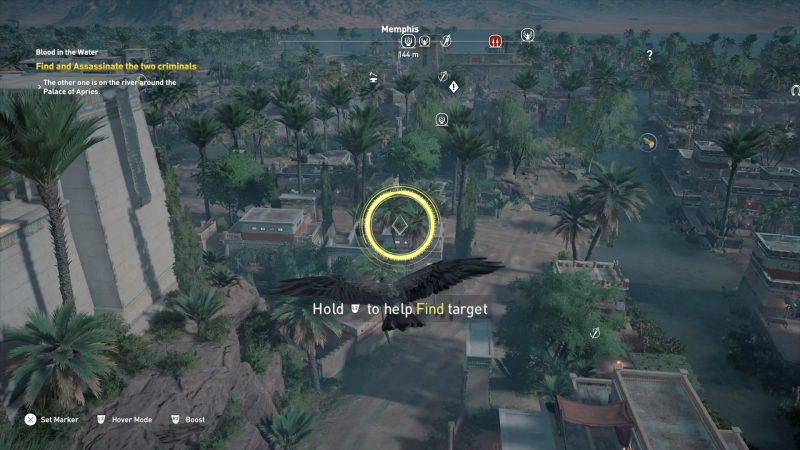
Eagle vision becomes literal of this game.
    There's a few acceptable breaks from reality like the fact we don't see the massive amount of slavery at the time since that would force our hero to either be anachronistically against the practice or lose him much of the audience's sympathy. We also get an early period for the Assassins' origins that keeps them locked in the present day versus making them responsible for all of history.

    Do I have any complaints about the gameplay? To an extent, yes, that the wholesale absorbing of the Witcher 3's gameplay doesn't really work for the setting. You should be able to sneak up and stab someone or drop on them from above so they die. Doing so and them getting back up doesn't make any damn sense, ditto when you shoot them in the head with an arrow.

    If you go after a target while underleveled, you might as well be fighting an indestructible tank. That means AC:O isn't so much a stealth game as a fighting game. The fact you have to constantly level up your weapons also feels silly in a "realistic" setting. As such, you have to do a lot of sidetreking in order to get to the end of the game. On the plus side, we do have a great new advantage in gameplay with Semu the Eagle. Bayek, for whatever reason, can see through his pet eagle's eyes and this allows you to mark targets as well as discover secrets about locations before planning your attacks. I also applaud the removal of synchronization challenges with the game allowing you to kill targets however you want.

Cleopatra is modeled after Elizabeth Taylor.
    There's also the fact the final portion of the game is played with Bayek's wife Aya who is not possessed of any levels of special equipment. While this is what I complained about earlier, it's a jarring gameplay shift and you've spent the entire time focused on getting your equipment to maximum then it's going to feel a trifle frustrating. You want to kill your final target (which is admittedly the mother of all assassinations) with your special Sword of Ptah +40, not a random bronze dagger.

    The map is huge and when I mean huge, I do mean huge. More of Egypt is detailed than I ever thought possible with Alexandria, Memphis, the pyramids, the Sahara Desert, rocky coasts, and the Nile all giving it a massive open-world feel. There's some flaws in this, such as the fact Alexandria was the second largest city in the world at the time while it's barely a map dot of a few key buildings in this game but acceptable breaks from reality. There's a staggering number of locations spread across the game. Plus, I do appreciate the opportunity to outfit Bayek in Pharaoh armor as well as riding around in a bling-covered camel.

A bit too much melee. Not enough stabbing from behind.
     A warning for those who hate microtransactions, Ubisoft did provide the game with a "pay to win" function that allows you to buy all the difficult-to-acquire skins and materials you need to max out Bayek's equipment. As gouging customers go, though, Ubisoft is doing the least offensive version possible since none of the stuff they're selling is necessary to win the game. I bought some cool outfits and they cost about $5 each. It's a far cry from gating away, say, Darth Vader or Luke Skywalker like some of the companies we know.

    In conclusion, Assassins Creed: Origins is a great Assassins Creed game but it isn't the best in the franchise. The game feels a little too much like a Dungeons and Dragons-themed fantasy RPG versus what the series has traditionally excelled at. The characters are likable but the portrayal of the time period is mixed. I'm glad I got the game and am glad I played it to the end but they could have gone a bit further with it.

8/10

Tuesday, March 14, 2017

Assassins Creed (2016 movie) review


    Assassin's Creed is a series I have great fondness for. I love conspiracy theories and alternate history, which is what the franchise survives on. I love the idea of an Atlantis-like precursor culture that created humanity via genetic engineering, only to be overthrown by their slaves until a natural disaster wiped them out. I love the millennium-long war between the Knights Templar and the Assassins which predates the actual orders in history. I also love Michael Fassbender and was really looking forward to this movie.

    Unfortunately, the first mistake I believe this movie made was the same one which was made with the Resident Evil movies: stray too far from the games and you lose something. Basically, Michael Fassbender was originally supposed to be Desmond Miles (the protagonist of the games) but got re-envisioned as "Callum Lynch." It turns out, instead of an adaptation of the first Assassins Creed, we were going to have an adaptation of an entirely new set of characters which just happened to closely resemble the games.

The Suicide Squad-esque opening could have been shortened.
    I understand the need to change things up and compress: both Desmond Miles and Altair have distinct arcs spread across the original game that would be hard pressed to put into one single movie. You have Desmond's imprisonment by Abstergo Industries, the search for the Apple of Eden, and the larger story about how Altair is forced to learn what it means to be an Assassin after screwing up a mission. Still, I was disappointed and the fact so much of the movie tried to exposit through these details didn't help.

    The premise is Callum Lynch (Michael Fassbender) is a death row inmate who is "rescued" by Abstergo Industries/The Templars before being put in an Animus. His father Joseph (Brendon Gleeson) was a Assassin who murdered Callum's mother as a child for reasons unknown but seems to be related to his capture by the Templars. Callum is greeted by Sophia Rikkin (Marion Collitard) who informs him he's a descendant of an even older Assassin named Aguilar (Fassbender again) who hid the Apple of Eden during the Spanish Inquisition. Sticking Callum in the Animus, he relieves his ancestor's memories until he comes to the point where he must decide to side with Abstergo or his ancestors.

I like the new Animus at least.
    The movie's major flaw is it wants to deal with a lot of the exposition in the story without any real way of knowing how. It even has an opening placard, which doesn't really help the story much. Also, none of the characters really take a moment to react to the strangeness of the premise, which would have helped ground the story. This lack of economy of storytelling really weighs the story down. I mean, yes, Assassins Creed is a profoundly weird setting but you can sell even the most bizarre stuff if you have the right sort of actors--look at the Marvel Cinematic Universe.

    The movie also hurts from the fact the best sections of the film are clearly the ones actually set in the past which are filmed like they're straight out of the games. Aguilar doesn't get much in the way of personality or exposition but he manages to impress by the way he slaughters hundreds of Templars. We also get to see a real-life Leap of Faith that more or less justifies the movie's existence by itself (especially since it was done without CGI). Even so, with as many parts as the movie is juggling, there's still more elements added by the Animus sequences with a kidnapping plot of Spain's prince as well as the question of love vs. duty.

Unfortunately, Aguilar seems more interesting than Callum despite his limited screentime.
    Speaking of love vs. duty, the Assassins and Templars don't do either side much in the way of service with their presentation in the movies. The Assassins really do come across as a bunch of closed-minded fanatics even though the movie is entirely on their side. The Templars are on their usual crazy psychotic "world domination" patrol but Marion believes eliminating violence from humanity is worth the cost (unaware the cost is the goal). Again, I miss Ezio and Edward Kenway for the fact they had big personalities independent of their Assassin status.

     There's a good deal to like in this movie if you're a fan of the series. The cast needs to be commended as no one gives a bad performance. Jeremy Irons adds a stately presence to the movie and is the perfect Knight Templar Grandmaster/Corrupt Corporate Administrator. Marion Collitard does an excellent job as Sophia Rikkin, selling she really thinks altering human biology to remove free will is a good idea despite how horrifying it is. Fassbender also does an amazing job with his limited material, making me wonder how he would have done playing a character closer to Ezio. I also loved the production values and new Animus.

Some really great action sequences in the past.
    The movie has way too many moving parts from the game while adding more to provide character beats that don't have room to pay off. Callum Lynch hates his father for murdering his mother and being a closed-minded fanatic, Sophia dislikes the fact her father perverts her work for his own gain, and Aguilar never once mentions his father but wants to be with Maria who only cares about Assassin business. That's in addition to the quest for the Apple of Eden which is never adequately explained as being valuable but could have been if they'd had time. I actually wish this movie would get a sequel as some of these plots feel like they could have paid off if they'd had time to.

    In the end, I think the movie is okay but suffers from taking the material way too seriously while removing much of its energy. There's a distinct need for a Shaun-style character to lighten things up and give context to the setting. Marion Colitard is a great actress and beautiful but they should have gotten Kristen Bell to show up as she would have sold better the idea of the Templars not being all bad (except not). While I love the modern sections in the games, I also think this would have worked much better if 75% of the movie had been in the past and the present-day sections were the remaining 25% versus the reverse.

7/10

Thursday, January 7, 2016

Assassin's Creed: Syndicate: Jack the Ripper DLC review


    Assassin's Creed: Syndicate was an excellent addition to the Assassin's Creed franchise. It wasn't an exceptional game, really, due to the rather stereotypical depiction of the Assassin vs. Templars conflict and greater difficulty at parkour but it was miles more enjoyable than Assassin's Creed V. I was, thus, glad at the prospect of a DLC expansion involving Jack the Ripper vs. the Frye Twins. So what did I think? Eh, I don't have much in the way of any real strong feelings about it. It's as fun as other Assassin Creed games but the story's potential is wasted.
It's not great. It's not terrible.

    Twenty-years after the Frye Twins defeated the Templars in the main game, Jacob Frye loses control over the Rook gang to his apprentice Jack. Yes, Jack the Ripper is an Assassin and has adopted a policy of trying to terrify the public into reforming their behavior by sending a message through murder.

    This isn't that far from some theories about why Jack the Ripper did what he did but that's rather beside the point. The problem is the story has a really good premise but is hurt by underdevelopment.

    One of the things which carries the Assassin's Creed games is the relative moral ambiguity. While the Templars can be treated as and often are cartoon villains, they have enough humanity to be interesting. Here, our depiction of Jack the Ripper is he's a psychopath who has weird messages appear in his head that order him to kill and spread terror to the masses--all because his mother was an Assassin killed by Templars which he blames Jacob for.

    Whenever you talk about a character's motivations and it's, "because he's crazy" then you run into problems. Not only is it insulting to the mentally ill it's also inaccurate to real-life psychology. Jack the Ripper appears to have motivations beyond his mental illness, including a "Creed of Fear" but this gets insufficiently examined. The game's presentation of Jack is, fundamentally, he's just a murderous lunatic.

Playing Jack the Ripper is an interesting experience and I like his "brutal executions." A nice contrast to the Assassins.
    There's an interesting plot here but it's hurt by the fact we're told Jack was like a son to Jacob rather than seeing it ourselves. We also are informed that the Rooks have been taken over by Jack and turned into his own private army. Which would, again, have been nice to see. We're told Jack the Ripper blames Jacob for his mother's death but we don't get any reason as to why this is. Was his mother working for Jacob when she was killed? Why doesn't Jack blame the Templars? Did Jacob not notice Jack was a paranoid schizophrenic? Did Jacob not think teaching a man with mental illness how to kill people more efficiently was a bad idea?

    There's a story here which is arguably more interesting than Evie tracking down the psychopath and killing him. In a very real way, the DLC raises too many questions for the small amount of time which is available to play. This storyline deserved to get its own proper game or, at least, should have been a full-blown expansion. You might have even put the Ripper DLC in the main part of the game and made the WW1 scenario of the main game as a download.

Evie gets a more balanced share of the Frye's story since you play her for the majority of the DLC.
    Either way, I have to give the story some credit. It's unusual enough playing a woman in video games but playing Evie Frye as a noticeably faded middle-aged woman is a fascinating experience. We also get to play Jack the Ripper for a few segments, the monster being a unique opportunity to cut loose with the absolutely horrifying potential of the Assassins. I was pleased they also made all of Evie's weapons non-lethal, signifying she's made a bigger commitment to life than most of her order.

    I do find it interesting that Jack the Ripper, one of history's most famous misogynists is completely removed from that element in his depiction here. The women sent after him are Assassins rather than prostitutes (or they're both). Jack has mommy issues but there's no indication these are affecting his sexuality. Furthermore, the issue of "Unfortunates" and Victorian England's obsession with them is only touched upon in the lightest manner. I find this interesting given the rather obvious way they could have gone with the story and its female heroine.

The Assassins erase Jack from their records. Unfortunately, for them, Abstergo now knows.
    The biggest addition to the game is the "Fear System" which is where you can kill someone brutally to terrify other opponents into fleeing. Likewise, using gas bombs designed to send people running rather than murdering. I'm not sure I really warned to this system but it added methods for cutting down on the killing (or ramping it up--depending on your playstyle) which I approved of. There's also a couple of new activities like rescuing kidnapped prostitutes from Jack's men.

    Jack the Ripper contains enough material here for a sequel to Assassin's Creed: Syndicate and it's kind of sad we don't get that but it's also a bit too slapdash. Still, I'm glad I bought it. For those who complained the main game was too light and fluffy, this DLC is one of the darkest installments of the series yet. We also get some small insight into the India branch of the Assassins.

    In conclusion, I give this DLC a rating of "okay, but not great." There's nothing really which leaped out from it for me. There's a couple of new sidequests, some new equipment, and a decent enough story but there's way too much going on for the DLC to really do it justice. Jack is also annoying with his scene-chewing relish and not even in a fun way like Crawford Starrick.

7.5/10

Friday, October 30, 2015

Assassin's Creed: Syndicate review


    Assassin's Creed: Syndicate is not the best Assassin's Creed game.

    It's not the worst either.

    Really, I'm inclined to think this is squarely in the middle of the road for games of the franchise. It's a serious improvement over Assassin's Creed: Unity but that's not saying much and doesn't take much in the way of risks compared to other titles. The plotline is cookie cutter but the gameplay is fun, the side-activities are always entertaining, and the leads are engagingly fun. The Assassin's Creed franchise has been accused of being the gamer McDonalds, tasty but bad for you. This is, in my opinion, a very good hamburger and fries.

London is beautifully rendered as always. A magnificent recreation of the past.
    The premise of the game is Jacob and Evie Frie are a pair of fraternal twins living in 19th century Croyden and like everyone ever born there from then til now, they're eager to get out (as told to me by several friends from there). Hearing there's only a single assassin in London and the British Empire almost completely under the control of the Templars, the pair decide to go against the will of the Assassin Council to help overthrow the new Templar Grandmaster, Crawford Starrick's, control. Along the way, they'll create a street gang called the Rooks to take over the city's Burroughs by seizing power from the Templar-aligned Blighters. It's a 19th century Steampunk version of Saints Row basically.

    Which is pretty damn awesome in some places.

    Less so in others.
I'd rank Evie up there with Shay, Edward, and Ezio.

    The positives first! This is probably one of the most singularly fun Assassins Creeds in terms of gameplay in the series. Unlike the majority of games where there was usually something not particularly entertaining, just about everything you do in the game is amusing.

    Child Liberation, Cargo Hijacking, Train Robberies, Assassination Missions, Boat Robberies, Gang Headquarters assaults, and even carriage chases are all fun. I've never been a completitionist with this franchise as I've never felt there was any incentive to do so. Here, however, there's side activities which tie directly to the plot and allow you to make use of your Assassin skills over and over again.

    Evie and Jacob Frye are also entertaining characters who manage to get the two kinds of protagonists in the series down pat: Evie is the studious social-justice orientated one like Altair, Adult Ezio, and Connor while Jacob is the lovable rogue we get in Edward or Young Ezio. The fact you can play 75% of the missions as your favorite of the siblings means you have a great opportunity to play as you want, too. I, myself, spent the vast majority of the game as Evie and had a splendid time doing so.

    Speaking of Evie, she's the kind of character who other franchises could take notes on. Evie is dressed appropriately for climbing rooftops, brawls, as well as leading a criminal organization. She's cute without being sexualized and has a distinct personality separate from her male counterpart.

Darwin helps you blow up a drug lab. I **** you not.
    There's a lot more variety in the representation of women, closer to Assassins Creed 2 than other entries in the series. We have nurses, gang bosses, train engineers, thugs, wives, queens, and occultists. The game doesn't do a very good job in representing the cosmopolitan nature of the city in terms of ethnicity, though, which is a shame. Still, this is marked improvement over Unity where Elise is seemingly the only significant woman in Paris.

    I've got to say the game also made itself more flexible in terms of how to use various tools. In previous games, I rarely used anything but my hidden blade and sword. Here, I made ample use of every tool in my arsenal including throwing knives and electrical bombs. I love the addition of the grapple gun which, while not something I would want in other time periods, fits the steampunk aesthetic the game seems to be going for.

    I even enjoyed the historical characters this time around as Evie and Jacob do the usual Assassin's Creed Forest Gump thing but it feels more organic to the plot than usual. It's a little strange wondering why Charles Darwin, Charles Dickens, Alexander Graham Bell, Karl Marx, THE QUEEN and PRIME MINISTER OF BRITAIN are hanging around with two of London's most notorious gangsters but I've made more allowances for worse. The fact a lot of these characters were just living in London and could be visited by their fans makes the integration a trifle more believable.

The Boss fights are some of the most fun and unbelievable parts of the game.
    Now for the negative. First of all, the game makes a large stink in advertising about how Jacob and Evie Frye are going to be waking up the working classes. The thing is, the Industrial Revolution plays almost no role in the actual storyline. Yes, you rescue a bunch of child laborers (I'm not sure where you're rescuing them to, however), but the focus is on the Rooks replacing the Blighters are the predominate street gang of London. Previous games highlighted the Assassins working hand-in-pocket with criminals but it's kind of disturbing seeing our heroes just replace one gang with another (especially when the membership of the Rooks is composed almost completely of Ex-Blighters).

    Next, there's the suspension of disbelief I'm having with London being overrun with a massive street gang which controls every Burrough. 19th century London was the Rome of its age and one of the most settled and controlled cities in the world. I don't have a problem with taking out the Blighters in Whitechapel or the Industrial Districts but I have difficulty buying they have a stranglehold on the areas just outside Parliament and Buckingham Palace. This is a small complaint in the grand scheme of things but something I've noticed.

Weirdly, one of my favorite parts of the game is parkor across the Thames.
    Third, and this is the big one, the plot is of no consequence whatsoever. Much like Unity, the Modern Day plot is vaguely related to finding some Precursor artifacts with Bishop but doesn't have anything resembling a "true" player character. Likewise, the Frye twins are against a scene-chewingly evil Templar Grandmaster who wants the same Precursor artifacts. This is the most paint-by-the-numbers Assassin's Creed plot you could possibly come up with. There's some hints at moral ambiguity like the fact the Templars are what's keeping the trains running on time in Britain (sometimes literally) but every one of them is introduced as mustache-twirling evil.

    There's some silly parts to the gameplay as well too. For example, the game introduces a leveling system which blows suspension of disbelief out the water. If you're not sufficiently leveled in terms of weapons you can wail upon an opponent with a knife all day without doing much damage. Likewise, the game introduces bosses which can and do take forever to kill if, again, you're not sufficiently leveled. On the plus aside, all of these characters are still vulnerable to air assassinations as well as head-shots. Still, I can't help but remember one particular boss fight where I shot them ten times with a revolver before managing to kill them. You'll also be fighting the same three Blighter character models several hundred times.

The creed says to stay your blade from the innocent. It doesn't say anything about running them over with carriages.
    The graphics in the game are, of course, great. London is amazingly well-designed and you can see where the city of yesterday becomes the city of the present. Several British friends have used the landmarks they found in the game to retrace their daily routine. We're finally getting to the point that it's a little too large of an environment to just run around but the game will hopefully go back in time rather than continue to increase in size at this point. As much as I loved the grapple gun, to get around the city, I either used fast travel or carriages for the most part. Traveling around the city on foot, rooftops or not, just wasn't practical for me.

    In conclusion, this is a fun game but it's not going to win anyone's award for their favorite Assassin's Creed game. It doesn't have the oomph of the Ezio games, the metaplot of the Desmond storyline, the charm of Edward Kenway, or even the novelty of playing a Templar. Still, it's a fun game and one I recommend. The fact I don't want to punch the hell out of the protagonist like I did with Arno makes it something I gladly have played for forty hours or more.

9/10

Monday, May 25, 2015

Assassin's Creed: Unity: Dead Kings DLC review


    Warning - this will contains spoilers for Assassin's Creed: Unity.

    Assassin's Creed: Unity was a very flawed game. It had an amazing set of graphics, fun gameplay, and a lot of bonus content contrasted with a vanilla protagonist who bounced his way through a brutal misrepresentation of history. One thing which really bothered me, though, was that Arno Dorian's storyline didn't really resolve itself.

    It just stopped.

    When last we left Arno Dorian, he'd just lost the love of his life and been drummed out of the Assassins. An epilogue revealed him wearing the robes of a Master Assassin and still working with Napoleon Bonaparte but this didn't provide any context to what his current situation was. There was a rather confusing voice over about what he believed the Assassin's Creed meant but that just added more questions since none of the events in the game related to his conclusions.

    In short, it felt rushed and half-finished.

I wonder what the Assassins DO with the Pieces of Eden.
    Assassin's Creed: Unity: Dead Kings is a free DLC from Ubisoft which provides a number of answers to the game's emotional questions if not the overarching plot. Much like the Siege of Foril and Bonfire of the Vanities, Dead Kings feels like an actual part of the story. I don't think the game is really "complete" unless you choose to play it.

    So it has that recommendation.

    I should note, though, Dead Kings wasn't originally meant to be free. It was originally part of the Season Pass of the game. However, Ubisoft decided to make it free to all purchasers of the game as a means of apologizing for the dicey launch of Unity. I've got to say that it goes a long way to winning over my trust, especially knowing that purchasers of the Season Pass get a free game instead.

    So what is the premise?

The Marquis de Sade is an odd choice for Arno's sole remaining friend.
    Arno Dorian is sick of France after the death of Elise at the hands of Germaine. Contacting the Marquis de Sade, he asks for help in getting to Egypt. Why Egypt? Maybe Arno wants to climb the pyramids. Anyway, the Marquis' price is the recovery of a treasure map which gets him involved in Napoleon's plot to recover another Piece of Eden. Along the way, Arno befriends a small boy named Leon who helps him recover a sense of purpose about what he's supposed to be doing with his life.

    There's a lot wrong with this premise, ranging from the fact I don't see why Arno Dorian needs help from a crime lord to get out of France when he can just buy a ticket. There's also the fact I'm not sure what the Marquis wants versus Napoleon versus everyone else. I'm sure it was explained but the plot seems to be almost an excuse. Plus, any time a story depends on the idea of the main character teaming up with a bratty adolescent--you know there's going to be problems.

    Yet, despite this, I liked it.

The bats are an annoyance as is the constant need to refill the lamp.
    The biggest thing this DLC has going for it is Arno's new cynical hard-edged personality. He actually emotes more than smug arrogant swashbuckler. Really, I'm kind of sad the storyline is about him regaining faith in the Assassin cause because I liked his new personality. Leon also serves a decent role as symbolizing Arno's lost idealism.

    Really, the entire DLC is nothing but one gigantic scavenger hunt for yet another Piece of Eden. It's about the laziest plotline you could conceive of for Assassin's Creed. Still, it's a well-done lazy bit of plotting with lots of strange puzzles and Indiana Jones-like scenes. It also culminates in getting a chance to use a Piece of Eden against the hordes of annoying bandits you faced in the previous levels.

    The graphics are well-done, too, with the city of Saint Denis being a fog-encrusted town filled with ruined churches and creepy cemeteries. The creepy sense of the macabre and decay contrasts with the relatively uplifting story, giving the game a unique feel. The addition of a lantern mechanic doesn't add much to the story but I enjoyed the new enemy types who are the first in the history of the franchise to realize fighting a superpowered ninja is stupid.

Leon could have easily been as annoying as Scrappy Doo but, shockingly, isn't.
    The biggest addition for the game is the "Guillotine Gun" which is a bazooka which can also serve as a spear. It's a kind of bizarre weapon that's out of place in the game but given it's shown up in the inventory of the main game from the beginning, a lot of us were looking forward to it. While useless to those of us who prefer to minimize casualties, it's wonderful for mass mayhem.

    Overall, I'm going to compliment the DLC as being slightly more enjoyable than the original, accent on slightly, even if it is derivative treasure hunt.

9/10

Wednesday, May 20, 2015

Assassin's Creed: Brotherhood review


    Assassin's Creed: Brotherhood is the sequel to Assassin's Creed 2, continuing the adventures of Ezio Auditore. Originally slated to be a DLC, it proved to have enough material for an entirely new game. The premise is Desmond Miles and the other Assassins have to flee their base in order to continue probing Ezio's memories for clues about the First Civilization. Taking up residence in the ruins of the Auditore mansion, they bond over the danger they face from the Templar's global sweep for them.

    Back in the past, Ezio returns triumphant from defeating Rodrigo Borgia's attempt to open the First Civilization Vault at the climax of Assassin's Creed 2. Unfortunately, Ezio overestimates the damage he's done to the Borgia family as Cesare and Lucrezia Borgia lead an army to avenge their father. His uncle killed and adopted hometown leveled, Ezio decides to pay the Borgias back by journeying to Rome and undermining their rule by taking out their supporters one-by-one.

Cesare and Lucrezia were the perfect choices for a follow-up story and historically accurate too.
    Cesare and Lucrezia Borgia are fine villains, despite being extremely over-the-top. Realism isn't always the best thing for a character, however, as sometimes you just want to deal with a pair of incestuous power-hungry weirdos. The fact neither villain is portrayed as particularly smart or capable of dealing with Ezio's plans works surprisingly well. You get to dismantle their empire like a Renaissance Batman and the story is profoundly satisfying.

    Ezio's supporting cast this time around includes the unexpected addition of Machiavelli, who provides a cynical contrast to Ezio's humanist optimism. There's also Le Volpe, a lovable rogue who provides a hot-headed contrast to Ezio's intelligence. Ezio's sister Claudia, who played only a minor role in the previous game, also ascends to become an Assassin herself.

    Much of the game is devoted to following Ezio's emotional journey from a hotheaded young man to the Mentor of the Assassins. The game wouldn't be nearly as emotionally poignant or powerful if we hadn't followed Ezio's journey from his teenage years to adulthood to middle-age. We see Ezio grow into his role as a Master Assassin and it feels earned, unlike so many games where you become the Listener or Archmage of a Guild after just a few favors on behalf of your bosses.

    Yes, I mean Skyrim.

Rome isn't as diverse as AC 2 but still a very satisfying open-world environment.
    The heart of the game, though, isn't the characters but Rome. The game nicely captures the fact that, far from being the center of the world, Rome during the Borgias was at its lowest point. About the only thing missing is the incredible prevalence of syphilis afflicting the city at the time. Rome is a great city to climb around with plenty of ancient monuments, ruins, and so forth to climb around. Indeed, such attention to these is paid that it sometimes makes Rome feel like a series of quaint little villages built in the ruins of a once-grand city 

    The big addition to the gameplay is that Ezio isn't just going to rooftops to synchronize his viewpoints this time around. No, he has to go to each district of the city and destroy a Borgia fortress after assassinating its Captain in order to liberate it. The game makes you feel like a big hero by having the regions be economically depressed, suspicious, and depressed looking places before becoming vibrantly alive ones you can refurbish if you free them. Historically accurate or not, it makes you feel like a big hero.

    Another feature added to the game is the titular Brotherhood. Ezio can recruit Assassins by rescuing them from the Borgia troops and then sending them on missions across Europe to undermine the Templars. He can also utilize them as weapons against the Templars in the city proper, calling them down like air strikes once you've built up your Brotherhood enough. It can be a bit game-breaking but the sensation of being the Mentor is more than worth it.

Going supervillain on Cesare's forces with Clockpunk mad science is my favorite part of the game.
    There's a trio of wild missions where Leonardo Davinchi sends you on quests to destroy his weapons designed for the Borgias. These are just completely insane and set you against wooden tanks, airplanes, and other devices in hopes of preventing Cesare from taking over the world with them. I loved them. The fact the game remembers Leonardo worked for the Borgias is a nice little bit of historical accuracy (as is the fact the Prince was possibly meant to be an insult in its dedication to Cesare).

    The game isn't without its flaws. Traveling around Rome can get tedious, even with the addition of a horse to speed up travel. Likewise, the game's system of having Ezio buy up land for development seems like a rather curious diversion for Renaissance Batman. The DLC for the game is less necessary than in Assassin's Creed 2, consisting primarily of a story about Leonardo being kidnapped by mathematician cult. I was also annoyed by the fact Ezio gets his character model updated while Claudia's remains the same as from when she was a teenage girl. These are minor flaws in the grand scheme of things, though, and ones I barely noticed.

This could have been a great finale to Ezio's adventures.
    In conclusion, this is a fabulous game. It's hard to separate it from it from Assassin's Creed 2 in that it's all just one gigantic story. Unfortunately, this isn't the last we see of Ezio as there is too much of a good thing. I'll get to that in Assassin's Creed: Revelation's review. Despite this, I can't help but give this game glowing remarks. There's no point in playing the game without having played its predecessor but both form a beautiful duology. Also, the ending of Assassin's Creed: Brotherhood's modern campaign will shock the hell out of you.

10/10

Monday, May 18, 2015

Assassin's Creed 2 review


    In honor of the Assassin's Creed: Syndicate trailer release, I've decided to go back and try to finish all of my reviews for the Assassin's Creed games up to the present. It's a bit late for most but, if nothing else, they'll hopefully be fun for readers who remember the games fondly.

    Assassin's Creed 2 remains, for many fans, the benchmark by which other Assassin's Creed games are judged. Its protagonist, Ezio Auditore, has surpassed Altair for most recognizable character of the franchise. He was so beloved that he starred in not one or two but three major games with a CGI movie epilogue for his adventures.

The architecture you get to run around on is gorgeous.
    Likewise, the game was considered a massive improvement over the original in terms of gameplay as well as storytelling. Praise was not universal for the sequel, though, as many felt the series also backed away from its more controversial themes regarding religion and moral relativism.

    The premise is divided into two separate stories, the same as most games in the series. In the present day, Desmond Miles has just escaped Abstergo Industries and discovered he is the key to finding a the legendary Pieces of Eden (technological artifacts of immeasurable power). Introduced to fellow Assassins Shaun Hastings and Rebecca Crane, Desmond must continue to probe his genetic memory to gain further clues to the Pieces of Eden's location.

    This leads us to Desmond's ancestor, Ezio, who is a stark contrast to the dour and humorless Altair. Whereas the original game was overly serious and somber, Ezio's adventures have the general theme and attitude of a swashbuckling historical epic.

Desmond gets a lot of character development this time around and I really started to like his story here.
    Without spoiling events, Ezio starts out his life both happy and carefree with a family that quickly ingratiates itself to the player. Events quickly disrupt that life for Ezio and he finds himself on a collision course with the most infamous corrupt Pope of all time: Rodrigo Borgia. Ezio must work behind the scenes to thwart Rodrigo's attempts to take over Italy from behind-the-scenes and weaken him enough to strike directly.

    This involves stabbing, parkour, and more stabbing.

    The game is a little more scripted this time around than in the Holy Land, giving you basically one or two paths to successfully reach the majority of your targets. There's a few exceptions to this so it doesn't feel like you're being confined but I felt a slight restriction in my freedom from the original game. This is compensated for by giving Ezio a great number of new weapons and devices, most of which are made by the game's most famous guest-star, Leonardo DaVinchi.

The parkour and stabbing was improved from the original game as well. Albeit, you still stick to walls when you don't want to.
    I give props to Assassin's Creed 2 for creating an eclectic cast of supporting characters to prop up Ezio's journey, too. The game wouldn't be nearly as entertaining if not for Claudia, Leonardo, Uncle Mario, Caterina Sforza, and your various Assassin mentors. Even minor characters like Christina and Lorenzo D'Medici make an impression for their short time on camera.

    The game has a surprising number of strong female characters, which is something that a lot of games are lucky to sport only one of but which Assassin's Creed 2 has several. Some are love-interests but quite a few simply are important members of the plot with their own agendas. Caterina Sfroza is a character I never expected to be a love interest of a video game protagonist but it works wonderfully in the context of the game. Really, I regret the games didn't do this for other historical female characters (or male in Aveline's case).

    The cities are not as advanced as they would be in later games, obviously, but I enjoyed the sheer variety of the locations you manage to visit. You get to Florence, the Vatican, Venice, castles, dungeons, palaces, secret thieves guilds, and carnivals. The graphics may not be eye-popping anymore but they're perfectly sound and that is better than a lot of games of its period. The sidequests and collecting is not as as advanced as it would be in this game but there's plenty of fun to be had tracking down every collectible on the map. The only ones I object to are assassination missions for Lorenzo D'Medici since, really, killing his political enemies is hardly heroic.

    I should mention that Assassin's Creed 2 is one of those games which benefits strongly from purchasing its DLC. The Bonfire of the Vanities and Siege of Foril were originally supposed to be part of the game and it shows. When played together, they add some truly epic set pieces which are a shame to play the game without (even if they're not strictly necessary). The fact Salvanarola was portrayed as a religious reformer who went too far rather than a complete caricature was a welcome bit of historical accuracy.

The opportunity to get in a fist-fight with a corrupt Pope is not to be missed.
    Speaking of history, its presentation in the game is better than I expected. While something of a gross simplification of Renaissance Italy's politics, here's plenty of legitimate scholarship on display here. While Rodrigo Borgia wasn't the papal version of Lex Luthor, the fact the game educates about things like the Pazzi Conspiracy is a definite feather in its cap. As I mentioned it to my students, there's nothing you do to make real history more bloody and exciting.

    In conclusion, Assassin's Creed 2 is just an awesome game. It's the perfect sequel for launching a popular but mixed-reception game into the multi-game global franchise it's become today. This game stands well on its own but also led to the equally-excellent Brotherhood, which we will be reviewing next.

10/10

Sunday, May 17, 2015

Assassin's Creed: Unity (novelization) review


    If you want to read my non-spoiler review of Assassin's Creed: Unity then go here.

    If you want to read my spoiler review of Assassin's Creed: Unity then go here.

    I had mixed feelings regarding the story of Assassin's Creed: Unity, even if I generally enjoyed the game for its gameplay and amazing graphics. However, I'm a big fan of Oliver Bowden's other entries in the Assassin's Creed novelizations.

    While some of the series are mere literary adaptations of the games, most are actually very good at streamlining the stories of expanding them into full-blown historical biographies. He also invented an entire history for the character of Haytham Kenway, antagonist of Assassin's Creed 3, which I enjoyed tremendously. So, I was looking forward to his interpretation of the story of Arno Dorian and Elise de le Cerre. I should note that this review will contain spoilers for the game as the framing device reveals a fact which took many gamers by surprise.

    So be warned.

    The premise is Arno Dorian receives the journal of Elise de le Cerre after her death during Assassin's Creed: Unity's climax. Sitting down to read it in order to make sense of the event, Arno follows her adventures growing up as the daughter of a Templar Grandmaster up to the game's events. Because the book is from the perspective of Elise, the vast majority of gameplay is skipped over or ignored. After the final confrontation with Grandmaster Germaine, the book returns to Arno's perspective and he provides an epilogue to Elise's story.

    The book gains props for me for providing a lot of context for the social changes happening in France at the time. While Arno remains aggressively apolitical throughout the game, Elise provides the context of being a anti-monarchist and progressive reformer who, nevertheless, is a noblewoman in her own right. While the book's plot remains distinct from the French Revolution, Elise not really caring about the Templar conspirators reforms or motivations, this plays a small role but a significant one.

    I like the depiction of Elise as a somewhat spoiled and naive woman who is still possessed of an iron-willed determination. Elise's intelligence and political awareness contrast against her passionate feelings on numerous subjects. I loved her relationship with Arno as it's not a storybook relationship by any means. Several times, she decides to break it off with him permanently only for events to bring them back together.

    The book is not perfect as there's a few things which are dissonant with the game. There's almost no mention of the truce with the Assassins being an ongoing consideration. Elise considers herself to be the Grandmaster of the Templars while the game indicates the Grandmaster following her father was Chrétien Lafrenière. Indeed, it's very strange to act like leadership of the Templars is hereditary since they've traditionally been a meritocracy anyone can join.

    Elise's supporting cast is entertaining with Freddie Weatherhall, Ruddock, her maid, and a half-dozen other minor characters giving us insight into how her mind works. While I regret the fact we didn't get any more insights into the Unity characters I enjoyed like Pierre Bellic, Mirabeau, or the like, I still enjoyed reading this novel a great deal.

    One of my favorite parts of the book is the discussion of Elise's relationship with the now-elderly Jennifer Scott, daughter of Haytham Kenway. Jennifer provides Elise with Haytham Kenway's journals and they inspire her to believe peace between the Assassins and Templars is possible. While this doesn't really fit with the Elise who was openly contemptuous of the Assassins, I felt it was a more interesting idea than the game's portrayal of the conflict. I also appreciate it as an epilogue to the events of the Kenway family. Someday, I hope Oliver Bowden will do an adaptation of Assassin's Creed: Rogue.

    In conclusion, Assassin's Creed: Unity's novelization is a fun book for those who enjoy the Assassin's Creed series and I recommend it to any who like it. Indeed, I recommend this book over the game itself in terms of pure storytelling. It's not perfect but it goes above and beyond the call of adapting a video game into literature. I also think it improves on many of the video game's weaknesses as well as focuses on an enjoyable lead. What more could you ask for?

9/10

Friday, May 15, 2015

Assassin's Creed: Unity (spoiler) review


    For those interested in the non-spoiler review, please go here.

    Okay, if you're reading this then hopefully you've finished the game or you don't care about being spoiled.

    So, what do I think about Assassin's Creed: Unity?

    I find it to be an extremely fun game which is brought down by a terribly handled story, awful history, and some serious missteps in pacing. There's plenty of good elements to the game but they're countered by decisions which leave the entire thing a disjointed mess. I still recommend gamers pick up Assassin's Creed: Unity, especially fans of the series, but it is not the best example of the franchise.

    Unity follows the adventures of Arno Dorian, a young boy orphaned by Shay Cormac (who kills his father in the post-credit sequence of Rogue), as he is raised by Templar Grandmaster Francois de le Cerre. Arno falls in love with Francois' daughter Elise and the two are happy together for about a minute before the Grandmaster is killed.

Arno discovers his father is an Assassin and there's a bunch of mysterious messages scattered throughout Paris. Neither of these qualities ever come up again.
    Arno is sent to the Bastille for Francois' murder, despite it being a minimum security prison in real-life, and meets an Assassin named Pierre Bellec who trains him the ways of his father. Arno joins the Assassins soon after and, under the auspices of a truce between them and the Templars, investigates his foster father's murder. Things promptly go to Hell with the French Revolution occurring because of a Templar scheme to destroy the aristocracy.

    It's a nice Count of Monte Cristo-esque plot.

    Except, not really.

    Arno has often been accused of being a rip-off of Assassin's Creed signature character, Ezio Auditore, but this is unfair. They have some similarities but the biggest problem is they're both, essentially, plays on the Count of Monte Cristo. We've already seen a protagonist lose everything and then rise up to dismantle his oppressor's organization. Ezio's family, however, is a constant presence in his life while Elise is gone for large portions of the game. Plus, I never spent enough time with Francois that I should care about his death.

Paris is alive in the game, very often surprising me with its color and vibrancy.
    The entire situation between the Assassins and Templars in the game is weirdly ambiguous. They have a truce during much of the game's earlier half but Arno is still taking side missions to kill them. Likewise, there's never any real sign that the truce officially ends. The Assassins never go to all-out war with the Templars nor do they retaliate. I really expected a full-scale assault on the Assassin's home base at some point.

    Then there's the bad history element. The French Revolution was a violent, tumultuous period in history but it wasn't a one-sided display of savagery either. The Revolutionaries outlawed slavery and attempted to impose a rule of law which would make all races equal in French territories. They also struck at the brutality and corruption of French aristocratic culture and privileges. In other words, you can't reduce the French Revolution to the Terror and nothing else.

    Having the Templars responsible for the French Revolution is something the game treats as purely evil. However, the contrast for those who know anything more than an elementary school summation of the French Revolution, it actually depicts the Templars in a very favorable light. Having Arno express no interest in the Revolution in light of the complicated, direly important issues involved seems a trifle ridiculous. As one reviewer said, "A French person with no interest in the Revolution at this time is like a New Yorker with no opinion on 9/11."

At one point you get to climb the Eiffel Tower and shoot down Nazi planes. That buys Unity a HUGE amount of slack.
    It doesn't help the game also shows a number of very interesting dynamic figures which Arno compares poorly to. Elise is trying to avenge her father she knew was a Templar from the beginning. Likewise, she's hunted by people she's known her entire life. Pierre Bellec is a figure who admires Assassins Ezio, Connor, and Altair. Arno just doesn't have the strength of purpose to make a strong leading man and that hurts the narrative. Even the Assassins' mentor, Mirabeau, acts with a stronger social conscience and desire to change the world.

    Which brings another problem to the forefront in the game kills its darlings far too early. Mirabeau and Bellec both die at the mid-point of the game while Elise's death robs the game of a lot of its emotional strength. She's willing to die to avenge her father, sacrificing her future with Arno for it, and that's not a bad thing.

    However, Elise's vengeance-related death keeps the story squarely focused on Francois de le Cerre and he didn't make enough of an impression that I cared about Arno's devoting a decade of his life to hunting down his killers, let alone Elise. The story is left with no real sense of justice or triumph with even the modern-day story turning out to have been a wild goose chase. Unity robs its player, essentially, of any reason to have paid attention to the narrative.

Poor Elise. You were a wasted character.
    There's also the fact that, and I mean this in the nicest way possible, Arno Dorian is the worst Assassin ever. If it's a question of who is the best Assassin ever, Arno Dorian has the distinction of being down at the very bottom. Over the course of the game, he kills the good Grandmaster of the Templars (during a truce, no less), fails to kill the evil Grandmaster multiple times, kills a Master Assassin, blows up a stockpile of weapons to fight the evil Templars, let's an Apple of Eden fall into the hands of the 18th century's worst dictator, and repeatedly screws up every mission he's given.

    Past Assassins have been accused of not understanding the Creed but I'm not even sure Arno cares. He's a member of the Assassins because it's something to do when he's kicked out of his family home. I *LIKE* Arno, don't get me wrong but he's as good an Assassin as Homer Simpson is a safety inspector. Shay Cormac may top out Arno due to the whole "treason on par with Darth Vader" thing but Arno certainly is down there.

    The gameplay is entertaining, as mentioned, and the graphics are superb. There's also some truly out-there moments I love like a sequence where Arno "time-travels" via the Animus to climb the Eiffel tower and shoot down Nazi biplanes. My only regret is there weren't a bunch of Nazi guards to stab but this is quibbling over pure awesome. The fact you ALSO get to climb around the Statue of Liberty is another sign this game is fun--and that's something that earns it a lot of forgiveness.

If the game had been more hot-air balloon chases and Nazi stabbings, I might have given this a 10 out of 10.
    In conclusion, I recommend this game to both Assassin's Creed and video game fans in general. It's fun, it's pretty, there's a lot of stuff to do and I will continue playing it for a long time. The problem is there's just so much they could have done differently and better. As a result, this game jumps along the rooftops when it could have soared.

7/10

Assassin's Creed: Unity (non-spoiler) review


    If you want the spoiler review, please go here.

    The Assassin's Creed games are one of my mainstay series and I've done my best to play every version of the story while keeping myself immersed in the lore. Still, I've been hesitant to review this particular incarnation of the game since it's launch release was somewhat infamous in gaming circles.

    I decided I would delay my review until several months later in hopes they'd clean up all of the problems with patches. This review, as a result, is with all of the patches and modifications done to the game including removing the requirement of the Initiates game in order to open certain locked chests in-game.

    So how is the game?

    Pretty good.

    Kinda? 

    Okay?

Paris is beautifully realized. Make no mistake.
    Assassin's Creed: Unity is a game which has extremely fun gameplay, is absolutely gorgeous, is full of entertaining side-missions, and has a fun main character (by which I mean Elise). The problem is the almost complete lack of a modern story, the protagonist's frequent stupidity, bad history, iffy storytelling, and some absent features from the previous games make this far less entertaining than previous entries in the series.

    Unity is Assassin's Creed and said series will always be fun unless you royally screw it up but I can't help thinking this game needed another year of development as well as major rewrites. The fact I'm enjoying playing it, though, should tell you I'm not unhappy with my purchase. I just wish I could enthusiastically embrace the game as I did Rogue and Assassin's Creed III.

    The premise is Arno Dorian is the son of an Assassin named Charles Dorian. Charles Dorian is killed in one of the (no less than three) opening scenes of the game. Adopted by Templar Grandmaster François de la Serre, he grows up beside the beautiful Elise to become a carefree swashbuckling rogue. Then Francois is murdered, Arno is framed for it, and ends up joining the Assassins who tepidly offer him the job of investigating the Grandmaster's murder. As all this occurs, the French Revolution brews in the background.

Arno is a charming, funny, and thoroughly incompetent Assassin.
    The story is somewhat disjointed from the beginning and lacks the elegant simplicity of, say, Assassin's Creed 2 or Brotherhood. The murder of Arno's biological father plays almost no role in the actual story other than to justify why the Assassins might be interested in him. Arno's passionate desire to avenge Francois de la Serre is kind of off-putting since we spend all of thirty-seconds with the man and only know he's the leader of a group traditionally treated as villains in the franchise.

    In short, I found it hard to get invested in Arno's story.

    The use of the French Revolution is also troublesome as it has long been considered the ideal location for an Assassin's Creed game. The Assassins have traditionally been revolutionaries fighting for equal rights and freedom while the Templars are often conservative reactionaries. Many fans were hoping this would be a game which depicted the Assassins as driving the Revolution, only to go too far and events spiral out of control.

    Here? Not so much.

The streets of the game are vibrant and alive with many mini-games.
    Without spoiling, the Assassins have very little to do with the actual Revolution and their interest in the subject is almost incidental. The story of Arno Dorian, Assassin raised by Templars out to avenge dear old dad, could have happened in any other setting in history.

    This is the polar opposite of Connor, who was a character deeply involved in the American Revolution even if he probably shouldn't have been. The problem is, I'm not sure Arno's political indifference really makes much sense. We see rioting in the streets, mass starvation, the execution of the nobility, regular murders in the streets, and gigantic slums where the poor live like animals.

    You'd think he'd have a comment or two on the subject.

    Despite this, I actually like Arno. Usually. When I don't hate him. He's a nice enough main character with a charming attitude and a strong moral compass. His motivation isn't particularly strong and he does some truly idiot bone-headed things in the game (what happens with Napoleon, for example, is a crime against Assassindom) but this doesn't ruin the character. I also love Arno's relationship with Elise and would have happily had the entire game be about those two. Except, well, there's times I just want to reach into the game and strangle him. Basically, he comes off as warmed-over Ezio without ever really maturing or learning from his mistakes.

Elise is a beautiful, fascinating, and fun character.
    Gameplay alterations include changing it so an Assassin can no longer just counter his opponents until they're all dead. Arno, also, avoids a common problem of Assassins in that he doesn't fall off every ledge he's on at the slightest provocation. Indeed, the latter is somewhat annoying when you're chasing someone and he sticks to the wall like Spiderman. Arno has only one Hidden Blade, unlike previous protagonists, but makes deadly use of it in fluid animations. I also love the new investigation mini-game.

    Arno Dorian, Private Consulting Detective of the 18th century.

    The biggest gameplay change, though, is the best one and something which compels me to forgive a lot of Unity's flaws: assassination missions are actually fun now. The game gives you a target, a location, and some suggestions on how to do it but you're free to kill them in any way you want. This freedom is a welcome change from the heavily scripted assassinations in previous games. I regret the loss of the Hidden Blade as anything but an assassination tool with a greater focus on the sword but, really, that's a small complaint.

The modern day plot is a complete excuse and that's disappointing. Also, I miss Rebecca and Shaun.
    As for the much-touted multiplayer element? Eh. It's fine, really, with a lot of really well-done missions for co-op gameplay but its greater incorporation into the single-player campaign felt like an unwelcome intrusion. There were numerous missions spread throughout the map I just had no interest in because I'm not a multiplayer man. The few times I did play them were fun enough but clashing playstyles led to a bit of frustration. I'm a run and stab sort of guy while other players were stealth or murder-frenzy types.

    Fans of Black Flag and Rogue will regret the loss of a pirate ship but I'm glad Arno Dorian isn't a sea captain since I think Assassins should have a variety of different qualities. I also don't miss the "recruit Brotherhood members and send them on mission element" which wouldn't have fit Arno's character arc either. I just wish Arno's role as the Assassin Investigator had been better incorporated into his character arc.

    In conclusion, Unity is quite fun and I suggest gamers pick it up when they have the chance. It's not as good as Black Flag or III but it's not bad. I had a lot of fun and will continue playing it past the main campaign.

    I just wish it had been better.

7/10