Showing posts with label Elder Scrolls. Show all posts

Saturday, October 26, 2013

The Elder Scrolls IV: Oblivion review


    The Elder Scrolls began with the game, Arena, and eventually moved on to become a number of successful spin-offs. I joined the series with Skyrim and have been working my way back through the series ever since. Oblivion was the first game I chose to pick up in this quest, having come out when I was first getting back into video games. I heard excellent word of mouth and as the precursor to Fallout 3 and Fallout: New Vegas, I had high hopes when I picked this up.

    The premise of the Elder Scrolls games is, usually, the player character is a prisoner who finds himself roped into a larger plot affecting the Empire of Tamriel. For newcomers, Oblivion is actually the end of an era as the game starts with the assassination of a major NPC in the franchise.

    This assassination triggers a cataclysmic series of events which culminate in the setting being invaded by the forces of the Mehrunes Dagon. The Devil, basically. At least in this game. What separates Oblivion from say, Diablo, is the game nicely contrasts the peaceful lands of Cyrodiil with the horrific Dante-esque universe inside the various dimensional gateways.

You must invade the dark-dimension of Oblivion numerous times to save Tamriel.
    Having familiarized myself with the Elder Scrolls universe prior to playing the game, Oblivion does its best to make the game a bit more "audience friendly" than the setting was previously. The province of Cyrodiil has gone from being a Roman tropical paradise to a forested Medieval fantasy-land all-too-reminiscent of countless others. Likewise, the titular dimension of Oblivion isn't really hell in the traditional sense but it's portrayed as a stereotypical vision of fire and torture.

As a thief, I rob this place blind. That includes the rather phallic Imperial tower.
     Despite these questionable elements, the overall game is incredibly fun. In addition to the main quest, there's a mammoth number of side-quests and in-game fiction. I was particularly fond of both the Dark Brotherhood and Thieves Guild questlines, enjoying how they both went in very odd directions. The main quest was also surprisingly well-written despite the unambiguous nature of an invasion from hell.

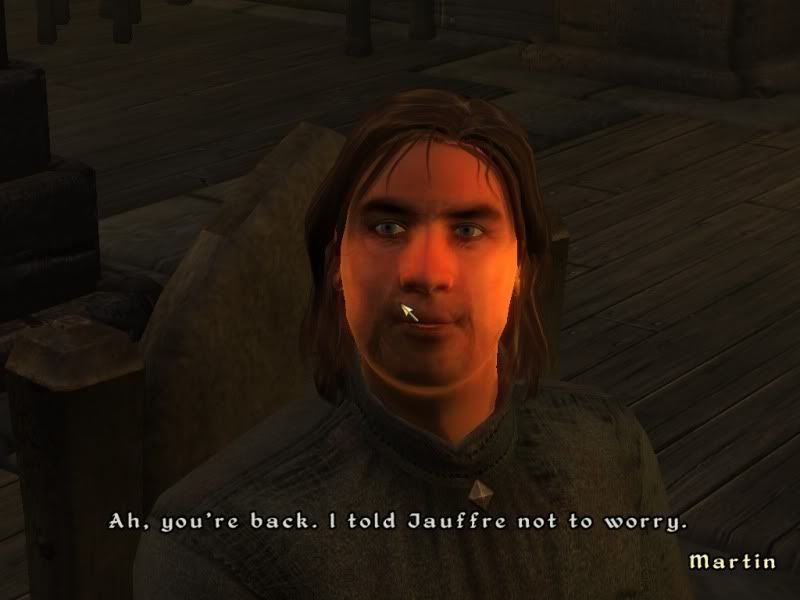
    I was particularly fond of both Uriel Septim and Martin, voiced by Patrick Stewart and Sean Bean respectively. While neither character gets as much interaction as I would have liked, both endeared themselves to me so by the time their stories ended, I was truly sorry to see them go. The game is also unprecedented in the fact that you are not the one "Chosen" to save the world from hell. You're just a guy who happens to wander into a stereotypical fantasy plot and ends up crucial to its resolution. In short, the character of Martin is Luke Skywalker and you're Han Solo. It's a refreshing dynamic.

After Game of Thrones, it's kind of hilarious to have a major NPC named Jauffre (Joffrey).
    The graphics on display in Oblivion are a bit dated as of 2013 but, even now, are still quite impressive. The land of Cyrodiil is rendered in loving detail and while not a nice place to visit, let alone live, Oblivion is delightfully infernal. I only regret we didn't get slightly more unique designs for both as opposed to such 'classical' fantasy depictions. When you first escape out of the Empire's dungeons, the sight of Tamriel is enough to take your breath away.

Even if it's somewhat generic in its high fantasy roots, Cyrodiil is still quite beautiful.
    Sadly, NPCs in Oblivion are butt-ugly. There's no other way to describe them. The design for the faces of the many people you meet in Cyrodiil could definitely use some work. This detracts from the overall feel of the game and is something they should have delayed until they'd worked out the bugs from. I also feel the persuasion system was needlessly complex, boring, and added little.

    Another problem with the game is the level scaling. Dorky ridiculous looking monsters appear at low-levels but if you level up the wrong skills, you'll be totally outmatched when the bigger nasties arrive. Oblivion has an extremely adjustable difficulty level, however, so there's not too many problems with this. Just know, unfortunately, you may have to crank the difficulty down to very-very easy.

     In conclusion, Oblivion is a great game but has dated badly. Likewise, there's several flawed choices made by the developers that Skyrim fixed. It's still worthy of a purchase but it's not perfect. I recommend fans of Skyrim pick up the game whenever they finish all there is to do up north.

9/10

Saturday, January 5, 2013

Skyrim: Dragonborn review


    I liked it but it's not as good as Dawnguard. That's my short but accurate summary of the Skyrim: Dragonborn DLC. The premise of Dragonborn is that the first Dragonborn, Miraak, has returned from the grave and is upset at you taking his place as the most important person in the world. As a result, he sends a couple of no-name cultists after you. These cultists, of course, fail miserably and leave clues which lead you right to Miraak's doorstep.

    I'm paraphrasing things but Dragonborn isn't a particularly deep story. Once you arrive, Miraak isn't all that difficult to find and the storyline is surprisingly short. It's just a series of dungeon-crawls culminating in a final boss fight with Miraak. Compared to the story of Dawnguard, especially with Serena serving as an emotional anchor, it just seems to be far weaker.

The buildings are very different from the rest of Skyrim.
    There's also a slight issue with the fact the storyline builds on a premise which doesn't get too much exposure. Miraak is the first Dragonborn, we are the last, but we learn very little about what it means to be a Dragonborn during the storyline. Even more so, we learn very little about the villain who is supposedly the antagonist. At the risk of spoiling one of the DLC's plot twists, we actually learn more about the Daedric Prince Miraak made a pact with long ago.

    This doesn't mean the DLC is bad as the bulk of the work clearly went into making the unique environment of Solstheim and it shows. Solstheim is an environment wholly unlike Skyrim with giant mushroom buildings, weird buildings, and many visual homages to Morrowind. I never played Morrowind so it was interesting to see and hear a bunch of references to the game I only recognized second-hand.

    The environment is beautiful, strange, and bizarre all at once. They become especially surreal when you take a journey, later, into one of the more intriguing planes of Oblivion. Sadly, by the time the main quest finishes, Oblivion is starting to feel a little stale and that's something it should never be. I say this as a person who had to shut down more than a dozen gates of Oblivion while playing the Elder Scrolls game of the same name.

    Dragonborn offers a variety of new equipment for characters but I can't honestly say I'm particularly impressed by it. A lot of it is merely window-dressing that will probably appeal to fans of Morrowind more than me. I have no particular desire to dress my character up in armor based on spiders but now I have the option if I ever change my mind.

I like the Eskimo feel of the Solstheim Nords too.
    The biggest change is now the option of dragon riding. Unfortunately, this system doesn't really wow me anymore than the rest of the DLC. Basicaly, you have the option of using a new Dragon Shout to enslave a dragon and can use your Fast Travel marker to send it in a certain direction. You can also target things on the ground. This should be awesome but it feels somewhat clunky and unwieldy.

     Overall, I really enjoyed Dragonborn and think it was a good additional set of material for people who enjoyed Skyrim and Dawnguard. I wasn't blown away with it but I think it's a perfectly serviceable piece of gaming.

7.5/10

Saturday, December 15, 2012

Skyrim: Hearthfire DLC review


    Hearthfire is the second DLC for Skyrim, though not a full-fledged expansion like Dawnguard. It's a delightful bit of fluff I haven't time to check out until now but am extremely glad I did. Basically, it allows a bit more customization of your particular version of Skyrim and the option of building a location to display all your various trophies from your adventures. There's also the option to adopt some of the many orphaned children spread throughout Skyrim. These children will thank you for your generosity, ask you for presents, and sometimes give them.

    And that's it, really.

Casa de Dragonborn.
    Really, Hearthfire is an opportunity to build yourself a massive storage space for all your goods and decorate it with the various hundreds of unique weapons you've probably amassed over the years. If you've sold them all off, well, then Hearthfire isn't probably going to be quite as fun for you as it was for me.

    One thing I really enjoyed about Hearthfire is that it allows you to reunite your favorite Companions with your spouse and children. For the longest time, Lydia and Ysolda lived together in my house in Breezeholme only for me to feel bad when I had to leave Lydia behind to go live in our new mansion. Now, it's possible to appoint Lydia (or virtually any other major companion) to be your Steward while you move in your new family.

    Still, actually, I'm going to say that the developers went above and beyond what they could have with Hearthfire. There's a bunch of new orphans introduced in most of the major cities and all of them have stories. The "fetch quest" nature of the crafting means that if you want your Shrine of Talos, you're going to finally have a use for all of those amulets you've found of his but will also need dragon bone!

The first daughter I adopted. She's ADORABLE!
    It's a really distracting past-time to try and get your house just perfect. Really, by the time my mansion in Falkreath was done, it looked less like a place to live and my personal Dragonborn museum. This was actually a flaw since I had a bit of difficulty believing my newly adopted children and wife would want to live in a building which consisted of wall-to-wall weapons racks and display cases displaying my awesome.

    I will say, for those who aren't into in-game crafting or role-playing, Hearthfire isn't really going to add much to the experience. There are already plenty of treasure chests in the existing houses you can buy across Skyrim and the mansions you build are limited to the lesser holds which didn't come with them in the first place. There's no new quests, monsters, or weapons to be had in this add-on.

    Do I recommend it? It's cheap, fun, and gave me hours of entertainment. Of course, I do. Sometimes immersion is the thing you need most in order to be able to experience a game world fully.

9/10

Wednesday, August 29, 2012

Skyrim: Dawnguard review


    My last review for August will be of Bethesda's new DLC, Dawnguard. This is an expansion for Skyrim, adding two new factions to the game and a whole new questline for your characters. In addition, the game adds a Perk Tree for Werewolves and Vampire Lords, making your characters vastly more powerful if they're willing to become monsters. In order to talk about some of the appeal for the DLC, there will be mild spoilers so proceed at your own risk.

    The premise for Dawnguard is a group of ultra-powerful vampires have started making attacks all over Skyrim. The player character is then recruited by a member of the Dawnguard, a group of vampire hunters, to go deal with the threat. Over the course of your adventures, you'll have the opportunity to switch sides and join the vampires or stick with the Dawnguard in order to wipe out the undead menace.

    There's already some problems with this premise. The first is why would your character join the Dawnguard if he's naturally a bad person and later inclined to become a friend to the vampires? There's no way, at least as far as I can tell, for you to join the vampires unless you start as a member of the Dawnguard. The problem actually gets worse in a way that verges on spoiler territory where you will also be forced to ally with a vampire even if you stick with the Dawnguard, hampering roleplaying as a anti-vampire zealot if your character is so inclined.

    I'm all for understanding that roleplaying can and will always be limited in video games. After all, there's no way to account for every possible choice. Still, this is something that hurts the narrative as allying with vampires and being devoted to their annihilation are two very logical extremes for most characters to lean toward. The game, instead, assumes your character will be somewhat ambivalent to both sides and persuadable.

    I'm not sure what to make of that.

    Assuming one can get over that particular hurdle, the DLC has much to offer. The main questline is as large as any of the other Guild quests in the game, taking you on a lengthy series of dungeon crawls and adventures that include a journey to a new section of a place not seen since Oblivion. The DLC has no less than three epic boss battles, two of which exceeded the final confrontation of the main game in enjoyment factor.

    Seriously, any game which can more or less replicate the final level of Castlevania where you are against Dracula's bat-form is one I have nothing but praise for. I played the Dawnguard version of the questline and kept expecting Lord Harkon, the main baddie, to shout, "What is a man but a miserable little pile of secrets!" The confrontation was epic and intense, leading to a climax I quite enjoyed.

    The locations introduced in this DLC include some truly beautiful locals. It's a tossup between the two Faction headquarters, Fort Dawnguard and Castle Volkihar but I have to say I lean towards the former. Fort Dawnguard is a huge castle, easily dwarfing any of the others in the game, giving the PC access to most everything he might need from shops to Arcane enchantment in one easy area. I admit, I do wonder why the Legion or Stormcloaks haven't occupied this massive fortress versus all the ruins they inhabit but it was a small issue of lore compared to admiring its beauty.

Isn't Fort Dawnguard lovely this time of year?
    Gameplay-wise, the biggest addition is the crossbow. It kind of goes without saying amongst Skyrim fans the standard bow sucks. It's big, awkward, obscures your vision and doesn't deal much damage. Archery is almost, universally, ignored in favor of magic or swordsmanship. The crossbow has the potential for changing that, being accurate and powerful while also possessing the potential to be upgraded. I think fans will definitely love the addition of the crossbow and I hope it makes it into the main game of whatever next Elder Scrolls title is released.

    Character-wise, I have no complaints about those introduced. The ones on the Dawnguard side are entertaining, if not terribly in-depth with Lord Harkon being delightfully over-the-top as a villain. Seriously, the guy chooses the scenery like there's no tomorrow.

     The Dawnguard, itself, is composed of quirky characters like a mad tinkerer, a schizophrenic priest of Arkay who my or may not have regular conversations with his god (who I swear is doing a Tim Curry impression), and a blacksmith who thinks they should put armor on trolls while keeping them as pets.

     Even the leader of the Dawnguard is a hoot, constantly harassing his subordinates with how they need to be more extreme while acting ridiculously liberal towards monsters compared to most vampire hunters of fiction.

    I suspect most players, however, will remember Serana best. Serana is an available vampire Follower for both Dawnguard and Vampire player characters. At the risk of showing my fanboyism, I'm fairly sure she's deliberately modeled on Kate Beckinsale. Don't believe me? Judge for yourself.

Combine Van Helsing's girl with Underworld's Selene and you get her. Oh and make her a vampire teenager.
    Serana is a subversion of virtually every female vampire stereotype in the history of fiction. Contrary to being sultry or a seductress, she's a meek and good-natured girl who acts a lot like my female friends in high school. She just happens to also be an incredibly powerful necromancer who can fill the area with animate corpses and ice blasts.

    She's a very well-designed character whose comments are usually funny and has an entertaining conversation tree where she more or less explains how her life sucks due to her cruddy parents. Really, she's like the vampire version of early Buffy the Vampire Slayer's Willow Rosenburg. Only, she looks like adult Kate Beckinsale. Really, I can't think of a character better designed to appeal to fanboys. Amusingly, she's also unmarriagable, something I know which has caused all manner of fanboy outrage.

    It's okay, my Dragonborn and her can hook up in a few centuries.

    The additions Dawnguard makes for vampires are incredible, though including a option of becoming a man-bat monster capable of tearing through most enemies without difficulty. You'll be attacked in towns if you go into them wearing this demonic form but I don't think people expected anything less. Vampirism has always been more curse than blessing in the Elder Scrolls series so it's nice to see some serious perks to it.

    There's one final flaw I should mention to gamers who are intent on picking this up. As soon as you begin the main quest, the towns of Skyrim start suffering vampire attacks. Until you deal with the main quest, these attacks will occur on a regular basis. The vampires won't just attack you but the locals, frequently killing characters you may or may not have come to like such as the female blacksmith in Whiterun.

    Even if you're quick on the draw, you may not be able to prevent this from occurring. Some towns have been almost completely wiped out in playthroughs due to players missing the vampires were slaughtering the inhabitants.

     In conclusion, Dawnguard is a flawed but enjoyable DLC. It's not as awesome as The Shivering Isles or Point Lookout but it has an epic quest and many entertaining new locations. I heartily recommend it to fans of the game but caution people to purchase it for later games as opposed to new ones, given the difficulty spike.

    Also, watch for vampire attacks.

8/10
Wednesday, August 15, 2012

The Elder Scrolls V: Skyrim review


    This is a review that's long overdue and seems like something I should do since it's one of my favorite video games of all time. Of course, I should also be working on my book(s) and trying to get my resume sent to as many colleges as possible.  Plus, being a husband. Decisions, decisions. Oh, well, I might as well talk about Skyrim.

    The premise of Skyrim is that you are a wandering traveler in the fantasy continent of Tamriel. While traveling to the Nordic-themed province of Skyrim, you were accidentally caught up in a battle of between the local rebellion and the reigning government. From there, the story arcs off into an epic tale of destiny, dragons, and so on with a dark subversive bent. It's not George R.R. Martin but Skyrim is a place where the threat of fantasy monsters isn't funny but a matter of life-and-death.

Did anyone wear this helmet for very long?
    For those familiar with Bethesda role-playing games, Skyrim follows the formula. There is a massive world of literally hundreds of locations to visit and an equally huge cast of characters. Forget Dragon Age: Origins' forty hours of gaming, you can literally sink hundreds into Skyrim. I don't think I've had the same level of addiction to any game save, maybe, Fallout 3 and Fallout: New Vegas. I also think Skyrim trumps those games in terms of how much time I'm willing to spend in their locations.

    At the risk of short-changing the story, I'd say the chief draw of Skyrim is the breathtaking visuals. I've literally wandered around for hours, just looking at the beautiful interactive artwork the developers have created. The nation of Skyrim is an amazing place with waterfalls, mountains, valleys, and natural beauty hard to put into words. This is probably the most beautiful place created by Bethesda and may be one of the most fully-realized fantasy worlds in gaming.

Gorgeous locations and people.
     The characters in the game are similarly beautiful with every one of them individually hand-crafted to appear as lovely as possible. Compared to Oblivion's god awful ugly characters, Skyrim is like a collection of models. That's not to say everyone is beautiful but people look a great deal more human and those who are, are lovely. Many times, I just found myself wandering around the gameworld taking in all the sights like I was a tourist from the Imperial capital.

    There's six major story arcs in the main portion of the game with an an additional story arc available for download called Dawnguard. These story arcs are each individually self-contained, which may trouble some role-players out there. You could become leader of the greatest warriors guild in Skyrim, the archmage of the only mage's college in the country, and so on but when you show up at any of the other Factions you'll be treated as just another guy off the street.

The number of repeated voice actors is a bit distracting.
    My favorite of the plot arcs has to be Thieves Guild plotline. This plotline and the Dark Brotherhood story arc are among the best written in the game but, unfortunately, aren't the sort of thing the average good-aligned player character is going to want to pursue. The other plots are still exceptionally enjoyable, though, with only the Mage College storyline being sort of on the 'meh' side for me. Unfortunately, the two primary quests of the Civil War and quest to defeat Alduin feel underdeveloped by comparison to these two evil quests. They could have used a bit more polish to make them soar and are merely serviceable when combined, let alone taken individually.

     The gameplay in Skyrim is pretty much an enhanced version of Oblivion's, though it nicely does away with that game's insane scaling issues. A perk system makes better character customization possible with a wide variety of interesting bonuses to choose from if you get your score high enough. Leveling is accomplished by using your skills and raising them, though simple combat won't get you high-level alone. You will have to do Speech checks, learn to use magic, or any of the other traits to max out your leveling. Some gamers may dislike this but I considered it an excellent opportunity to vary my play style.

The giants are more intimidating than the dragons, especially with ragdolling that may be unintentional.
    Even when you complete the main quest, that doesn't mean there's still not plenty more to do. There's literally hundreds of smaller quests to do across the map and countless dungeons fit for monster bashing. There's also the introduction of "Radiant Quests" where the game generates artificial quests for you to do. These aren't really all that interesting but it's an attempt to provide unlimited content and I approve.

    Character content-wise, the game has quite a few memorable NPCs like Ulfric Stormcloak, Jarl Balgruuf, Maven Blackbriar, Paarthurnax, High Queen Elisef, General Tullius, and more I can name off the top of my head. Lore is integrated well with the setting's gamey bits so the majority of tombs you visit will have some sort of story associated with them, even if it's something off-kilter like a necromancer who wants a bunch of ghostly milkmaid sex slaves (that was a weird one). The Companions are, sadly, woefully underdeveloped and deserved better but there's a few stand-out ones.

Love the glowing eyes effect.
    Fans of zombies, in particular, will love this game due to the Draugr. They manage to combine all the appeal of mummies (an underused enemy in stories) with the ravenous mindless undead. You'll be facing a lot of them too, since it seems Skyrim is a country with more tombs than people. The funeral costs must be staggering.

    Gameplay-wise, Skyrim is basically the same as Oblivion but much smoother with a better perk interface. You still go around using your skills in order to master them, which can be tedious but still encourages you to try out a wide variety of approaches to level up. I very much enjoyed playing the magic knight with a spell in one hand and a sword in the other. Indeed, with the Daedric Armor, I basically became Darth Vader.  Combat has a strong visceral sense to it and you really feel like a badass whenever you kill a dragon. I felt this way when I was fighting my 60th dragon let alone my first or second.

Have you been to the Cloud District? Of course you have.
     Despite Skyrim being one of my favorite video games of all time, it's not a game without flaws. Bluntly, the bugs at the initial release were horrible and there was no excuse for some of the glitches I encountered in-game. My initial playthrough had a glitch during a particularly important quest which literally prevented me from finishing that story arc. It was saved, too, so I couldn't reload and hope it sorted itself out. So, really, when Skyrim first came out it was only a 9/10 despite my love for it.

     It's been out awhile, however, so there have been numerous patches since then. So, I'm comfortable giving Skyrim a 10 out of 10 ranking. I do think this is one of the major flaws of needlessly constrictive release dates, however. Good art takes time. In any case, thank you all for reading, I'm off to go slay some dragons!

10/10