Monday, November 28, 2011

Star Wars: Ascension (Fate of the Jedi book 8) review


    Star Wars: Ascension is the penultimate novel in the Fate of the Jedi series. It follows the adventures of Luke Skywalker as he battles the Lovecraftian monster Abeloth, the Lost Tribe of the Sith, and rogue Supreme Chancellor Daala. The series has been a remarkable improvement over its predecessor, Legacy of the Force, but that's not saying much.

    I think Ascension is worthwhile for fans invested in the Star Wars EU but it's likely to be incomprehensible to those not immersed in the setting. The EU lost its way after the New Jedi Order book series and has never really found its way back. The Fate of the Jedi series isn't bad, per se, but it's meandering.

    There's about forty plots in the book: including a group of rogue Imperials, the Lost Tribe making an alliance with Aboleth, and Daala's attempts to regain her position as head of a major galactic government. None of them are boring, except maybe the rogue Imperials, but they all compete for the reader's attention.

    This is most true for the Lost Tribe of the Sith. The tribe, for those unfamiliar with it, is a group of a thousand or so darksiders recently freed from the planet Kesh. The problems with this premise have been discussed to death already on various forums.

    Really, you'd think the Jedi would have noticed them in the past five thousand years. If not them, Palpatine or the other Sith. After all, the Emperor could sense Luke Skywalker gaining power in the Empire Strikes Back.

    Still, the Lost Tribe of the Sith aren't your typical 'bwahaha' Sith and I appreciate that. Instead, they're more like the Sith version of the Kardashians. They're arrogant and beautiful snobs who just happen to use the Dark Side of the Force. I'm not sure how I feel about them since I expect my Sith to have a little more dignity than that.

    The Lost Tribe of the Sith's members get about as much development as the Dark Jedi Revan kills by the hundreds in the Knights of the Old Republic game. Luke Skywalker kills thirty here, Ben Skywalker kills twenty there, and Abeloth enslaves a whole fleet of them at the start of this book.

    Really, this isn't the lowest point the Sith have ever sunk to, but it's pretty close. I'm not a fan of the Rule of Two but these guys deserve better than to be used as lightsaber fodder for Luke and his son. The Lost Tribe of the Sith in Ascension exists for the sole purpose of making new villainess, Abeloth, look better. Given the Lost Tribe of the Sith could have easily carried the series themselves, I'm annoyed.

    Abeloth, for new readers, is more or less the Star Wars version of Nyarlathotep. She's a shape-shifting tentacle monster with godlike power who was imprisoned by elder beings centuries ago. Luke and company accidentally let her out by blowing up Centerpoint Station and it's a rush to try and figure out how to put her back in. Either that or simply kill her, old-school style.

    I don't mind Abeloth's concept, actually. I'm quite fond of the idea of writers creating new villains for our heroes to face than the old Sith and Imperial standbys. It's a 20,000 year old galaxy, why not create new villains capable of fighting the Jedi Grandmaster? It's just Abeloth isn't exactly the most well-characterized villain, befriending people only to suck out their brains. I'm still not entirely sure what her agenda is. With one book left in the series, that's not good.

    There's entirely too much Abeloth stomping on the Lost Tribe of the Sith, especially towards the end. It's hard to take the Sith seriously when they spend whatever time they're not getting stomped on by Luke getting stomped on the Eldritch Abomination. After the events of this book, I'm afraid we're not going to see much more of the Lost Tribe and their schemes.

    It seems a waste.

    Luke, himself, gives a good showing in Ascension. One of the things the Fate of the Jedi series gets right is their treatment of the Jedi Grandmaster. Luke is brave, wise, kind, and heroic throughout. He's a bit more suspicious and vindictive towards the Sith than I expected, especially for a man whose defining feature as a Jedi is his belief no one is beyond redemption, but not to the point of being out-of-character.

    Ben Skywalker continues to be inconsistently written. Part of this is the wholesale retconning of his character arc from Legacy of the Force. In LOTF, Ben was trained as a spy and as Darth Caedus' apprentice, becoming very canny and manipulative. He specialized in investigation with an almost Sherlock-Holmes ability to find clues. Now? He's just pretty much Anakin Solo 2.0, possessing a goofball personality and mad skills. I'm not complaining since I felt a fourteen year old super-spy was ludicrous even in Star Wars, but  some hint of his prior characterization would have been appreciated.

    One thing I did like was the treatment of the character Vestara Khai. Vestara Khai is a character that a lot of fans didn't know what to make of. For many, she was essentially Mara 2.0. A character that was raised by a Sith Lord to be an assassin and who had some romantic tension with a Skywalker. The book goes in an interesting direction with Vestara, managing a careful balance between a search for redemption and enlightened self-interest.

    Vestara is a character I finally started to like at the end of the book and I'm glad they made her. I just wish that Luke had treated her better, since you'd think he'd be more forgiving of a sixteen year old raised in a twisted Dark Side environment. Likewise, you'd think he'd be trying to talk her out of the values that corrupted her.

    The rest of the book is amusing and surprisingly light-hearted. I disliked the politics sections of the book, which unfortunately compromised nearly a third of the volume, but the humorous encounters with Han and the Squibs were worth at least half the book price. Squibs are always hilarious and Han playing the straight man worked wonders. Add in a decent showing by the rest of the Jedi Order and I wasn't dissatisfied with this volume.

    In conclusion, Star Wars: Ascension is a fairly typical example of the Fate of the Jedi series. There's nothing particularly spectacular about the books but they have a good deal more "fun" to them than the NJO and LOTF series. Star Wars is meant to be a lighthearted tale about good vs. evil. There's room for moral ambiguity and tragedy within the story but good should ultimately overcome darkness. The Fate of the Jedi series remembers that and, because of that, I can't be too harsh on it.

    7/10

Thursday, November 24, 2011

Star Wars: Revan review


    I'm underwhelmed.

    I'm sorry, but I am.

    I like Drew Karpyshyn, I really do. I enjoyed the Darth Bane trilogy. They were a set of novels which managed to make a purely evil protagonist interesting to read about. I also enjoyed his Mass Effect novels (with the exception of Retribution). They were entertaining fluff that nicely expanded on several points of the ME universe. Plus, I absolutely love the story in every one of the video games he's worked on.

Star Wars: Revan
, however, doesn't do anything for me.

    For the uninitiated, the book is a quasi-sequel to the video game Knights of the Old Republic. I've mentioned before I think it's the greatest video game of all time and any sequel was probably destined to disappoint. I'm also one of the vocal minority that thinks Knights of the Old Republic 2 had its strong points (the Exile, the Sith Triumvarite, Handmaiden) but wasn't in the same league.

    The premise for the book is dealing with the biggest "left-hanging" element of KOTOR2. Revan and the Exile have gone into the Unknown Regions, seeking the Sith Empire. What sort of adventures did they have there? What sort of epic deeds did these two legendary heroes do? What was their ultimate fate, knowing the Sith Empire eventually invades the Galactic Republic?

    Yeah, we get the answer to that here and it's "nothing too impressive."

    I won't get into spoilers but the book pretty much defines Revan and the Exile's quest as a small-scale adventure that ends on a tragic note. Despite Revan and the Exile previously having been treated as epic champions of the Force, they are treated as fairly typical Jedi Masters. When compared with the Sith Emperor, both of them together are a fairly minor threat. Given the Exile defeated Darth Nihilus, a guy who could devour planets, this rings false.

    I'm not one of the guys who feels that Revan and the Exile have to be invincible Gary Stus. I think some of fans requests for Revan, like him being to be the one to defeat the Sith Emperor, are ridiculous. Still, Revan was one of the great Expanded Universe characters. The backstory given him was quite epic and a lot of fans had a vested interest in him. Would you have Luke Skywalker causally tossed around by a new villain so he could go train a new hero to defeat him?

    No, because that's disrespectful to the character. Plus, we already had that plot with Obi Wan Kenobi.

    It's a foregone conclusion the Sith Emperor will survive Revan and the Exile's plan and so will the Sith Empire. I don't mind this, personally, but I was hoping for something a bit better planned out than what we got in the book. It's hard to tell that Revan and the Exile were military geniuses, mostly because they act like typical PCs and their actions don't really require much thought.

    Speaking of the Sith Emperor, I was disappointed with him as well. We get the Sith Emperor's origins in this book and they pretty much amount to: "The Sith Emperor was the single baddest ************ ever born. He was an evil monster before he could crawl and he's the single nastiest guy you will ever face." Seriously, Damien Thorn has less of an apocalyptic origin. It's saved, somewhat, by the fact that it's told in the form of a legend and probably isn't completely true. Still, I was hoping for something slightly more original from Darth Bane's developer.

    The Sith, overall, are a big disappointment in these books. One of the things I liked about the Darth Bane trilogy is, while its protagonist was a sociopath, you could understand his reasoning. He'd been kicked around from the day he was born and, one day, he decided to kick back. Here, the Sith are far more one-dimensional with Darth Scourge being someone who reminds me a bit of Darth Sion. He doesn't really have any motivations but power and is about as one-note evil as possible.

    He was so bad, I actually didn't buy his supposed revulsion at one of the Sith Emperor's experiments. The guy portrayed in this book would have enjoyed the power which came from destroying a world and ignored the consequences. Given that the time when the Sith were a trifle more morally ambiguous, this annoyed me. I'm still hoping to see some of these morally ambiguous Sith since we've yet to see any of them in Star Wars. We've seen plenty of gray Jedi, why not a gray Sith?

    Really, the Sith's depiction is the biggest disappointment for me. The Sith Empire depicted in the book is about as one-dimensional as we've seen their race portrayed. I may think of the Lost Tribe of the Sith from the new Legacy of the Force series as "Sith-lite" but at least they have personality. One of the great accomplishments of Knights of the Old Republic was fleshing out the Sith philosophy. This book feels like a major step back in the humanization of the Dark Side's champions.

    I have a few other minor complaints, like the complete failure to mention Carth Onasi at all and the Exile's name, but the book isn't badly written. It's just not what I was hoping for and wasn't terribly impressive. Taken on its own merits, Revan is not a bad novel. Unfortunately, it's meant to be the epilogue to one of the greatest video games of all time and falls drastically short of being a satisfying conclusion. The only part I really enjoyed was the ending, which felt like the kind of book I wanted to read. It was interesting, touching, and a nice send off for Revan.

5/10

Why I'm looking forward to Star Wars: The Old Republic


    I am really looking forward to Star Wars: The Old Republic. In fact, I'm looking forward to it with the same level of anticipation I would be looking forward to Knights of the Old Republic 3. Mostly because it will be that (more on that later, though).

    I like Bioware, they pretty consistently hit all the high marks whenever they release an RPG. I like Dragon Age: Origins, Dragon Age 2, Dragon Age: Awakenings, Mass Effect, Mass Effect 2, Baldur's Gate, and so on. I haven't played Jade Empire yet but it's on the list of things I want to get around to.Above them all, however, is Knights of the Old Republic.

    I'll do a review of Knights of the Old Republic 2 someday but I actually go against the majority opinion in that, underrated classic or not, it wasn't a very good game. Knights of the Old Republic, however, was just candy for the brain. It was the closest thing to the original trilogy ever released for the Star Wars Expanded Universe and remains probably my single favorite video game of all time.

    The storyline of Darth Revan, Darth Malak, Bastilla, and Carth hits all the emotional high notes of Star Wars for me. Some of it was derivative but I was willing to overlook the Millennium Falcon and Stormtrooper rip-offs to appreciate the greater whole. It was a tragedy Bioware didn't get to make a proper sequel to the game.


    KOTOR was pretty much the basis for Mass Effect and Dragon Age so I'm confident all of the elements I like about these three games are going to be transplanted to SWTOR. Still, it never hurts to be cautious about these sorts of things. I've been keeping up with all the news about SWTOR and am going to explain exactly what I am looking forward to most.

    1:] The Morality System: This is something I know some people loathe. However, I think a Morality System is integral to the Star Wars universe. Luke must choose whether to rule the galaxy with the Sith or save the universe and his father. Han Solo must choose between the Rebellion and his life as an outlaw. These are the sorts of choices that made the Original Trilogy’s characterization meaningful.

    One thing which intrigues me is the SWTOR Morality System isn't going to affect your status as a Sith or Jedi. In the film it's a pretty consistent line. Darth Vader and Count Dooku are Jedi up until they fell and became Sith. As soon as they became evil, they joined with Palpatine despite having every reason to hate him.

    In SWTOR, though, you can have a Dark Jedi who passionately hates the Sith or a Sith "seduced by the Light Side of the Force.” Some people might resent this distinction but I think it's a pretty cool idea and fans have been dying to play "Bright Sith" for decades.

    2:] Giving the Empire back its strike: Poor Imperials. Yeah, they're stock Nazis and not exactly dripping with deep characterization. However, the Empire has gone through a large amount of Villain Decay over the years. The Star Wars Expanded Universe is guilty for 90% of this due to its re-hashing of the Original Trilogy.

    The Sith Empire, as depicted in SWTOR, is group that has managed to grind over 50% of the Republic and is fully capable of smashing the rest down. They’ve obviously fought for their victory and deserve what gains they’ve made.

    Note: I don't approve when bad guys get easy victories. I felt cheated when Darth Krayt was handed the galaxy in the Star Wars: Legacy comic book series. Darth Cadeus was worse, basically conquering the universe in a day and a half. If you don’t get those references, you didn’t miss much.

    Here, the Sith Emperor and his Sith Council have obviously fought for their position as rulers of half the galaxy and I respect them for it. A hero is only as good as his villains and it seems like the Sith are going to be excellent ones.

    3:] Justifying 3,000+ Jedi and Sith in the setting: Star Wars: Galaxies made a game effort at trying to be THE Star Wars MMORPG. I could do a whole article about why it didn't but I think one of its biggest problems was the way it handled the Jedi. Being set in the Original Trilogy era, there were only supposed to be two Jedi left in the universe (Yoda and Obi-Wan).

    Player characters start as Jedi and couldn’t become them without jumping through a lot of hoops. When that was changed, there were hundreds of lightsaber-wielding folk running around when Vader was supposed to have annihilated them all.

    Here, in the Pre-Pre Prequel Era, thousands of Jedi and Sith can exist without contradicting canon. Better still, you can be the Luke Skywalker of the Era (i.e. the Big Hero) without feeling like the Empire will survive until the Battle of Endor.

    4:] Fully voiced NPCs: One of the things I have a problem with in Multiplayer Online games is the fact that they do not usually develop their NPCs very well. World of Warcraft is one of the few exceptions and comparing any games to their runaway success is an invitation to disaster. After all, most MMORPGs don’t have the kind of resources WOW has.

    The fact that Bioware is going to the elaborate length of voicing all of its NPCs means that they’re undoubtedly going to have a LOT more personality than you typically see in these games. It may take up a lot of space but I’m anxious to see how it works out.

    5:] Muggles can kick ass: One thing I’ve always suspected is that Jango Fett could kill 90% of the generic Jedi we see in the movies. It’s just his misfortune he ended up fighting Obi Wan Kenobi and Mace Windu.

    Likewise, I think Han Solo is as cool (or cooler) than Luke Skywalker. The fact the non-Force Using classes in the game (Bounty Hunters, Imperial Agents, Smugglers, and Troopers) will be able to fight the setting’s mystical classes is a big appeal. 

    I don’t like the treatment of force users as gods and individual heroism is increased when both sides have tough opponents to face.

    6:] The chance to play the Empire and Sith: I love playing the bad guy, especially anti-heroes. One of my favorite flight simulators was TIE fighter and we never got a sequel to that – perhaps because it glamorized a group of Space Nazis. The Sith Empire is a much more interesting creature than the stock villains of the films, offering a glimpse into the kind of society that would have been created had Palpatine and Vader had a century to adjust galactic society.

    I'm definitely going bad for this game.

    7:] Romance: Romance is a controversial subject in video games, mostly because peoples level of immersion varies tremendously. For example, I’m married to a real life woman and have no desire to date Princess Leia. However, I love imagining my characters going on to have happy endings with NPCs in the games I play. 

    Bioware has an excellent track record with these games so I’ll be looking forward to see what sort of characters they have now. I’m actually on the fence over whether I’m going to be a Sith Warrior or a Sith Inquisitor based on the characters I romance.

    8:] A fully fleshed-out story: Stories in MMORPG usually don’t blow people away. Sometimes, there’s awesome stories like the Fall of Arthas and the rise of the Lich King. More often, the stories consist of “Go forth and kill six snow moose.” I’m hoping for a lot more from Bioware and from what I’ve seen, it’ll be far more intricate. I’m not expecting Shakespeare but if they can keep to the quality of their other RPG games – I’m game.

    9:] Replay Value: One thing which is both a strength and a weakness is you can’t do the majority of the game’s adventure content as a single class. This is disappointing to me, on one level, because I actually am quite fond of having one character that can do everything. However, overall, I salute Bioware’s effort to make every class’ experience unique. I don’t know if I’ll play all eight classes but I am glad the option exists.

    10:] World-Building: One thing that I applaud Bioware for is the fact they’re obviously going all out in building this universe. Just go to their website and look at the amount of lore they’ve created for the setting. The amount of attention to detail I’ve seen from timelines to NPCs really impresses me. This really could be the most important thing to happen to Star Wars’ Expanded Universe since the Prequels.

    So, I’ll see you all at the launch!

Saturday, November 19, 2011

Grand Theft Auto, Violence, and Alternative Media


    Time for another video game essay!

    Today's subject is Grand Theft Auto and its various clones. The games are pretty much distilled mayhem. The point of the game, obviously, is to steal as many cars as possible and trash them. Oh there's stories in-between the stealing  and crashing but I can't help it if it's my favorite part of the game. I can't tell you how many times I went riding around town at top speed, in the wrong lane, listening to Welcome to the Jungle by Guns N' Roses. It gets even better when there's fourteen or so cop cars chasing you.

    What does this say? If video games are a form of art, does it mean anything to us as an audience we prefer to play as criminals rather than the police? Does it encourage violence or does it discourage it--giving people an outlet for their frustrations? Does it mean nothing at all and it's simply pure entertainment, divorced from a larger context?

    The answer is, of course, all and none of the above.

    We are each individuals and the way art affects us is dependent on the person in question. That doesn't mean the question of whether a video game is too violent shouldn't be asked, it's, instead, a question about what level of responsibility we're willing to accept versus blaming someone else. People like Jack Thompson blame GTA for criminal activity but the truth is, we are the products of multiple influences. One of these influences, much to the annoyance of parents everywhere, is individual choice.

    I'm not going to say that media doesn't affect a person's behavior. Star Wars got me interested in religion and helped model who I wanted to be as I grew up. However, there's an interactive relationship between fiction and reality. A person who hungers for violence seeks out violent media, as often as not to squelch his urge for it as to enhance it. Certainly, in the wake of economic recession I find a lot of my anger deflated by seeing evil corporations get it in fiction--even if they're walking away scott free in the real world.

    One can also enjoy special effects for what they are. There was a scene in Highlander where the Kurgan goes on a wild car chase through downtown Manhattan, singing New York, New York. Damn if it wasn't the coolest scene in the movie (not involving music by Queen or sword-fights). Grand Theft Auto is one of the few games to really master the car chase and I would forgive much for this alone.

    But isn't this terrible? Is taking a rocket launcher given to you by a half-mad hippie and starting to wreck the majority of a downtown San Fransisc...err San Fierro wrong?

    If it is, I don't want to be right. I also haven't engaged in any wanton acts of violence in real life.

    Yet.

    What about playing the villain rather than the hero? Putting the player in the role of the bad guy versus the hero. Compared to Mario and Link, your average GTA protagonist is a pretty bad dude. Carl Johnson is a sociopath whose only saving grace is he loves his family. So is Tommy Vercetti (for some value of family) and Niko Bellic. Two out of the three may feel bad about killing, but they still do it. Worse, they get away with it. There's no forces of good to oppose our antiheroes, only worse evils. The police are corrupt, the politicians are satirical caricatures. Even the average citizen is rotten to the core.

    Let's face it, if the Grand Theft Auto world were real, it'd be close to hell on Earth.

    Except, it's not real.

     The characters in video games are completely fictitious. Their lives are as valuable as those of Alderaan's population. Given literally billions of people have watched said planet's explosion without a trace of trauma, there's something to be said for the idea the line between fiction and reality is firmer than people give it credit for.

    Action movies have, since the invention of film, gone out of their way to dehumanize the enemy. Star Wars is all about creating stock Nazis and faceless troopers for our heroes to kill. It took over a decade for someone to point out that there was probably a construction crew on the Second Death Star (thank you, Kevin Smith). The Grand Theft Auto series portrays a world of over-the-top violence overlaid with cartoonish  stories of sociopathic behavior.

    Really, I'm inclined to think these sorts of stories do more to discourage violence than anything else.  Propaganda exists for either recruitment or painting a real-life movement as good or bad but it's different from escapism. The Grand Theft Auto games are about putting on the hat of a criminal for a time and exploring what that means in the safety and security of our own homes.

    And that's okay.

    The point of fantasy is to getr away from what's mundane. To give people a chance to explore a different sort of life than they might normally posses. It's why so many stories about the Middle Ages are about Kings, Queens, and Knights. No one wants to be Dirt-Sowing Peasant 72#. They want to explore the glamor, glory, and wonder of a life which is interesting. Criminals, despite the tendency of their lives to be nasty, brutal, and short--are interesting. The games are a way of exploring that natural curiosity without getting us into any trouble.

    But Charles, you may ask, shouldn't we always play heroes? Why can't we play escapism where we're always in the right and everyone else is in the wrong?

    Because it's a bad idea.

    Spec Ops: The Line deconstructed the potentially dangerous attitude of video games which glorified being the hero and how it was much more problematic than the reverse. While I don't agree with it completely, it's easy to fall into the trap that morality is easy. Without naming names, plenty of shooters encourage their players to vilify real-life groups while taking comfort in their flag-waving righteousness. This makes me more uncomfortable than the belief GTA-players will decide to start joy-riding with other people's vehicles. Being a villain is easy, being a hero is a lot harder. Which is good. Because, God knows, I need a reminder of that when I steal a cement mixer so I can slam it off a rooftop into oncoming traffic.

    Ahem. In the game, I mean. Honest.

    Admittedly, there's something to be said that crime, violence, and corruption have a place in video games but not an unlimited one. That it's perfectly alright to play the bad guy but it's possible to go too far. I actually think these detractors have a point. It's possible in Vice City, as Jack Thompson would say, to take a baseball bat to hookers. Which, frankly, is just not cool. It's harmless, hurting nothing more than a bunch of free-floating pixels, but not cool.

     The question is what to do about it. For my part, I suggest nothing.

     The video game sequel to Scarface specifically prohibits the murder of civilians as a counter to these activities. Yet, there's a very good point that just because you can do something doesn't mean your average gamer will. You could make civilians indestructible and immortal in your video games but that's a band-aid the fact they're already playing criminals.

    In short, given these games are about artificial people who are about as meaningful as any other blip on a screen, the difference is a matter of taste rather than morality. Violence against the bytes of data onscreen doesn't matter save how the person playing chooses to react to it. We can't control that, though some uses of it will be disgusting or stomach churning. Some people's reaction to football is disgusting. That's life.

    In most cases, people will just do what's fun because it's fun. Not because it's illicit or forbidden. When something becomes genuinely disturbing, they'll put it down. If they don't, maybe it's not as dangerous as people think. I support ratings for video games, fully aware I watched more R-rated movies at age fourteen than I ever have watched as an adult. Violent media may have an affect on our children, just as it may have an affect on adults, but it's not going to be the deciding factor whether we turn out to be sociopaths or not.

    Otherwise, I would have been a killer the moment I finished watching Robocop for the 300th time.

Friday, November 18, 2011

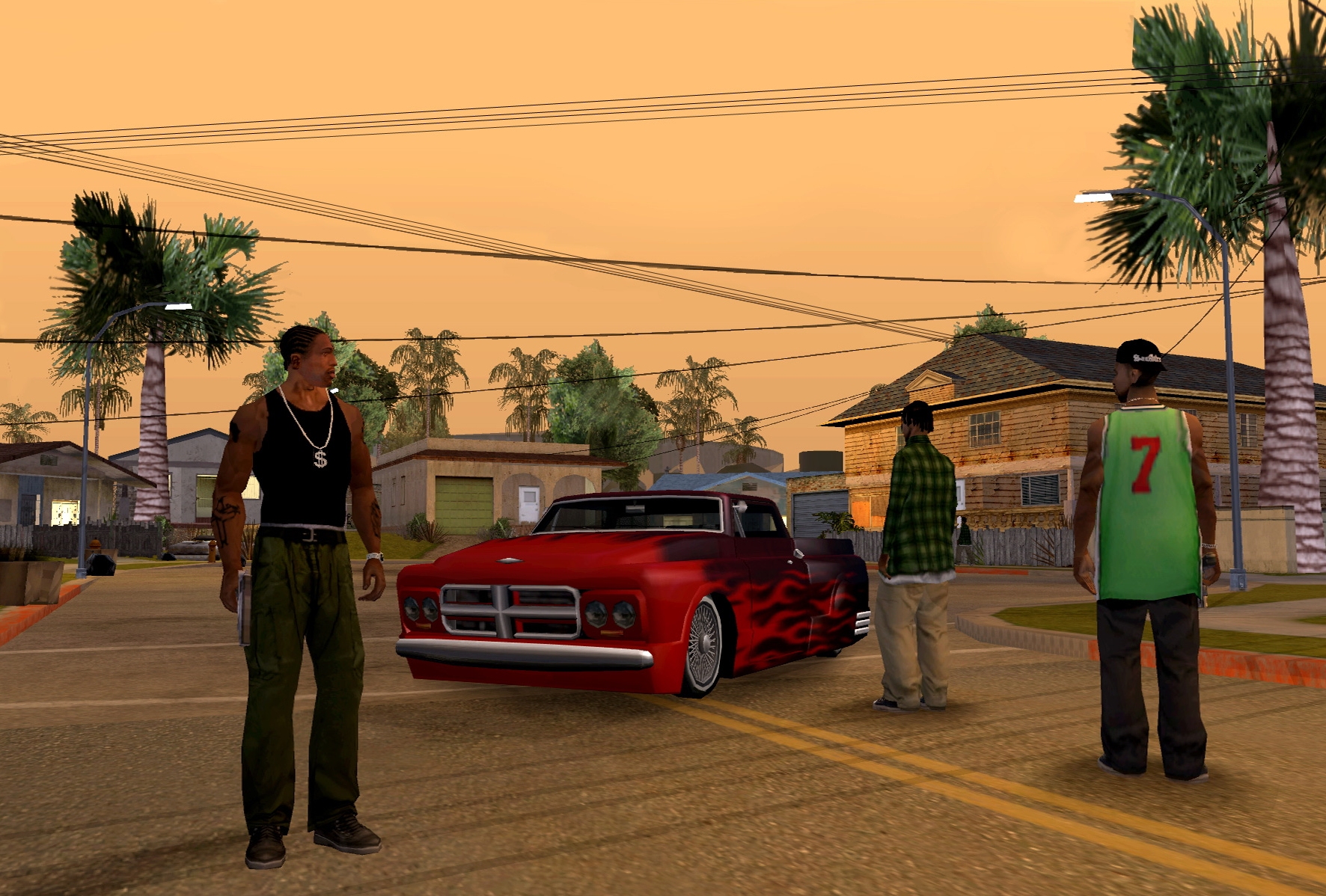
Grand Theft Auto: San Andreas review


    Grand Theft Auto is the King of Controversy in video games. There's been talk about how they're a bad influence on kids, contain inappropriate content, and are a glorification of crime. It's also a game series I, until recently, never really played. It's not that I paid these accusations any attention, it's more that crime games weren't my thing until recently. I preferred to be the hero and, as a result, missed out on some extremely interesting stories.

    I actually tried to get into the GTA-series with Grand Theft Auto IV and its spinoff, the Ballad of Gay Tony. However, the learning curve was too much for me. I really needed a tutorial for Grand Theft Auto IV and was under the mistaken impression that wrecking your car was a bad thing as opposed to an inevitability. The Ballad of Gay Tony was a poor way of easing me into the series because my first real mission was Luis killing thirty or so cops. So, I swore off the series and ironically picked up Saints Row and Saints Row 2. Those two games are equally violent as Grand Theft Auto but are much more ridiculous in tone, letting me remove myself from the violence of the game.

    So, knowing Saints Row was inspired by Grand Theft Auto: San Andreas, I decided to try and give the game another shot. The game is, thankfully, available for download off Xbox Live and I got it for a steal. So is San Andreas different from Grand Theft Auto IV? Certainly. Is it better? That's subjective, but in my opinion, hell yes. Grand Theft Auto: San Andreas is a much more cheerful, for lack of a better term, game than Grand Theft Auto IV. It takes place in sunny California, or an analog thereof, rather than a dark and gritty analog to New York City. The game's learning curve is much more forgiving than GTA IV, giving you much more time to ease into the role of your protagonist and learn the ropes. You move from tagging walls to car chases to bigger crimes and, frankly, I appreciated that.

The game takes inspiration from Spike Lee's Boyz-In-The-Hood. Obviously, it takes a somewhat different approach to gang life.
    Players take the role of Carl Johnson, a young African-American gang member who is returning to the city of his birth after a five-year-absence. Not minutes after arriving in Los Santos, Carl is framed for the murder of a police officer and made the pawn of the corrupt Officer Tenpenny. It occurred to me as I played that, barring Jax from Mortal Kombat, there aren't that many black protagonists in video games. It's kind of disappointing that the first lead in a sandbox role-playing game is a gangster, but it's better than nothing--which is what the video game world usually provides for black protagonist. Carl is a likable enough character, despite being willing horrible stuff over the course of the game, and I quickly bonded with him.

The fact all of this is visitable, on foot, just boggles the mind.
    The game is huge, really, giving you a lengthy map and mission set which left me feeling like I'd gotten my money's worth less than halfway through the game. The graphics hold up surprisingly well and it didn't feel too dated. Like Symphony of the Night, I don't think that Grand Theft Auto: San Andreas will ever go out of style. It's just a good, good game with excellent voice acting and storytelling.

    The soundtrack isn't as good as the one in Saints Row 2, "Welcome to the Jungle" by Guns N' Roses being the standout song, but it was passable. Really, my favorite channels were the talk radio ones, routinely going in bizarre and oddball directions.  Just about every aspect of American culture is satirized at one point or another, sparing neither the Left nor the Right. I think the whole ridiculousness of the setting was necessary to make it feel like a fun game, otherwise the violence CJ sometimes engages in would be unsettling.  Indeed, one of the game's few flaws is that the storytelling is tight-enough that the mayhem and conscienceless sociopathy contrasts sharply with the character of CJ as established in cutscenes. It's hard to believe the pleasant, upstanding, and friendly CJ is the guy who would bury a man alive in cement for whistling at his sister.

    No, seriously, that's a level.

    The gameplay is wonderful, though. It's as fun to steal cars and wreck stuff as complete the story missions. The sheer variety of activities is amazing. One thing that always put me off most Shooters is the fact that every single mission is more or less the same. GTA: SA is all about variety. There's car chases, stealth missions, gun-play, martial arts brawls, and more. Just about every mission requires you to react in a different way. It makes the whole thing a great deal more rewarding. I think my favorite missions would be any of the elaborate chase sequences and a later Ocean's Eleven-style casino heist.

The fact you can travel around the city by air, sea, or plane is innovative now--let alone when the game was made.
    I mentioned it above but the storytelling and voice acting deserve a special note. Samuel L. Jackson turns in a stellar performance as corrupt cop, Officer Tenpenny. He reminds me of Vic from The Shield and it's obvious that Tenpenny has gone off into his own little world of crazy self-justification for all the horrible things he does. As bad as Carl Johnson is, Officer Tenpenny is worse. Yet, you can tell that Tenpenny was probably made the way he was by his job. You can't stare too long at the abyss without the abyss staring back and all that. Despite how impressive Samuel L. Jackson's performance is, I actually liked the supporting character of Big Smoke better. Voiced by Clifton Powell, Big Smoke is a simultaneously endearing and skeevy character. Compared to CJ, Big Smoke is much more cynical about the gangbanger lifestyle. Yet, simultaneously, he's probably a lot less hypocritical about it. CJ talks repeatedly about protecting the neighborhood and doing right by his friends yet they consistently manipulate him and try to incite him to violence. Big Smoke seems aware, often quoting Bible passages with dubious applicability, that there's something wrong with the world they live in. He just doesn't have the courage, or perhaps the strength, to escape it. I really liked the guy and wished I could have had more interactions with him.

     Other members of the cast are interesting and memorable, albeit not as much as these two. There's aging hippie pot-farmers, cynical government agents, the incredibly annoying OG Loc, and the likable but surreal Woozie. One of my favorite sections of the game is the extended homage to Grand Theft Auto III, which I've never played, involving the psychotic Catalina. Watching her manipulate CJ into being her partner in crime was hilarious and disturbing. The fact there's dozens of memorable characters alone makes this game a cut above regular video games.

    Finally, the game-world is massive, covering fictionalized versions of Los Angeles, San Fransisco, and Las Vegas with a farming community thrown in. There's even an analog to Area 51, adding to the sense of the world's immensity. The number of activities possible in the game are tremendous too, including everything from dating mini-games to working out. This is all in-addition to the staggering number of vehicles you're capable of stealing from cars to planes to, I kid you not, jet-packs. If you're on PC, the number of Mods available to GTA: SA players staggers belief. The storyline missions provide you with all of the tools necessary to enjoy the craziness of the world while being good storytelling on its own. I admit, I had to cheat in several places but it was worth it.

Boxing is just one of the many mini-games available.
     Were there faults? Well, the game is almost ten years old but I think it holds up remarkably well. A good game is a good game, irregardless of whether or not it's older and GTA: SA is a great game. The violence can occasionally be shocking but for those who identify with their protagonists, I suggest they simply turn off their consciences and remember, "It's only a game."

    Overall, I enjoyed GTA: SA and I hope others will download it from Xbox Live or Steam. I might not agree with all of the design choices but the sheer variety of activities, size of the gameworld, and quality of the writing trumps any objections I might have. With so many linear, boring, and short video games out there--it's nice to see something showcasing serious effort. No wonder the designers decided to rename themselves Rockstar.

10/10

Wednesday, November 16, 2011

Where I appear om a podcast

Well, before I became a writer for novels, I tried my hand at designing tabletop RPGs. My result, Halt Evil Doer! was something I was quite proud of. If you're curious about it, here's a link to the podcast where I discuss it with one of my co-designers.

http://tinyurl.com/d9hkma5

Sunday, November 13, 2011

It's my anniversary

I've been married one year and I'm terribly pleased about it. The wife and I are mostly staying at home today and just enjoying the fun of being together.

I hope for many further happy years ahead.

Best of wishes, everyone.

Thursday, November 10, 2011

Dark Force Rising Review


    Dark Force Rising is the sequel to Heir to the Empire, it's also the first Star Wars book I ever read. Dark Force Rising was pretty nonsensical to me the first time I read it but improved tremendously once I had a context for who Mara Jade, Talon Karrde, and Grand Admiral Thrawn were. It's one of the best Star Wars books ever written and I encourage anyone with a love for the setting to read it.

    The premise of Dark Force Rising is a mythical two hundred Dreadnaughts, lost like the Flying Dutchman, are within reach of the Empire. These two hundred ships are enough to change the balance of power in the galaxy and our heroes are, of course, anxious to keep them out of the hands of the Empire.

    This book was made before the Star Wars galaxy was quite as big as it eventually became. In the movies, we only saw a fleet of about twenty-five Star Destroyers at Endor and the entire rebel fleet was overwhelmed by them. A rebel fleet, I point out, which is enough to cause the Empire considerable distress.

    In the WEG RPGs, by contrast, there were 25,000 Star Destroyers spread throughout the Empire. With those kind of numbers, two hundred Dreadnaughts could be either a game changer or something that's nice to have but ultimately unimportant. I think the current Star Wars universe has grown to the point that two hundred Dreadnaughts would be considered little more than a drop in the bucket of the galaxy's military reserves but what do I know?

    Dark Force Rising, like the Empire Strikes Back, is a good deal darker than Heir to the Empire. We get to meet the Noghri at length, who are basically a people inhabiting a Post-Apocalyptic Wasteland and who show just how easily it is to destroy a planet in Timothy Zahn's conception of the Star Wars universe. Admittedly, this is more "realistic" with how fragile eco-systems really are but it kind of makes the Death Star redundant. We also get to hear Joruus C'baoth's philosophy, which is about as Anti-Jedi as it can get.

    As a digression, I'd like to point out I really didn't like what George Lucas did with the Jedi Knights. Back in the 1980s, I felt role-models were distinctly lacking for a lot of kids. George provided me a couple in Indiana Jones and Luke Skywalker, two fictional characters which helped shape who I am. By making the Jedi have feet of clay and lionizing sociopath basket case Anakin Skywalker in the Star Wars Prequels, I wonder if he unwittingly did kids a diservice.

    Despite this, the Jedi Knighthood's philsophy remains one of humility and patience. Joruus C'baoth nicely shows a person doesn't have to be a cackling madman like the Emperor or Sauron to rip out the heart of what a Jedi is supposed to be. Instead, he just sets a Jedi Knight up as a superior being who lords over lesser people. It's particularly notable as Luke has come to Joruus in hopes of learning how the old Jedi dealt with having a position of respect and authority.

    If only, in real life, our leaders approached their task with as much humility as Luke does. We'd live in a much better world.
   
    The quest for redemption by Mara Jade continues in this book, following her as she's forced to choose between Talon Karrde and Grand Admiral Thrawn. A choice which, amusingly, Grand Admiral Thrawn doesn't really care to indulge. I found this to be an interesting dynamic between them, highlighting the subtle differences between the Empire as Mara Jade remembers it versus the Empire that Grand Admiral Thrawn is trying to build.

    Back in the nineties, the Empire was still a stand-in for the Nazis and it's easy to see Mara as a sort of confused Post-War Hitler Youth. She's the kind of person who saw Palpatine as a godlike figure who served as her father substitute. Grand Admiral Thrawn is aware of this and seems to hold both Palpatine and Darth Vader in disdain, much like many German military officers considered Hitler and Himmler. If you object to my portrayal of Vader as Himmler, I agree, but it's the best analog I can think of.

    (Bizarrely, I think of Vader as a Rommel analog. Which is amusing because Thrawn is ALSO Rommel.)

    One of the interesting things that Prequel fans will note is that the book is strongly tied to the Clone Wars and Old Republic despite the fact George Lucas hadn't created either yet. This can lead to a lot of inconsistencies to fans determined to keep a straight continuity in their heads.

    The Dark Force fleet, for example, is something that Lando Calrissian dreamed of searching for as a child despite the fact that the Republic didn't have a military less than twenty years prior. The character of Garm Bel Iblis is a legendary Corellian Senator seemingly from a different time when we know the Republic ended fairly amicably on the Senate's part. Finally, the heroes look at clones with a mixture of revulsion and horror when we know the Republic used them as opposed to fight against them.

    Really, a running theme of Dark Force Rising is the futility of trying to recapture the past. Garm Bel Iblis and company are living in the days of the early rebellion, predating A New Hope. Mara Jade is living in the glories of Palpatine-era Imperial glory, probably equivalent to the heyday of Hitler's rise to power. Luke Skywalker is trying to look to the Jedi Masters of old for guidance when Obi Wan Kenobi obviously wanted him to found his own order  with its own rules (even more obvious with the Prequels establishing Luke is not trained REMOTELY like other Jedi).

    Even Grand Admiral Thrawn and Captain Pellaeon are living in a fantasy world constructed around rebuilding the Empire, when the entirety of the galaxy is just glad they're gone. Hell, it's questionable whether Joruus C'baoth realizes the Jedi Knighthood of old was nothing like he remembers it but he certainly wants to rebuild the organization. Only Princess Leia and a few others are looking to the future and it requires their efforts to liberate the galaxy from a (in-universe) crippling nostalgia.

    Maybe I'm biased but Dark Force Rising is one of my all-time favorite Star Wars books. Everyone should read it who loves Star Wars.

10/10

Wednesday, November 9, 2011

Autobiography of a Werewolf Hunter review


    I really enjoyed Autobiography of a Werewolf Hunter by Brian P. Easton. It's series of linked short stories that tell the beginning and middle of a werewolf hunter's life. Notably, since there's a sequel (entitled Heart of Scars), it doesn't tell the ending of a werewolf hunter's life. So it's a bit like the History of the World part 1. We're not exactly to the end of the story.

    Unlike most urban fantasy novels, AOAWH is not really about one particular hunt. It's about a lot of werewolf hunts. I applaud the author for this as it made the book feel like I was getting more "bang for my buck" so to speak. The protagonist isn't just a guy who goes on one werewolf hunt, he's a veteran hunter and we get to see how he earned his credentials.

    A few of the hunts are especially noteworthy, including one which took place in a Mexican village that really surprised me with its audacity. Likewise, I enjoyed a hunt involving a werewolf female that put a twist on the usual "sexy female monsters" you see in fiction. By the end of the book, I felt that the protagonist had a long and storied career with potential for future installments down the road.

    A warning for sensitive readers, Autobiography of a Werewolf Hunter is a story about a man who fights monsters. Both internal and external. The old Nietzsche quote is especially true as our hero, Sylvester, has to make countless moral compromises in order to fight the enemy. He does not come out of it entirely intact. A major theme is that hatred is a damning and self-destructive emotion, which is brought out by the horrible consequences to his actions.

    The book is also not entirely politically correct, being about a man who grew up in the 1960s and was a Vietnam war veteran on the decidedly Pro-War side. The use of the Vietnam War, I believe, is a parallel to the protagonist's werewolf hunting career in it takes him to dark places without ever really giving him sight of victory. If you're upset about a volunteer soldier from Canada being bitter about the Vietnam War not ending in a victory, this book may not be for you.

    Really, I am grateful the author chose not to shy away from the damning effects of its hero's quest. Not only do people get hurt because of his actions, innocent people do die and they do so because of him. Furthermore, it's questionable if he's entirely in the right to do so. Sylvester makes no attempt to determine if werewolves are evil to the core, he just takes it for a given and proceeds onward.

    Many times, it's driven home our hero is fighting for vengeance and his hatred is blind. It leads him to several rather anvilicious comparisons with other bigots, including the KKK. I admit, coming from the South, I appreciated the KKK being made to look like fools but the book also humanized them to a level I worry some readers will misinterpret. The author notes, explicitly, the KKK is a criminal organization which murders innocents and would kill our hero if they knew his heritage but I'm sure some will worry it's not portrayed evil enough.

    Some other enjoyable qualities I found about the book is that the hero is Canadian, which is rare enough in fiction. I also enjoyed the attention to detail paid to Native American culture as well as New Orleans voodoo. There's a certain element of Hollywoodism to both, but they're both positive portrayals that I enjoyed. Our hero, amusingly, doesn't believe in Voodoo magic and it's ambiguous whether or not there's anything supernatural about it.

    One thing I definitely enjoyed was the "Magical Native American" trope so prevalant in Hollywood is removed. Our hero is partially Cheyenne in his heritage but there is nothing magical about it, it's simply part of his background. Likewise, any training he gets from his full-blooded Cheyenne mentor is explicitly non-magical in nature.

    There's no hints that being partially Native American makes our hero any better a tracker or werewolf hunter.  It's all due to training. I know that's an awfully fine line to walk but I felt a difference between it and stories with similar protagonists. Readers are free to disagree with me on the subject, but I feel it's a deconstruction of the trope.

    Overall, I enjoyed the book. It's a hard, grizzled, and violent book which shows a sometimes unlikable protagonist on a never-ending quest to save the world from a seemingly endless foe. The book doesn't shy away from Sylvester a.k.a Heart of Scar's flaws and that makes the book more interesting to me. I look forward to reading the sequel.

8/10

The Estuary review


    Vampire Apocalypse series' author Derek Gunn’s The Estuary is a novel that is both easy and difficult to describe. Effectively, if you were to say it was a Stephen King-esque novel set in Ireland with zombies you would have a fairly good estimate of what exactly the story is about. There’s a lot more to it but the fundamental premise is the same. Derek Gunn takes a bunch of small town residents, examine their lives in detail, insert a supernatural predator of some kind, and hit 'frape.'

    The crisis, in this respect, is an experimental Nazi biological agent was created in the last days of World War 2. An experimental biological agent which, apparently, creates zombies. You have to wonder if the Nazis would have won the war in fiction if they'd spent half of what they spent on occult weirdness on tanks.

    Still, Alfred Hitchcock was correct that Maguffins are ultimately unimportant. It doesn't matter how th zombies are created, the important part of the book is how their attack affects the town that our protagonists are from.

    Derek Gunn does an excellent job in setting up a large ensemble cast for the duration of the book. There's the Businessman, the Writer, the Wife, the Spy, the Prostitute, and so on. All of them have interactions before the zombie attack and plenty of them go through some pretty staggering changes once the action starts. As quoted by Shepard Book in Firefly, you never really know a man until you dangle him over a volcano.

    The start of the book is a bit slow for those expecting wall-to-wall zombie action from the get go. It's a much slower paced book than Derek Gunn's Vampire Apocalypse books. Really, they're two different genres and should each be taken on their own merits. I will say, however, the book reminds me more of Night of the Living Dead than Dawn of the Dead.

    The heart of the matter is that the zombies here are treated perfectly straight. They're not a metaphor for social change or something self-referential. No, they're actually monsters and their purpose is to drive the plot. In a way, if they're a metaphor for anything, it's a natural disaster that everyone has to struggle against.

    If I have a bizarre complaint, it's The Estuary is actually a little too short for its premise. It's a fairly typical sized book and not nearly the kind of door-stopper Stephen King is prone to writing. A lot of questions are raised in the book like, 'why is X doing Y when they don't know Z' which you know the author has an answer for but gets glossed over in the narrative.

    Bluntly, there's just not enough space to address everything. While it's a self-contained novel, I'd really appreciate either a sequel or some form of short story epilogue. I suppose it's a testament to the characterization that I care enough about the survivors to want to know what happens to them.

    Overall, The Estuary is a heart-filled tale of survival horror and an excellent entry into the whole 'Zombie Genre' of stories. I salute Derek Gunn for his work and hope he'll continue to write for many years to come.

9/10

Monday, November 7, 2011

National Writing Month

http://www.nanowrimo.org/en/participants/charles_phipps

I'm participating in National Writing Month for those people who might be interested in. I ditched my original premise of "Merciless: Galaxy's Most Wanted" for something a little more mundane. I think it's hard to follow your original novel work in a way that doesn't diminish it. So, I had to work very hard to get a sequel opening I was comfortable with.

I'm a bit behind but I hope I'll be able to catch up in the coming week.